Assembled by L. G. Wilson (George Wilson@ncsu.edu) and Clarinda Carrington (Clarinda_Carrington@ncsu.edu). If you have any questions or comments, please contact us. We are always looking for feedback on VEG-I-NEWS.
IN-STATE MEETINGS (For more information, see CALENDAR section):
1999 Winter Vegetable Conference, February 17-18, 1999, Asheville, NC
The North Carolina Herb Association Winter Conference, February 19-21, 1999, Oak Island, NC
6th Organic Growers School, March 20, 1999, Flat Rock, NC
MORE IN-STATE MEETINGS:
February, Area Sweetpotato Production Meeting, Tabor City (Columbus County), Contact Milton Parker 910 640 6605
February, Lenoir and Wilson County Regional Greenhouse Shortcourse: transplants, plugs and crop production., place TBA, Contact Bill Jester 252 527 2191 or Lewis Howe 919 731 1520
February, East Central Coastal Plain Sweetpotato Meeting, Mt. Olive, Contact, Bill Jester 252 527 2191 or Allan Thornton 910 592 7161
February, Cucurbit Production Practices, place TBA, Contact Bill Jester 252 527 2191
Febuary, N.C. Herb Conference, Fort Caswell (Brunswick County), Contact Milton Parker 910 640 6605
February, Area Small Fruits School, Lumberton, Contact Milton Parker 910 640 6605
February , Tomato Growers Meeting, Asheville, Contact Jeanine Davis
(email: jeanine_davis@ncsu.edu) 828 684 3562
OUT-OF-STATE MEETINGS:
New England Vegetable & Berry Growers Association Annual Meeting, February 6. 1999. Contact Dominic Marini at 508-378-2546.
United Fresh Fruit & Vegetable Association's 95th Annual Convention, February 6-8, 1999, San Diego Convention Center, San Diego, CA. Contact Caren Schumacher at 703-836-3410.
New York State Vegetable Conference, February 9-11, Sheraton Four Points Hotel, Syracuse, NY. Contact Jean Warholic at 607-539-7648.
North American Farmers' Direct Marketing Association Conference, October 10-12, Cioncinnati, OH. Contact Rick Breeden at 888-884-9270.
National Farm Machinery Show, February 10-13, Kentucky Fair & Expo Center, Louisbille, KY. Contact Steve Fowler at 502-367-5100.
28th National Agricultural Plastics Congress, May 19 - 22, 1999, Tallahassee,
Florida (For more information, see CALENDAR section)
NO-TILL VEGETABLE PRODUCTION FOR THE SAND HILL REGION OF NORTH CAROLINA
by Greg D. Hoyt
1. Introduction
Conservation tillage is an effective production method for growing many crops throughout the world. Conservation tillage conserves soil and water, reduces irrigation, labor, and fuel requirements, improves soil chemical and physical properties, and enhances nutrient recycling. However, no-till can lower early season soil temperatures, which affects vegetable early season growth and crop maturity date, and potentially increases pest carryover in residues. Cover crops provide protection against water and wind erosion, and generate beneficial surface organic residue for the following year. Grass cover crops tie up soil nitrogen while growing in early spring, and grass residues have a slow rate of decomposition during the summer. Fertilizer
nitrogen recommendations may be reduced if a legume cover crop is used,
but may need to be increased if a grass cover residue is used for growing
high N consuming summer crops such as sweet corn. The objectives of this
experiment were to establish no-till vegetables in the Sandhill Region
of North Carolina and determine which cover crop residue would be appropriate
for no-till sweet corn, yellow summer squash, and pumpkin production.
2. Methods
This experiment was conducted at the Sandhills Research Station, Jackson Springs, North Carolina in 1998. The experiment was established as a randomized block design with four replications of five treatments (five different cover crops). Plots were 24 feet wide and 33 feet long. Fall seeded covers of triticale, crimson clover, little barley, crimson clover/little barley, and fallow (winter weeds) were established in October, 1997. The soil type was a Candor sand (sandy, siliceous, thermic Arenic Paleudults). A John Deere no-till planter was used to plant each vegetable crop. All vegetable crops received herbicide, insecticide, and fungicide applications appropriate and labeled for use during the growing season. Each vegetable crop was irrigated as needed. Spring residue biomass samples were taken the day of vegetable planting (April 24 for sweet corn and squash and May 28 for pumpkins) each year by sampling one 0.25m2 area of each plot. Pumpkins (Howden) were harvested on September 1, by counting and weighing all pumpkins in the two middle rows of the four row plots. Sweet corn (Silver queen) was harvested on July 23, 1998 by hand pulling all ears in 3 middle rows of the eight row plots. Squash (Dixie) was harvested from 3 middle rows of the six row plots, with harvest starting on June 19 and continuing for 10 harvests to July 23 (two harvests per week). Fertilizer was surface broadcast at a rate of 200 lbs of 17-17 17 after winter cover crop planting (January 12, 1998) for the 1998 cover residue.
-------------------------------------------------------------
Crop Amount Analyses N P K
lbs/acre lbs/acre
-------------------------------------------------------------
Sweet corn:
May 18, 1998 100 15-0-0 15
June 1, 1998 250 34-0-0 85
June 16, 1998 100 13-0-44 13 44
Squash
May 18, 1998 100 15-0-0 15
June 16, 1998 100 13-0-44 13 44
Pumpkins
June 4, 1998 100 17-17-17 17 17 17
July 7, 1998 150 13-0-44 19.5 66
-------------------------------------------------------------
3. Results:
The 1998 growing season at the Sandhills Research Station had both very low rainfall and high day time temperatures during the summer. Spring cover crop growth and biomass measurements (Table 1) were low due to poor fall germination and cool early spring weather. Cover biomass cut before the sweet corn and squash planting were much lower than before pumpkin planting. Although light, all residue remaining after each vegetable planting was adequate for use as mulch, and provided some needed soil water conservation during the hot, dry season of the summer.
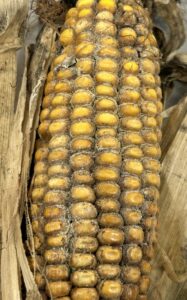
No-till sweet corn yield among the various cover residues were not statistically different (Table 2). Both marketable and total yield for both weight and numbers per acre were reasonable for the dry conditions that prevailed during the growing season. We did see an increase incidence in smut in the ears where triticale residue was on the surface (we will see if this occurs in 1999).
The results from the no-till pumpkin experiment shows the beneficial affect cover crop residue has on vegetable yields when dry conditions exist. Triticale residue is composed of stalk materials that are high in carbon and low in nitrogen. This type of material is very hard for microbes to decompose, thus leaving much of the material on the soil surface during the summer (as compared to the small stems of little barley or the higher nitrogen content of crimson clover residue). Because of the very dry weather, the triticale residue thus provided much needed soil moisture (even with applications of irrigation) to produce more numbers of fruit per acre and greater weights per fruit (Table 3). Overall the pumpkin yield was light, mainly because of foliage disease (powdery mildew) that was affecting pumpkin vines in all treatments.
Summer no-till squash (Dixie) harvest started on June 19 and continued
every 3 to 4 days until July 23. Initial harvests (first 4) showed steady
increases in yield through time by all treatments with crimson clover residue
treatment with the greatest yields and triticale residue treatments with
the lowest (data not shown). Squash yields for harvest 5 - 10 showed improved
yields where triticale and little barley residue occurred, with final accumulated
harvest of > 4 lbs/plant with triticale and little barley cover residue
treatments and >3 lbs with crimson clover, clover/barley, and fallow residue
treatments. Similar results occurred with number of fruit per plant, with
triticale and little barley residue treatments with about 7 fruit per plant
harvested during the season, and about 6 fruit per plant with crimson clover,
clover/barley, and fallow residue treatments. Individual weight per fruit
harvested was around .5 lbs per fruit, with no one individual residue treatment
producing larger fruit on a continuous basis.
4. Focus for 1999:
The field trial for 1999 will try to improve on our planting technique,
fertilizer application, and disease control. We have established the cover
crops again, and plan to use more resistant varieties of squash and pumpkins
to reduce the powdery mildew problem. Sweet corn and squash will be planted
earlier in the spring than in 1998. Squash harvest was twice per week,
and we see from the large size of individual squash that we will need to
harvest 3 times per week. I look forward to any comments you might have
on this project.
Acknowledgments
Thanks to Mr. Tom Garrett and the staff at the Sandhills Research Station
for maintaining the field plots and to Anthony Cole for technical assistance.
Table 1. The amount of cover residue for the no-till vegetables,
1998.
-------------------------------------------------------------
Cover residue <----------Cover crop biomass--------->
Pumpkins Sweet corn Squash
<-------------- lbs/acre ------------->
Triticale 3546 ab 1901 bc 1886 ab
Crimson clover 4221 ab 2926 a 1228 bc
Little barley 3367 b 1672 c 2074 a
C. clover/L. barley 4630 a 2477 ab 1420 abc
Fallow 702 c 602 d 779 c
Lsd (.05) 1208 784 678
-------------------------------------------------------------
Cover measurements were taken on April 24,1998 for sweet corn and
squash and
May 28, 1998 for pumpkins.
Table 2. The effect of cover residue on no-till sweet corn number
and weights,
1998.
--------------------------------------------------------------
Cover residue Ear Yield
<---Marketable---> <-----Culls------>
Dz/acre Tons/acre Dz/acre Tons/acre
Triticale 1238 4.29 464 .31
Crimson clover 1294 4.22 544 .30
Little barley 1237 3.98 580 .27
C. clover/L. barley 1259 4.27 654 .56
Fallow 1331 4.74 522 .30
Lsd (.05) ns ns ns ns
--------------------------------------------------------------
All data based on avg sweet corn population of 24,000 plants/acre
smut % = percent of ears/acre with smut
Table 2. The effect of cover residue on no-till sweet corn number
and weights,
1998 (cont).
--------------------------------------------------------------
Cover residue Ear Yield
<------Total-------> Smut
Dz/acre Tons/acre %
Triticale 1701 4.60 6.69 a
Crimson clover 1838 4.52 3.21 b
Little barley 1817 4.25 3.91 ab
C. clover/L. barley 1913 4.83 2.61 b
Fallow 1853 5.04 4.11 ab
Lsd (.05) ns ns 3.05
--------------------------------------------------------------
All data based on avg sweet corn population of 24,000 plants/acre
smut % = percent of ears/acre with smut
Table 3. The effect of cover residue on no-till pumpkin fruit
number and
weights, 1998.
-----------------------------------------------------------------
Cover residue <------------------Fruit Yield----------------->
lbs./ weight(lbs)/ Tons/
#/plant plant fruit #/acre acre
Triticale 0.42 a 3.35 a 8.1 a 1340 a 5.4 a
Crimson clover 0.15 b 1.01 b 5.9 a 469 b 1.6 b
Little barley 0.24 ab 1.81 ab 6.8 a 737 ab 2.7 b
C. clover/
L. barley 0.20 ab 1.18 b 5.1 a 570 b 1.7 b
Fallow 0.24 ab 1.35 b 5.3 a 771 ab 2.1 b
Lsd (.05) 0.25 1.63 4.0 744 2.5
-----------------------------------------------------------------
Greg D. Hoyt
Soil Science, NCSU,
Mtn. Hort. Crops Research & Extension Center
Greg_Hoyt@NCSU.EDU
OPPORTUNITY CROP: SPECIALTY LETTUCES
By Doug Sanders, Horticultural Science, NCSU
Item: I attended the Great Lakes Vegetable Growers Convention which met with the National Farmers Market meeting. They had over 2000 in attendance with a 300 exhibitor tradeshow. I would commend both meetings to you and your growers. The Farmers Markets meeting is in Cincinnati Ohio next year; more on that later.
Cooperators: Bill Jester and Don Thompson, NC Coop Ext. and NCDA&CS, respectively, Bonnie Faulkner, Specialty Crops Program, Hort. Science, NCSU, Becky Harrison, Hort. Science, NCSU
We are testing leaf lettuces as a possible crop for development in eastern North Carolina. This work is part of the specialty crops program based at the Cunningham Center in Kinston. Some of the products are being test marketed through Don Thompson of NCDA & CS. To that aim we evaluated 20 cultivars of non head types of lettuce. We used plastic to keep the lettuce free of soil and it worked. We found that we can produce good quality lettuce even in the high temperatures we had this fall and that the crop does hold potential for our growers. In other work (that we will report later), we are trying to determine the window of production for leaf lettuce. We think it can be harvested from mid April to early July and Sept to December (if row covers are used). We also have a second variety trial underway.
In test marketing this spring, Don Thompson found that several buyers were very happy with the product and wanted more. We aim to offer them clean lettuce that is fresh, thus giving them 4 additional days of shelf life over California product.
Cultivars: (Green leaf) Green Vision, Royal Green, Slobolt, Tango, (Red leaf) Royal Red, Red Sails, Red Zone (Boston or butter head) Aquarius, Ermosa, Esmeralda, Nancy
Culture: For spring: Bare ground or plastic mulch. Transplant mid to late Feb. through April 30. Direct seed mid to late Feb. through March 30.
For fall plastic mulch--use painted white (1 gallon inexpensive white latex paint to 4 gallons water spray 20 gpa at 20 psi) for plantings up to Sept. 1. Use black plastic for plantings made after Sept. 15.
Spacing: leaf lettuce; 3 rows per bed 9 inches in row or 4 rows per bed 12 inches in row. Boston lettuce; 4 rows per bed 9 inches in row. Rows should be equally spaced on a 30 inch bed top.
Seeding transplants: Use 200 cell trays with a coarse potting soil. Seed transplants 3 to 4 weeks prior to transplanting. Be sure to singulate seed or thin to one plant per cell. Do not over water. If seeding is done in July or early August, use coated seed for the `desert' or place trays in a cooler at 50 to 75 F, until seed sprout to overcome thermal dormancy.
Planting transplants: Start planting in early August and continue through October or until threat of frost is 45 days from planting. Plantings should be made every 7 to 10 days to ensure steady flow of product to the market.
Direct field seeding: This can begin in mid to late August after temperatures begin to cool below 90F for daily maxima. Use pelleted seed and drop 2 per hole, then thin to one seedling upon emergence.
Irrigation: Use drip irrigation, one line per 30 inch bed top. In July and August, apply water 3 to 5 times per day for one hour to establish transplants while the weather is hot. As temperatures cool in mid August, this frequency can be reduced. Once plants are established one irrigation per day is adequate.
Fertilizer: If following cantaloupes, preplant apply 30 pounds/acre of nitrogen and potash as 15-0-14. Once plants are established apply one pound of nitrogen per acre per day for the first 2 weeks, and 2 pounds of nitrogen per acre per day for the remainder of the season.
Insects: Aphips, and Beet and fall Armyworm are most common problems, but leafminer, thrips, corn earworm, and tarnished plant bug can also be troublesome. See the North Carolina Agricultural Chemicals Manual for materials and rates.
Disease: Downy Mildew, Bottom Rot, and Drop are the most common problems, but Damping-Off, Gray Mold and Yellows can also be troublesome. See the North Carolina Agricultural Chemicals Manual for materials and rates.
Cheating the season: Using sprinkler irrigation to cool newly set transplants
will allow for earlier planting in August. Using row covers to protect
against early season frosts will allow you to extend the season well into
November and some years to December.
Yield and Comments from Early Fall Lettuce Variety Trial,
Cunningham Center,
Kinston, NC, Fall 1998
Cooperators: Doug Sanders, Becky Harrison, Bonnie Faulkner, Bill
Jester, NCSU
and Don Thompson, NCDA&CS
------------------------------------------------------------------
CASES HEAD Wt. COLOR
VARIETY* /ACRE LBS. TYPE^ COMMENTS
------------------------------------------------------------------
AQUARIUS * 1143 .40 DG Boston Very Good
CARIMAS * 798 .21 DR Curly leaf Needs more N
CERIZE * 998 .29 DR Oak
ERMOSA * 1089 .58 DG Butter Very Good
ESMERALDA * 1179 .49 G Boston Good
GREEN VISION # 1034 .37 G Curly Bolts
JLE 4297 * 1137 .20 DR Curly leaf Needs more N
MEDALLION # 1161 .68 DG Romaine Short
MIKOLA @ 871 .46 R Leaf Late Drop
NANCY * 1089 .57 LG Boston Good
PREMIERE * 1064 .67 G Head Fair
PSX 64289 * 889 .43 G Curly leaf Good
RED FOX * 1258 .35 R tipGrand Rapids Good
RED SAILS * 762 .27 R Leaf Good
RED VOGUE @ 1016 .30 R tip Bolts
RED ZONE # 1089 .31 R tip Bolts
ROYAL GREEN # 1040 .37 G Leaf Bolts
ROYAL RED @ Bolts
VULCAN # 1016 .27 R tip Leaf Good Bolt tolerant
LSD.05 351 .11
------------------------------------------------------------------
*Continue testing
@ Drop from testing
# Possibly continue testing
^ DG=Dark Green, DR=DarK Red. G=Green or light green, R=Red
Doug Sanders
Horticultural Science, NCSU
doug_sanders@ncsu.edu
What: NORTHERN PIEDMONT SPECIALTY CROPS SCHOOL
Where: Ramada Inn, Jct. of Interstate 85 and NC 96, Oxford, North Carolina
When: Friday, February 26, 1999
Contact: Carl Cantaluppi, NC Cooperative Extension at 919-603-1350; or 336-599-1195 FAX: 919-603-0268; E-Mail: ccantalu@granvill.ces.ncsu.edu
What are the keys to successful production and marketing of specialty crops? What are some of the high value crops to try? What are the innovative ways that experienced marketers are doing to continually attract customers to their operations?
The answers to these and many other questions can be found by coming to the Northern Piedmont Specialty Crops School on Friday, February 26,1999 at the Ramada Inn, located at the junction of Interstate 85 and NC 96, in Oxford, North Carolina.
The program will kick-off at 8:30 A.M. with Mr. Ralph Hanskiewicz (pronounced hanSKAYvitch), the keynote speaker who will talk about "How We Grow and Market Specialty Crops at R.B. Acres, Our Little Corner of the World". Ralph is a diversified fruit and vegetable grower in Myrtle, Mississippi in rural Union County. Living in a county with a small population, Ralph is able to draw customers from the surrounding seven counties and beyond.
He has been growing specialty crops on his 20 acre farm since 1980, including strawberries, asparagus, pumpkins, and chrysanthemums. He has a number of attractions on the farm, including a petting zoo, maze, and a nature trail with a number of photo-ops at each of these areas. Listen to Ralph as he outlines what direct marketing ideas have worked well for him over the years.
Alex Hitt, along with his wife, Betsy, are specialty crop growers in Graham, NC who practice organic growing and sustainable agriculture production techniques. They grow specialty lettuces, heirloom tomatoes, cut and everlasting flowers, and a wide variety of fruits and vegetables. Come hear Alex explain their multi-faceted operation.
A new fruit and vegetable cooperative, known as the Northern Piedmont Fruit and Vegetable Cooperative was formed in Granville County, NC this year. The group is composed of six growers who have collectively grown and marketed their produce to a wholesale grocery chain as well as several retail outlets. Mr. Ken Daniel, an officer of the corporation will explain how the co-op functioned in 1998 and what their plans are for 1999.
The afternoon session will open with Mr. Carl Cantaluppi, Horticulture Agent in Granville and Person Counties that will share his research results with asparagus and tomatoes, including the second harvest year for the asparagus variety trial and time of harvest study. He will also show the results of a 14 variety fresh market tomato trial, including their adaptability to be grown in wire cages.
Next, Mr. Charlie O'Dell, Extension Vegetable Specialist at Virginia Tech will inform us of his research growing "eastern" strawberry varieties on black plastic, to select varieties that can over winter better in the northern climates, yield well, and can also have good flavor. Carl Cantaluppi will also share the results of his "eastern" strawberry variety research with the primary purpose of selecting berries for yield and flavor as a comparison to the "Chandler" variety now commonly grown on black plastic.
Following Charlie will be a grower panel made up of two fruit and vegetable growers from the northern Piedmont of NC, a western NC grower, and a Virginia grower. Their discussion topic will be "Successful Growing and Retail Marketing of Fruits and Vegetables". The panel members will include Mr. Mark Lyon of Creedmoor, Mr. Garnett Carr of Roxboro, Mr. Doug Carrigan of Mooresville, and Mr. Peter Perina of Matthews, VA. They will discuss their operations and their strategies that make them successful produce growers and marketers.
The school will end with a hands-on workshop conducted by Bea Hanskiewicz, wife of Ralph. She will demonstrate how to make scarecrows to sell along with pumpkins on the farm as well as other trinkets that can be purchased inexpensively and made into pins to wear. She will be very interesting to watch and learn her techniques.
The cost of the one-day school is $25.00 for the first person in the farm family or business, which includes lunch and a copy of the school's proceedings. The cost for each additional family member is $15.00, which includes lunch without the proceedings.
For a copy of the program and pre-registration form, contact Carl Cantaluppi at 919-603-1350.
The following priority lists were generated from roundtable discussionsat the Annual Extension Conference training session "Vegetable Crops: Statewide Research and Extension Activities; PART II." Go to http://ipm.ncsu.edu/vegetables/veginews/veginw11.htm for priority lists for Cucurbits, Sweetpotato and Legumes & misc. veg. crops. The purpose of listing these priorities is to increase awareness, and to solicit input on how these objectives might be achieved. Anyone in the state of NC working with these vegetable crops should become familiar with these priorities and look for ways to achieve them. Working together we can accomplish more.
TOMATO and PEPPER (R=research need; E=extension need)
Discussion leaders: P. Shoemaker and M. Lancaster
1. Bacterial wilt of tomato (R)
2. Phytophthora blight of pepper (R)
3. Thrips control (E)
4. Revision of tomato bulletin (E)
Secondary importance:
1. Cover cropping systems (E)
2. Revision of pepper bulletin (E)
3. Fumigant alternatives for future (R)
4. Variety trials (E)
5. Develop production systems for specialty pepper & tomato types
& cultivars (E)
POTATO (R=research need; E=extension need)
Discussion leaders: F. May, T. Campbell, and N. Creamer
1. Soilborne diseases (Rhizoctonia, pink rot, Erwinia, Verticillium)
(R/E)
2. Preventing poor stands (poor seed warming, cutting, handling, dusting,
uneven planting) (E)
3. Wireworm control near harvest (R?/E)
BRASSICAS (R=research need; E=extension need)
Discussion leaders: T. Campbell and K. Sorensen
1. Diamondback moth control (R/E)
2. Black rot (E)
3. Whole-systems approach to brassica production (R/E)
4. Fertility management to reduce abiotic nutritional disorders; e.g.,
tipburn (R/E)
Secondary importance:
1. Heat-tolerant varieties (E)
2. Specialty brassica types and cultivars
3. Preventing Pythium in float, transplant production systems
DOES ASANA OR GENETICS CAUSE GOLD FLECKING ON TOMATOES?
by Jeanine M. Davis
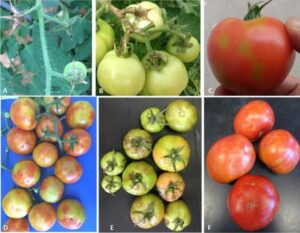
Over the past seven to eight years, growers and researchers have noticed an increase in the condition called `gold fleck' which can develop on the surface of ripe tomato fruit. As the name implies, it looks like a light sprinkling of gold flecks in the top layers of the skin of the fruit. The condition is only noticeable on mature, red fruit. Usually, the amount of gold fleck is barely noticeable and does not affect the marketability of the fruit. In 1998, however, the incidence of gold fleck was severe in several areas of the country. Some loads of tomatoes shipped into western North Carolina from western states had up to 42% of the fruit affected. On some of the fruit, up to 75% of the surface area of the individual fruit was covered with gold fleck. The more severely affected loads were rejected due to poor fruit quality. Reports were obtained from some Florida growers attending the 1998 field day at the Mountain Horticultural Crops Research Station that they quit harvesting some fields due to the severity of gold fleck. An increase in the amount of gold fleck was also reported by some North Carolina growers.
Many growers, and several researchers, are of the opinion that gold fleck is due to use of high rates of the insecticide Asana. There are reports in the literature, however, that indicate that gold fleck is a genetic disorder. In 1998, I conducted a study to determine if gold fleck is caused by Asana and/or is variety dependent. The study was conducted at the Mountain Horticultural Crops Research Station in Fletcher, NC. The plants were grown in staked culture on raised beds, with black plastic mulch and drip-irrigation. Treatments consisted of three varieties (Mountain Fresh, Celebrity, and Mountain Pride) and four insecticide treatments (Asana XL, Karate 1 EC, Thiodan 50 WP, and water as a control). The water (control) treatment did not receive any insecticides. The study was arranged as a factorial, randomized complete block design with four replications. The insecticides were applied at the maximum label rates four times during the growing season. Fruit were tagged at time of spraying so that we knew how many insecticide applications each fruit has received. The study was duplicated in an early and late planting, field set on June 1 and June 16, respectively. Each plot was harvested four times. Only red ripe fruit were harvested.
At all four harvest dates of the early planting there was more gold fleck in the control (water) treatment than any of the insecticide treatments. For the first harvest, 19% of the control fruit had gold fleck versus only 1%-4% of the insecticide treated fruit. There were no differences among the insecticide treatments. At the second harvest, 31% of the control fruit had gold fleck whereas only 1%-5% of the insecticide treated fruit had the disorder. On the first and third harvests there was no difference in the amount of gold fleck between the three varieties. On the second and fourth harvests, however, `Mountain Fresh' had more gold fleck than `Celebrity' or `Mountain Pride'. Over the total season, `Mountain Fresh' had more gold fleck than the other two varieties and the water control had more gold fleck than any of the insecticide treatments. There were no differences among the insecticide treatments, i.e., Asana was the same as Thiodan and Karate.
For the late planting, the water control had more gold fleck than the insecticide treatments for the first three harvests. The first harvest exhibited the most gold fleck, with 20% of the fruit affected in the control versus 0-1% in the insecticide treatments. The incidence of gold fleck decreased dramatically with each succeeding harvest. By the fourth harvest only 3% of the control fruit were affected and it was not different from the insecticide treatments. There was a difference between varieties only at the second harvest. As in the early planting, `Mountain Fresh' had more gold fleck than did `Celebrity' or `Mountain Pride'. Over the whole season, the control had more gold fleck than did any of the insecticide treatments and there was no difference between varieties or insecticides.
At the 1998 field day, the general consensus among growers was that gold fleck was caused by Asana. This study, however, clearly shows that Asana is not responsible for gold fleck! Asana actually reduced the amount of gold fleck compared to the control. This is good news because Asana is an effective, safe insecticide that is widely used in the industry.
The question still remains, however, as to what does cause gold fleck? Because there was so much gold fleck where insecticides were not applied, it may be that gold fleck is caused by an insect! We propose to examine this hypothesis during the 1999 growing season.
This research was generously funded by the N.C. Tomato Growers Association. A more detailed report on this study will be presented at the Winter Vegetable Conference in Asheville on February 17-18, 1999.
Jeanine Davis
Horticultural Science, NCSU
Mtn. Hort Crops Research & Extension Center
jeanine_davis@ncsu.edu
TRAINING SESSION: Precision Agriculture Technology for Vegetable Production
An in service training session on precision agriculture technology as applied to vegetable production will be offered this spring. The date and location are still being worked out, but the late May to mid June time frame is probable.
Precision agriculture technology is being adopted for a number of field crops in North Carolina. Much of the technology in use and under development has beneficial applications in vegetable production. This training will identify and explain the technologies available and their applications in vegetable production.
To sign up, look for session number 475 in the in service training catalog. If you have questions or suggestions, please contact Gary Roberson at 919-515-6715 or gary_roberson@ncsu.edu.
Gary T. Roberson, PhD, PE
Visiting Associate Professor & Extension Specialist
Biological and Agricultural Engineering, NCSU
gary_roberson@ncsu.edu
URL: http://www.bae.ncsu.edu/people/faculty/roberson/index.html
The 1998 test was located at the Horticultural Crops Research Station in Castle Hayne, N.C. on a Norfolk Sandy Loam soil. On 16 Oct 97 certified, non-dormant transplants from a commercial source were received and planted. The test was installed on 23 Mar 98. Plots were single, 6-in. raised, 27-in. wide plastic mulched beds on 60-in. spacing. Plots were 12-ft long and contained 24 plants on 12-in. spacing staggered in two rows 12-in. apart. Treatments were randomized in four complete blocks. Recommended fertility and insect management practices were followed. Fruit was picked 6 times, 21 Apr through 26 May. Yields were recorded in grams and number fruit per plot. Treatments were applied 9 times from 23 Mar through 21 May on selective intervals depending upon protocol standard procedures. Sprays were applied using a CO2 back-pack sprayer equipped with a 2 nozzle handheld boom centered over the row, fan nozzle tips and operating at 40 psi (100gal/A). Weather conditions for the growing season were good for strawberry production.
All fungicide treatments significantly reduced Botrytis fruit rot when compared to the control. Switch and Elevate provided the best control of Botrytis fruit rot. Differences between treatments for control of Anthracnose were not as great as those compared to Botrytis, although significant differences were observed. Captan + Topsin-M and Quadris significantly reduced anthracnose fruit infections compared to all other treatments. No significant differences were observed between the control and the remaining treatments for anthracnose control. Total yields were not affected by treatments (data not shown) but percent marketable fruit by weight and number was affected by treatments. Evidence of phytotoxicity was observed with Elevate at the last spray date. No other treatments showed signs of phytotoxicity during the growing season.
Part 1 of table.
--------------------------------------------------------------
Percent number of fruit with:
-----------------------------
Treatment Rate / acre Anthracnose Botrytis
--------------------------------------------------------------
Control 55.8 4.8
*Captan 50WP, 4.0 lb 33.5 2.1
Quadris 2.08SC, 590 ml 38.1 2.3
Cygnus 50WG, 81.6 g 48.7 2.1
Switch 62.5WG, 435 g 50.1 1.0
Elevate 50WDG, 408 g 55.0 .5
LSD P=0.05 9.3 .8
--------------------------------------------------------------
Part 2 of table.
--------------------------------------------------------------
% market. % market.
fruit by fruit by
Treatment Rate / acre weight number
--------------------------------------------------------------
Control 41.0 35.7
*Captan 50WP, 4.0 lb 65.7 60.1
Quadris 2.08SC, 590 ml 63.2 54.4
Cygnus 50WG, 81.6 g 49.3 45.0
Switch 62.5WG, 435 g 53.1 46.0
Elevate 50WDG, 408 g 45.0 38.2
LSD P=0.05 7.9 9.6
--------------------------------------------------------------
F.J. Louws, W.O. Cline, and J.G. Driver
Dept. Plant Pathology, NCSU
frank_louws@ncsu.edu
1
The 1999 Winter Vegetable Conference will be held at the Holiday Inn SunSpree Resort in Asheville, NC on February 17-18. The conference will convene on Wednesday at 1:00 pm and finish up that day with a social at 5:00. The meeting will resume on Thursday at 8:00 am and end with a sponsored lunch at 12:30. Preregistration is $12 per person (before Feb. 10th). Send name, address, phone number and a check made out to the N.C. Tomato Growers Association to David Massee, NCDA, 570 Brevard Rd., Asheville, NC 28806. Registration at the door will be $15 per person.
This meeting is sponsored by the N.C. Tomato Growers Association. For further information contact David Massee at 828-253-1691.
Wednesday
8:00 Exhibitor registration and set up
10:00 Registration and tradeshow opens
12:00 Lunch on your own
1:00 Welcome
1:15 Tomato Disease Management Update by Dr. Paul Shoemaker, NCSU
1:45 Herbicide Injury and Preventing Herbicide Carry-Over by Dr. David
Monks, NCSU
2:15 Enhancing Disease Resistance to Tomato Pathogens by Dr. Peter
Lindgren, NCSU
2:35 Break
3:05 Drip-Irrigation: Design for Success by Dr. Robert Evans, NCSU
3:35 Does Asana or Genetics Cause Gold Flecking on Tomatoes? Dr. Jeanine
Davis, NCSU
3:55 Comparing Tillage, Rotation, and Pesticide Use in Tomato Systems
by Dr. Greg Hoyt, NCSU
4:15 What You Should Know About the Food Quality Protection Act by
Tom Butzler, Buncombe County Extension
4:45 NCTGA Business Meeting
Thursday
8:00 Registration and Tradeshow opens
9:00 Float-bed Production Systems for Vegetable Transplants by Dr.
Jim Rideout, NCSU
9:30 A Profile for Regional Pepper Production by Dr. Terry Jones, University
of Kentucky
10:00 The Organic Vegetable Option by Aubrey Raper, grower
10:30 Break
11:00 Control of Phytophthora Crown Rot in Summer Squash by Mark Lancaster,
Henderson County Extension
11:30 Variety Showcase by Seed Industry Reps
12:00 Improved Tomato Varieties to Increase Profitability by Dr. Randy
Gardner, NCSU
12:30 Sponsored Lunch and Silent Auction
February 19-21, 1999 The North Carolina Herb Association Winter Conference will be held at the North Carolina Baptist Assembly on Oak Island, NC. Dr. Jim Duke will be the keynote speaker and will be involved in a number of workshops during the weekend. This unique site offers tennis courts, a gymnasium, and pier fishing. You can also tour historic Fort Caswell during your spare time. To find out more, contact Meg Shelton at 910-253-5964.
The 6th Organic Growers School will be held on Saturday, March 20th, 1999 at Blue Ridge Community College in Flat Rock, NC from 9:00 am - 4:30 pm.
Five tracts will be offered:
Beginning Organic Gardening, which will include a session called "Body and Soil" with two massage therapists teaching you how to keep your body healthy as you garden. Other sessions include "Soil Building", "Good Bugs, Bad Bugs", and "Introduction to Growing Culinary Herbs".
Advanced Gardening, which will include sessions on "Gardening with Children", "Beneficial Insects", "Permaculture Plants for the Region", and "Basic Propagation Techniques".
Beginning Commercial Grower, which will include sessions on "Finding Your Market Niche", "Selling Opportunities in WNC", "Successful Farm Systems", and "Organic Training Opportunities".
Advanced Commercial Grower, will include sessions on "Chicken Tractors"; "Composting"; "Finding, Fabricating, or Hiring Fabricators for Farm Equipment"; and "Managing Beneficial Insects".
Self-Sufficiency for the Home and Farm with sessions on "Food Preservation", "Alternative Energy and Water Systems", "Energy Free Food Storage Systems", and "Winter Gardening".
For more information and registration details, contact Jackie Greenfield at 828-684-3562.
This program is sponsored by Blue Ridge Community College, Carolina Farm Stewardship Association, Mountain Area Gardeners in Communities, and North Carolina Cooperative Extension Service.
Preliminary Program:
Wednesday - evening Welcome Reception
Thursday - 3 concurrent tours and evening night out optional spouse
tour
Friday - keynote session. research presentations, trade show, Awards
Banquet
Saturday - research presentations, trade show
Keynote Session:
"Climate Deja Vu"
Dr. Dale Linville, Agricultural Meteorologist, Clemson University,
South Carolina
Trade Show of Plasticulture Technology and Related Industry Suppliers
Additional Educational Opportunities:
Southeastern U.S. Greenhouse Vegetable Growers Conference and Trade
Show
Wednesday, May 19, 1999 - Tallahassee site
Extension Agent and Grower Plasticulture Workshop scheduled as part of the Congress, targeting topics of special interest to county agents and growers, with certified crop advisor credit available to congress attendees
Location:
Tallahassee is located in a region well-known for its picturesque oaks, historic plantation homes, and intensive agricultural production. This area, once home to "shade tobacco," is now an established production center for vegetables and ornamental plant materials, much of it grown on plastic, and shipped throughout the eastern United States and into Canada.
Congress Co-Chairs:
Darbie M. Granberry and K. Dean Batal, University of Georgia
Stephen M. Olson, University of Florida
For more information, contact:
American Society for Plasticulture
526 Brittany Drive, State College PA 16803-1420
Phone: 814-238-7045, FAX: 814-238-7051 e-mail: peh4@psu.edu
Web page last updated on February 2, 1999 by Stephen J. Toth, Jr..