Prepared by:
M. A. Powell, Specialist in Charge, Horticulture Extension
Publication AG-248
North Carolina Cooperative Extension Service
North Carolina State University
The planning process, possibly the most important aspect of residential landscaping, is often neglected. We frequently see the evidence: a few scattered shade trees, overgrown foundation shrubs, a narrow concrete walk, and a fenced-in backyard. The resulting landscape rarely looks good, can be fairly expensive, and may not serve family needs. Good planning can save you time, effort, and money and can lead to a much more satisfying environment.
When you begin planning the landscape of your home grounds, think about the entire space and the overall effect you want to achieve. Don't limit your ideas to trees, shrubs, and grass. Consider a patio, deck, mailbox, screening wall, outdoor lighting, a new walk, or a parking area as possible landscape features.
There are six basic steps to creating your landscape. If you follow them, the finished product will be a personal landscape that reflects your family's wants and needs and allows for growth and change in the future.
Locate one corner of the house by measuring the distance from the nearest property line and from the back edge of the curb. Measure the distance from each corner on the side of the house to get the correct orientation. Use a 50- or 100-foot flexible steel tape to make accurate measurements of the property. If a plat is available, use it to obtain more accurate dimensions.
When all of your information has been gathered and marked on a rough sketch,
transfer it to a final plot plan drawn accurately to scale
Next, locate any existing features on the property and the house using the same method as shown in Figure 1. Be sure to include the following:
Public, private (family), and service (utility) areas can usually be defined in residential landscapes. Try to develop each one according to your family's needs and priorities. Record these areas as shown in Figure 6, using another sheet of tracing paper taped over the plot plan.
One of the first questions is where your guests enter the house. If they come in through the garage and utility room rather than the front entrance, concentrate on redirecting them to the front door. This can be accomplished with several landscape features.
First, consider the width of the front walk. A minimum of 4-1/2 feet is
comfortable for two people walking together
Try to add a focal point to the entrance area. You might use an interesting tree underplanted with a ground cover or a planter with a specimen shrub. A popular trend in landscaping is low, indirect lighting. Remember, do not limit yourself to trees, shrubs, and grass to create interesting landscape areas.
Your plan should include vehicles as well as people. If off-street parking is needed to accommodate additional cars, consider locating these spaces where they are easily accessible. Parking can be incorporated into the landscape design.
Foundation plantings are often the first feature homeowners think of when landscaping is mentioned. Many home foundations are overplanted. Choosing and placing foundation plants is one of the most important landscape concerns.
Foundation plants are always in the public eye. They greet visitors, add dimension to the area, and when properly chosen, accentuate the architectural lines of the house. Foundation plantings are often installed according to the old formula, "big ones on the end and little ones in the middle." This approach is not completely wrong, but there are other design criteria to consider as well.
The old formula funnels attention to the entrance. Often, however, the result is
shrubs that quickly become overgrown and troublesome
This landscaping theory assumed that the house must be surrounded by plants to conceal its unsightly foundation. More recent architecture usually does not need this screening.
When planning the foundation areas, consider the size, color, texture, and number of plants needed to direct visitors to the entrance and accentuate the architectural lines of the house. Quality plants are most important. Instead of overplanting with small shrubs (of the size sold in 1-gallon containers) to give an effect of instant maturity, use fewer plants of specimen size and character. A few well-placed specimen plants are much more impressive than a row of small ones. Choose a location to enhance the individual character of a plant so that as it matures it will get better without major maintenance.
In modern landscape designs a small ornamental tree is frequently located as close as 5 or 6 feet from the foundation. Good choices are dogwood, redbud, Japanese maple, crape myrtle, star magnolia, and sourwood. Treeform evergreen shrubs are also useful, such as waxmyrtle, burford holly, ligustrum, or cherry laurel.
Incorporate masses of ground covers or mulched areas to create interesting lines. Remember that quality, not quantity, enhances the landscape.
Various construction materials are available to the homeowner for these projects. The use of pressure-treated wood for decks and screening walls is very popular in modern landscaping. Brick and aggregate concrete make excellent terraces and patios. Hot tubs, container plants, raised beds, water features, and sculptures can all be combined to enhance an outdoor living area.
The recreation and sports area is naturally a part of the family activity area. Some families enjoy sports such as tennis or swimming that require special planning. If you may someday add a tennis court or swimming pool to your site, be sure to leave enough space.
The needs of small children for landscape space should also be considered. Plan for sandboxes, swing sets, playhouses, and toys to be located in the family activity area. Consider their removal when the children grow up.
Remember to keep the back of your site accessible to vehicles. Some day you may need to have a tree removed or a concrete patio installed.
Space for gardening activities, such as a greenhouse or beds for vegetables and cut flowers, should be provided for this area. Also, locate any compost pile here. If unsightly utility areas are visible from your house or patio, a screening wall or hedge may be needed. Do not forget to screen off unsightly areas from the neighbors, also.
In designing a landscape, consider the site inventory and analysis, the style of architecture, and the family's personal landscape requirements. The objective is to create good visual relationships between the features on the site and the site itself. Creating spaces is important in accomplishing this objective. The finished design should reflect the priorities set by your family to satisfy its aesthetic values and functional requirements.
From among the modern landscape trends explained in this section, select those that will enhance your site. Landscape design includes both plants and construction materials.
Wood construction offers the homeowner a readily available and relatively simple way to create functional, pleasing outdoor garden features. Selecting the proper kind of wood is important because the finished product must withstand all kinds of weather and insect attacks. The wood must also be strong and resist wear, splintering, and warping.
Use either the heartwood of a decay-resistant species or lumber that has been treated with a preservative for outdoor construction in North Carolina. The naturally decay-resistant woods are redwood, cypress, and western red cedar. Various outdoor grades of these woods are available, although all are quite expensive.
Treated lumber is more economical and is satisfactory for most projects. Pressure-treated wood is the best choice. This lumber must meet certain standards for various uses and is marked accordingly. Several yellow pine species native to the South are often used for treated lumber.
Waterborne salts are the best wood preservatives. Wood treated with these salts can be painted or stained; it is odorless and nonleaching. To eliminate any confusion, ask for "salt pressure-treated lumber." It is also a good idea to help select the various sizes and lengths. Try to find lumber that is not warped or splintered and that has the fewest knots.
When designing a structure to be built with treated lumber, try to use the entire board. Common lumber lengths are 8, 10, and 12 feet. Longer boards are progressively more expensive. A deck designed to be built with 10-foot lumber will be much less expensive than one designed with planks 10 feet 8 inches long. Also, remember that you are working with "outdoor scale." Instead of an 8-foot ceiling and walls 12 to 15 feet apart, outdoor spaces might be defined by a 25-foot tall tree canopy or the backyard fence 75 feet away.
If you are designing a deck or patio for outdoor entertaining, imagine all your guests in the allotted space. Outdoor furniture is usually heavier and larger than that used indoors, and people are accustomed to more elbow room outside. Stake off the space you plan to use and see if it "feels" the right size.
Brick is one of the easiest construction materials to use and is readily available. Building a walk, terrace, or patio can be a weekend project. Laying brick on sand (with or without mortar) is an acceptable landscape practice.
Railroad ties offer many possibilities for landscaping. They make very attractive retaining walls, planters, or borders. Use care to square off rough ends and turn down ragged edges.
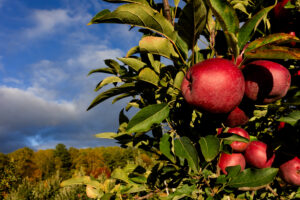
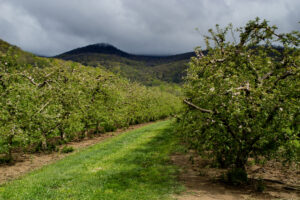
For example, try planting fruit trees. No matter how small the space, there is some variety of apple, pear, cherry, peach, or plum that can be planted. Dwarf varieties generally reach a height of 6 to 10 feet and should bear fruit within three to four years. Semi-dwarf varieties grow to approximately 15 to 20 feet.
Instead of planting junipers, liriope, or cotoneaster, think about planting strawberries as a ground cover. An area with well-drained soil that receives at least 6 to 7 hours of direct sunlight will produce lush green foliage, spring blossoms, and early summer fruit. Be certain to choose a variety adapted to your area, and plant disease- and insect-free plants. Set individual plants 12 to 18 inches apart in the spring, allowing runners to develop and mass over the entire bed. Clean cultivation is essential. Strawberries are perennials, but their beds need to be renovated every three to four years.
Blueberry bushes are a good substitute for a ligustrum or burford holly hedge. The rabbiteye type is more widely adapted to different soils than are high-bush varieties. Rabbiteye blueberries will not tolerate the cold climate of the mountains but grow well all across the piedmont and coastal areas. Acid soils (with a pH of 4.5 to 5.5) usually promote best growth. Modify soils by adding plenty of organic matter and by mulching with 4 to 6 inches of decayed sawdust. Two or more varieties should be planted to ensure proper pollination. Plant the bushes in full sun about 4-1/2 to 5 feet apart.
Extension offices in every county offer publications on vegetable gardening and on the culture and care of fruit trees, blueberries, strawberries, and figs. Also ask for a brochure listing the various recorded messages on landscaping and gardening available through the toll-free Extension Teletip service.
After completing your plan, you will probably be eager to begin work on the landscape. You may want to implement the design over a period of years. Decide which part of the landscape is most important. By establishing priorities, the landscape can be implemented in stages. Always try to finish one project before starting the next. Remember that "design is opinion." What pleases you and your family is the only criterion for a "good" design.
| Botanical Name | Common Name | Size | Root Handling | Quantity |
|---|---|---|---|---|
| Trees | ||||
| Lagerstroemia indica | Crape myrtle | 6-8 ft | B&B* | 2 |
| Cornus florida | Dogwood | 4-5 ft | B&B | 1 |
| Acer palmatum | Japanese maple | 4-5 ft | 5 gal can | 1 |
| Shrubs | ||||
| Myrica cerifera | Waxmyrtle | 3-4 ft | B&B | 9 |
| Kurume azalea | Azalea | 18-24 in | 3 gal | 16 |
| Juniperus chinensis 'pfitzeriana' | Pfitzer juniper | 18-24 in | 3 gal | 10 |
| Cotoneaster horizontalis | Cotoneaster | 12-15 in | 3 gal | 8 |
| Ilex cornuta 'rotunda' | Dwarf horned holly | 12-15 in | 3 gal | 8 |
| Ground Covers | ||||
| Liriope muscarii | Liriope | Clump | 1 gal | 25 |
| Pachysandra terminalis | Pachysandra | 2-4 in | 2-in peat pots | 45 |
| Ophiopogon japonica | Mondo grass | Clump | 1 gal | 5 |