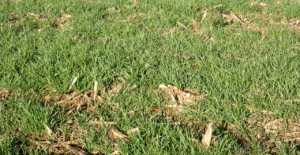
No one type of grass is best suited to all situations. A number of factors shou ld be considered before deciding which lawn grass to plant. Your decision shoul d be based on region, climate, intended use or wear at the site, and desired app earance.
Look at the map in Figure 1 to find you region. Cool-season (northern) and warm-season (southern) grasses are grown in North Carolina. Cool-season grasses grow best in the spring and fall and less actively in the summer. They stay reasonably green in the winter. Tall fescue, Kentucky bluegrass, fine fescue, and perennial ryegrass are common types of cool-season grasses. Table 1 rates the performance of various cultivars of these grasses in North Carolina. Warm-season grasses are slow to green up in the spring, grow best in the summer, and go dormant after the first heavy frost. Table 2 lists many warm-season cultivars.
Regardless of the region, the characteristics of each site and your goals will determine which types of grass are appropriate. Choose an adapted grass that best meets your preference for color, density, and texture. Choose a tough, aggressive, wear-tolerant grass where heavy traffic is expected. Take into consideration the amount of time, effort, and money you are willing to spend forturfgrass maintenance.
A comparative chart of principal lawn grasses used in each region is provided in
Table 3. Study the Chart to help select the appropriate grass
for the site and the intended use of the lawn. This information is based on
cultivar (variety) trials and observations by turfgrass researchers at North
Carolina State University.

In the absence of a soil test for all grasses except centipedegrass, apply per 1,000 square feet 75 pounds of ground limestone and one of the following fertilizers:
Centipedegrass prefers acidic soils and low levels of phosphorus and may not require the addition of lime and phosphorus.
Cool season grasses are best seeded from mid August to mid October, depending on location. Planting times ard rates for cool season grasses are given in Table 4. Seeding beyond these dates increases the chance of failure caused by winter injury.
Spring seedings are often less than satisfactory because the seedlings do not have time to become well established before the heat and drought of summer. If spring seeding is necessary, do it as early as possible to take advantage of cool weather and absence of weeds. Seeding cool season grasses after March generally results in a need to reseed the following fall.
Annual ryegrass can be used as a temporary cover until fall. However, it is better to seed the desired cool season grasses and renovate in the fall. This may require the assistance of a professional. Install cool-season grass sod anytime in the cooler portions of the growing season when the ground is not frozen.
Warm season grasses may be planted vegetatively (by sprigs or plugs) from March
through July. Best results are usually obtained by planting dormant sprigs in
March. Planting times and rates for warm-season grasses are also given in
Table 4. To avoid winter injury problems, plant before late
summer so the turf can become well established. Warm-season grasses can be
planted from March through September with reasonable chance of success as long
as soil temperatures are above 55°F. Professional sod installers have been
successful in establishing lawns beyond these dates, but care must be given so
that the sod does not dry out. Sod will not produce roots unless the soil
temperature exceeds
Lawns can be established by seeding or vegetative planting. Buying poor-quality plants or seed often results in less-than-satisfactory performance, pest problems, and general disappointment. Selection is especially important when establishing a lawn. Read the information on the seed tag carefully, and make sure you purchase seed with no noxious weed seed and low levels of other crop seed. One way to be sure you have seed or planting material that is true to type, free of noxious weed seed, and contains low levels of other crop seed is to purchase certified seed or sod. A blue certified tag indicates that the seed or plants have met certain standards to assure high quality and low levels of contaminants.
Seeding is usually the fastest, most economical method of establishing grasses. To ensure uniform coverage, use a centrifugal (rotary) or drop-type spreader. Apply half the seed in one direction and the other half moving at right angles to the first pass. Apply a starter-type fertilizer to the soil surface -- for example, 10 pounds of 5-10-10 or 5 pounds of 10-20-20 pe r 1,000 square feet at the time of seeding or, preferably, three weeks after planting so that nutrients are available for the seedlings as they appear. This surface application should be made in addition to the fertilizer incorporated into the soil. Lightly cover the seed by hand raking or dragging with a mat or chain-link fence. Roll the soil lightly to firm the surface and provide good seed-to-soil contact.
Mulch grass seed with weed-free small grain straw or hay. Use one bale per 1,000 square feet for warm-season grasses and 1 to 2 bales for cool season grasses. This will help conserve moisture, control erosion, and reduce surface crusting until establishment. Once in place, stabilize the mulch by rolling or watering. Twine netting can be used if wind displacement is a problem. If applied evenly and lightly, these materials need not be removed.

Vegetative planting is necessary for some grasses that do not produce seed that will germinate. When this method is used, the planting material must be kept fresh and moist from removal site to planting are. Keep planting material moist until established. Fertilize with 1/2 to 1 pound of nitrogen per 1,000 square feet every one to three weeks for fastest spread. Here are the methods most useful in lawn areas:
Space planting is the planting of separate shoots or sprigs (runner, cuttings, or stolons) at regular spacings. This labor-intesive method is best used for planting small areas. Spacing is determined by how fast the grass will spread, how fast you want it to cover, and how much material you have available. The closer the spacing, the faster the lawn will become established.

Broadcasting is the uniform distribution of sprigs (cut stems) over the entire area. The sprigs are pressed into the to 1/2 to 1 inch of soil by hand or by using an old disk set straight, special planter, cultipacker, or roller. Large areas planted with bermudagrass or zoysiagrass sprigs require a minimum of 3 to 5 bushels (yards) of sprigs per 1,000 square feet and 5 to 10 bushels (yards) for extremely fast cover. St.Augustinegrass is seldom established through broadcasting because the stems are too sensitive.
Plugging is planting individual pieces (2 inches or larger) of sod on 6-inch or 1-foot centers. This is an excellent way to introduce a more adapted lawn grass into an old lawn in an effort to replace old grass by crowding out. Zoysiagrass, St. Augustinegrass, and centipedegrass are often planted by pluggin g.
Soddingis placing sod stripped from one site to another for an "instant" lawn. Lay sod as soon as possible after it has been harvested to prevent injury. Sod should be installed within 24 hours of delivery. Plan to unstack and unroll the sod if it cannot be laid within 48 hours. While installing, keep sod in the shade to lessen the chance of heat buildup. Soil should be moist (but not overly wet) before laying sod. Irrigating the soil several days before delivery is often adequate.
Start sodding from a straight edge (driveway or sidewalk) and butt strips together, staggering them in a bricklike pattern. Avoid stretching sod. Use a knife or sharp spade for trimming to fit irregularly shaped areas. Lay sod lengthwise across the face of slopes and peg or stake the pieces to prevent slippage. After the sod has been placed, roll the lawn to ensure good sod to soil contact. Then begin watering.

The times and rates for planting vegetative grasses are given in Table 4.
To prevent drying of planting material and soil erosion, keep the top 1/2 inch of the soil moist. This may require light watering two or three times a day for 15 to 20 days. Bluegrass takes 7 to 14 days longer to germinate than other coolseason grasses. As the seedlings grow and root, water less often but for longer periods. For mixtures containing bluegrass, do not make the mistake of decreasing water as soon as the seedlings appear. Continue watering until the bluegrass seedlings emerge. After the third mowing, water to a depth of 6 to 8 inches about once a week or when needed.
Begin mowing as soon as the grass is 50 percent higher than the desired height. For example, mow tall fescue back to 3 inches when it reaches 4 1/2 inches. The frequency of mowing is governed by the amount of growth, which is dependent on temperature, fertility, moisture conditions, season, and the natural growth rateof the grass. The suggested height of cut is given in Table 3. The average homeowner should cut often enough that less than 50 percent of the total leaf surface is removed. Use a mower with a shape blade.
To reduce the danger of spreading disease and injuring the turf, mow when the soil and plants are dry. If clippings are heavy enough to hold the grass down or shade it, catch them or rake and remove then. Otherwise, do not bag the clippings. Allow them to fall into the turf where they will decay and release nutrients. This may reduce the need for fertilizer by 20 to 30 percent.
For faster spread of vegetatively planted warm-season grasses, add 1/2 to 1 pound of nitrogen per 1,000 square feet every three to four weeks during the growing season until coverage is complete. To help reduce turf loss, avoid high nitrogen fertilization of cool-season grasses in the late spring or summer and the warm-season grasses in the fall or winter.
To apply 1 pound of nitrogen per 1,000 square feet --
Divide 100 by the first number on the fertilizer bag to determine the amount of product to be used per 1,000 square feet
Example: A 16-4-8 fertilizer. 100 divided by 16 equals 6.25. Therefore, 6.25 pounds of fertilizer per 1,000 square feet will deliver 1 pound of nitrogen.
To apply 1/2 pound of nitrogen per 1,000 square feet --
50 divided by the first number on the fertilizer bag equals the amount of product to be used per 1,000 square feet.
Example: A 10-10-10 fertilizer. 501ded by 10 equals 5. Therefore, 5 pounds of fertilizer per 1,000 square feet will deliver 1/2 pound of nitrogen.
Seedlings.Siduron (Tupersan 50WP) may be applied to cool-season grasses at time of spring seeding for selective pre-emergence control of some annual grassy weeds such as crabgrass. DCPA (Dacthal 75W or 6F) may be applied to young seedlings of tall fescue and bluegrass once they are 1 to 2 inches tall. Either benefin (Balan 60DF) or bensulide (Betasan) may be applied in the spring to fall-seeded cool season grasses. It is safe to reseed lawns in the fall if pre-emergence herbicides were applied the previous spring.
Broadleaf weeds are common in new seedlings; however, many will be controlled with frequent mowing at the proper height. After the lawn has been mowed three times, remaining weeds may be controlled using the minimal label rate of a broadleaf herbicide. The particular herbicide used depends upon the weeds present and the tolerance of the turfgrass to the herbicide.
Space planting sprigs, broadcasting sprigs, and plugging. Atrazine (AAtrex) or simazine (Princep) may be applied for control of certain annual grass and broadleaf weeds when sprigging bermudagrass, centipedegrass, St. Augustinegrass, and zoysiagrass. Do not apply these herbicides over the rooting areas of trees and ornamentals that are not listed as being tolerant on the herbicide label.
Sodding Pre-emergence herbicides such as siduron (Tupersan), DCPA (Dacthal), and bensulide (Betason) can be applied for annual weedy grass control after sodding cool and warm season grasses.
Consider your lawn established when you have mowed in three times
Improper irrigation of lawns results in waste, added coast, and unhealthy plants. Water should be applied only when lawns show signs of moisture stress. A dark bluish gray color; footprints that remain some time after walking; and wilted, flooded, or curled leaves are indications that it is time to water. Delay in watering at first signs of wilt can result in permanent damage unless the turf is being allowed to go dormant.
Early morning is the preferred time to water because it reduces the risk of disease, water loss through evaporation, and improper water distribution. Also, the demand for water by industry and municipalities is usually low at this time.
Established lawns should be watered to a depth of 6 to 8 inches to encourage deep rooting. Usually, 1 inch of water per week is adequate. Cans or a rain gauge can be used to determine how much water is being delivered in a certain period of time. It takes 640 gallons of water to apply 1 inch of water per 1,000 square feet. Because clay soils accept water slowly, water should be measured to prevent wasteful runoff. Water clay soils until runoff is about to occur; wait 30 minutes for the water to be absorbed; and rewater until the desired depth or amount is achieved. This technique can be used on slopes and compacted soils. Few lawns established on clay soils can absorb more than 1/2 inch of water per hour. Sandy soils require more frequent watering; applying 1/2 inch of water every third day is usually sufficient. Adjust any automatic irrigation system to supplement rainfall so that the lawn is not over watered.
Certain precautions should be taken if you do not plan to irrigate throughout the summer. Slowly ease a lush, actively growing lawn into dormancy. This can be accomplished by deep and infrequent watering, by mowing high, and by not overfertilizing with nitrogen. In the absence of rain, water dormant lawns every three weeks to prevent turf loss from heat and drying. Brown, withered leaves are normal signs of dormancy; don't be alarmed by them. Turfgrasses are able to withstand prolonged periods of drought. Note:Do not regularly water established cool season gr asses during the summer unless you plan to do so all season. Many lawns are los t by discontinuing irrigation in midsummer.
Either the rotary (centrifugal) or reel (cylinder) mower can be used. The reel mower is preferred for grasses such as zoysiagrass, hybrid bermudagrass, and centipedegrass that need to be cut to less that 1 inch. The cleanest cut and best mowing are obtained when the mower blades are sharp. Dull mower blades reduce lawn quality by tearing instead of cleanly cutting the grass, creating many ragged leaf ends that quickly wither and bleach and are easy ports of entry for disease. Using a sharp mower is especially important for difficult-to-mow grasses such as zoysiagrass, bahiagrass, and certain types of perennial ryegrass cultivars. A properly sharpened and balanced mower blade will also reduce mower vibration, lengthen mower life, and reduce fuel consumption by as much as 22 percent.
To maintain a high-quality lawn, turfgrass should be cut often enough that less than 50% of the leaf surface is removed with each mowing. The frequency of mowing is governed by the desired grass height and by the amount of growth, which is dependent on temperature, fertility, moisture conditions, season, and the natural growth rate of the grass. In most instances, this may amount to biweekly and weekly mowing. The proper mowing heights are presented in Table 3. If the lawn gets too high during wet seasons, raise the mower and cut off one-fourth to one-half of the present growth. Then, lower the mower to it's proper height and mow again in a day or two.
Most homeowners bag lawn clippings because they think that the clippings add to the buildup of thatch, which can be harmful to the lawn. Actually, thatch is made up of roots, stems, and the lower portions of leaves that are below the mower blade. Frequent mowing, mowing when the grass is dry, and proper fertilization are the best ways to reduce thatch buildup. Though studies have shown that a lawn of 1,000 square feet can produce 500 pounds of clippings in one growing season, these clippings contribute very little to thatch. In fact, clippings that remain on the lawn quickly decompose and release valuable nutrients. Fertilizer use can be reduced by 20 to 30 percent.
If prolonged periods of rainfall prevent mowing, clippings may be long enough to shade or smother the grass. In this case, rake, bag, and remove the clippings. Collected clippings can be used as mulch around trees and shrubs or added to compost. Because yard trash accounts for 20 percent of the waste in our overflowing landfills, legislation has been passed that will ban the depositing yard trash in most public landfills as of 1993. Homeowners will be forced to look for other alternatives. Contact your county Cooperative Extension Center for information about composting yard trash and other uses for this material.
A soil test should be made every two to three years to determine the amounts of lime, phosphorus, and potassim needed by your lawn. A complete fertilizer with a ratio of nitrogen (N): phosphorus (P2O5): potash (K 2O) of 4:1:2 or 4:1:3 can be used in lieu of a soil test, but it is a poor substitute.
The proper amount of fertilizer, ratio of nutrients of fertilizer elements, and time of application vary with the grasses being grown. See Table 5 to determine the amount of nitrogen fertilizer to apply and the time of application. To help reduce turf loss, avoid high nitrogen fertilization of cool season grasses in late spring or summer and the warm season grasses in the fall or winter.
Most soils in North Carolina are acidic and often require the application of lime to sweeten the soil. For most turfgrasses, except centipedegrass, soil pH should be between 6.5 and 7.0 for optimum nutrient availability. Centipedegrass requires more acidic soil with a pH close to 5.5. Lime may be put on any time during the year; however, winter is usually best since there is less traffic. Gentle winter rains minimize runoff, and alternate feezing and thawing help incorporate lime into the soil.
Fertilizer and lime should be applied uniformly with a centrifugal (rotary) or droptype spreader. Apply half the fertilizer in one direction and the other half moving at right angles to the first pass to ensure uniform coverage.
Soils that are subject to heavy traffic are prone to compaction. Coring will alleviate the condition. Use a device that removes soil cores. Chop up the cores, and, if possible, distribute them by dragging with a chain-link fence.
Coring should be done at a time when the lawn is actively growing so that it can recover from any injury. It is best to core cool season grasses in fall or early spring. Warm season grasses are best cored in late spring or early summer. Some lawn care and landscape companies offer coring service if rental equipment is not available.
Sod-forming grasses such as Kentucky bluegrass, bermudagrass, zoysiagrass, St. Augustinegrass, and centipedegrass have a tendency to build up thatch when they are heavily fertilized and watered. When thatch exceeds 1/2 inch, lawns should be power raked and cored.
A light power raking is better than trying to remove too much debris at one time. When not excessive, thatch buildup can be removed from warm season grasses by cutting as closely as possible at time of spring green up then raking by hand. To avoid seriously injuring the lawn, a 3-inch blade spacing is required to remove thatch for centipedegrass and St.Augustinegrass. Some lawn care and landscape companies have specialized equiment and offer power raking service.
Lawn renovation refers to any procedure beyond normal maintenance (short of soil modification) required to upgrade and existing lawn. A deteriorated lawn is often a symptom of some underlying problem. Failure to identify and correct the exact problem can often lead to further lawn deterioraton and the need for repeated renovation. Some of the major causes of turf deterioration include:
The problems that caused lawn deterioration must be corrected before the renovation process begins.
Late summer to early fall is the best time to renovate cool season lawns. Warm season lawns are best renovated in late spring to early summer. Attempts to upgrade existing lawns when conditons are not conducive to good growth are difficult at best.
The first step in lawn renovation is the control undesirable vegetation that competes with newly planted grasses. Some weeds growing in small areas may be controlled by hand weeding or removal using a small hoe, rake, or shovel. Hard to control weed, such as perennial grasses with underground shoots, or weeds in large areas are best controlled with herbicides.
Most postemergence broadleaf herbicides must be sprayed four to six weeks before seeding. Control of annual grassy weeds such as crabgrass with selective postermegence herbicides should also be completed at least four weeks before seeding. To control perennial grassy weeds, undesirable turfgrasses, annual grasses, and broadleaf weeds, spray the nonselective herbicide glyphosate (Roundup or Kleenup). If perennial grassy weeds such as bermudagrass are scattered throughout, consider killing the entire lawn.
When using glyphosate, do not disturb the soil or plants before treatment. Tillage or renovation techniques such as vertical mowing, coring, or slicing should be delayed for seven days after application to allow proper movement of the herbicide into underground parts of the weeds.
Young and actively growing weeds are easiest to control, so make sure that the soil is moist several days before application. Carefully read and follow directions and precautions on the herbicide labels. Treat only those areas in need.
Preplanting renovation procedures are designed to create and environment best suited for the establishment of newly planted grasses. This process includes the following:
Reducing Competition. Set the rotary or reel mower at the lowest setting, mow, and collect the clippings. Remvoe all undesirable vegetation, dead grass, thatch, and weeds so the soil is exposed. (This may not be necessary if a slit seeder is used.) A rake or hoe is ideal for small areas. Several passes with a dethatcher (power raker, vertical mower) is usually the best choice for large areas. If thatch is excessive, it may be necessary to make another pass with a dethatcher after mowing. Both mowing and dethatching reduce plant competition and enhance light penetration for good germination and fast establishment.
Applying Nutrients. Uniformly apply needed fetilizer and lime based on soil test results. Hand application is fine for small areas, but a rotary or drop-type spreader should be used on large areas to ensure uniform application.
Preparing a Good Seedbed. In small bare spots, loosen the top 4 to 6 inches of the soil with a rake, hoe, or shovel. Fill in low areas and smooth the surface so clods are smaller than marbles.
Large areas and areas that contain 50% desirable grasses are best prepared for seeding by using a piece of equipment (such as an aerator or coring machine) that brings small soil cores to the surface. This will bring soil to the surface with minimal disruption and create and environment for good seed-to-soilcontact. Core in several directions, allow plugs to dry and then pulverize with mower, dethatcher, or chain-link fence. Because tines have a difficult time penetrating dry, compacted soils, coring is best achieved when the soil is damp.
Bare spots larger that 4 inches in diameter should be planted. Smaller areas tend to fill in naturally, provided the lawn grass is capable of spreading. Tall fescue and perennial ryegrass exhibit a bunch-type growth habit and are incapable of spreading. Choose a blend or mixture that is compatible with the environment and the existing lawn.
To ensure uniform coverage, use a rotary or drop-type spreader, applying half the seed in one direction and the other half at right angles to the first pass. Incorporate seed and fertilizer into the top 1/8 inch of soil by lightly pulling a leaf rake over loosened soil or running a vertical slicer over areas that were just power raked and cored.
A slit seeder, consisting of a vertical grooving seeder and seed box, can be used to drill seed to ensure good seed-to-soil contact with minimum disruption. Seed should be drilled in a diamond-shaped pattern. Dry, compacted soils, obstructions such as rocks and trees, and excessive slopes may limit the usefullness of a slit seeder.
Bare areas that are seeded should be mulched to enhance germination.
Plugging can be used for those grasses that spread laterally -- not bunch-type grasses such as tall fescue, ryegrass, bahiagrass, and fine fescue. Place plugs on either 6-inch or 12-inch centers, depending on the desired establishment speed. Use a plugging device to remove plugs of soil from bare areas, and switch them with plugs collected form healthy areas. Apply a starter-type fertilizer, such as 10 pounds per 1,000 square feet of 5-10-10 fertilizer.
This method is often reserved for bermudagrass. Rototill the recommended amount of fertilizer and lime, indicated by soil test results, or apply 75 pounds of lime and 20 pounds of 10-10-10 fertilizer to the area to be sprigged. Spread sprigs over the surface using rates provided in Table 4 for new areas. Press them into the top 1/2 to 1 inch of soil using a old disk set straight, special planter, cultipacker, or roller. Roll the area to firm the soil and ensure sprig-to-soil contact.
Keep renovated areas moist with light sprinklings several times a day. As the seedlings, plugs, or sprigs grow, continue to decrease the frequency of waterings while increasing the duration to promote deep rooting. After the third mowing, water to a depth of 6 inches.
Mow the area as you normally would, using a sharp blade. But continue to severely stunt existing vegetation by mowing short until desirable grasses have germinated and the desired mowing height is achieved. This will reduce the competition for new seedlings.
Fertilize the new seedings of cool-season grasses using a complete (N-P-K) fertilizer that provides about 1 pound of nitrogen per 1,000 square feet. To enhance establishment, this fertilizer should be applied approximately three weeks after seedlings emerge. The section "How to Determine Fertilizer Requirements" will help you determine how much fertilizer to use.
Warm-season grasses can be fertilized every four weeks until coverage is complete. Use a complete (N-P-K) fertilizer that provides about 1 pound of nitrogen per 1,000 square feet. Biweekly applications of a nitrogen-only fertilizer that provide about 1/2 pound of nitrogen per 1,000 square feet may help warm-season grasses fill in more rapidly.
Keep unnecessary traffic off the renovated lawn until it is well established.
People are becoming more aware of and concerned about the effects of chemicals on our environment. Research indicates that pesticide use poses a minimal threat to the health of humans, animals, and the environment. But because we can't be certain, many people choose to avoid pesticides. So how would you handle a pest problem that is destroying the appearance of your lawn? Do you use pesticides, change cultural practices, or both?
The balanced use of all available control methods is called Integrated Pest Management. The idea is simple. All available prevention and control methods are used to keep pests from reaching damaging levels. Pesticides are only used when necessary.
Planting the best-adapted grass and then watering, mowing, and fertilizing it properly form the basis for integrated pest management. Keeping the lawn healthy enables it to tolerate low levels of pests and makes the area a good habitat forbeneficial organisms that help control pests.
To best use natural controls, it is important to develop a sound understanding of the biology and ecology of the lawn environment. Fortunately, many books and other educational materials are now available to assist the homeowner. Also, many companies offer materials for organic lawn care. These range from nematodes that attack caterpillars to traps and repellents. Some of these are quite effective, whereas the effectiveness of others has not been documented. As each product is tested and proven to be effective, it will be added the list of available options for turf pest management.
In the meantime, if chemical control is necessary, select the safest effective pesticide and follow label recommendations. Chemicals should be applied when the pest is most susceptible. Treat only those areas in need and regard pesticides as only one of many tools available in lawn care. Integrated pest management can be successful, but homeowners mush realize that more time and labor are required and high expectations may not be met when pest pressures and environmental conditions are severe.