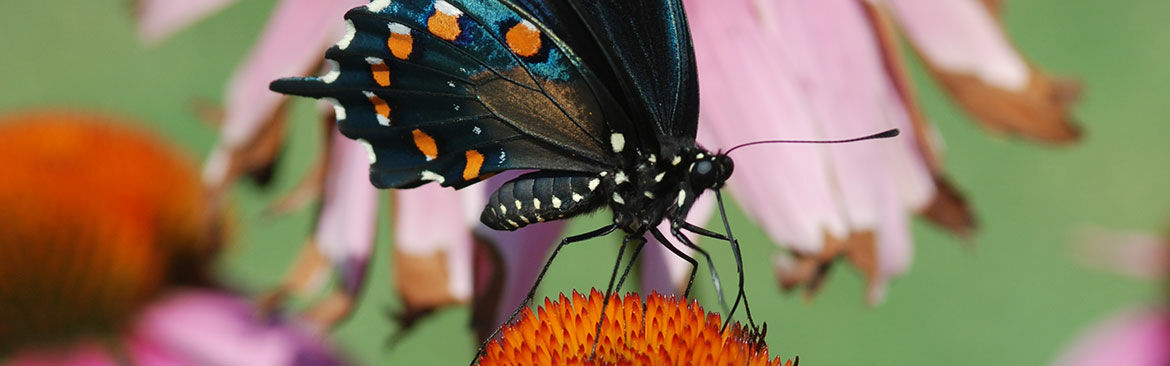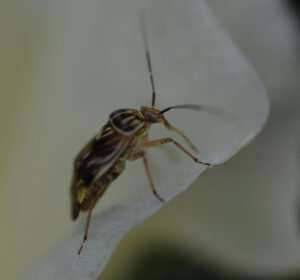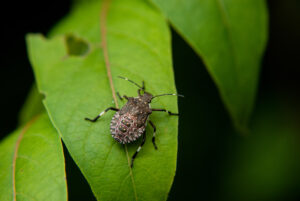
Euthyrhynchus floridanus is a stink bug that feeds on other plant pests. It is one of the more attractive stink bugs with three orange spots on a dark, metallic blue background. These insects overwinter as adults probably in some dry, sheltered location. Eggs are laid the following spring. The eggs hatch 19 to 33 days later. Nymphs of Euthyrhynchus floridanus take a long time to develop through five stages (40 to 67 days). New adult females wait 5 or 6 days before mating and the eggs are laid 23 to 67 days later. Total developmental time for this species is much longer than for plant-feeding stink bugs. Immature Euthyrhynchus floridanus are highly aggregated and even attack larger prey in concert. Apparently, aggregation behavior allows them to successfully attack prey too large to be subdued by a single nymph. Sometimes the adults aggregate with nymphs, although when times get hard these bugs sometimes feed on smaller individuals. When the bugs jab their prey with their proboscis, they inject a toxin that slowly immobilizes the prey. Euthyrhynchus floridanus bugs have an unusual wagging behavior in which the bug rocks its body from side to side while it grips the substrate firmly with its feet. This is thought to be a defensive behavior. Many of these predaceous stink bugs feed on plant tissue when insect prey is not available. Plant feeding is not reported for Euthyrhynchus floridanus, but if such feeding does occur the plant damage must be slight and is certainly outweighed by their beneficial role in controlling plant-feeding pests.
Over the years, Jim Baker has often wondered why some oaks have lumps on otherwise smooth bark. This week we received a branch of southern red oak about six feet long that had lumpy twigs and a lumpy stem that seems to answer that question. David Stephan determined that either Callirhytis or Neuroterus gall wasps had infested the twigs and the bark had swollen over the tiny cells in which the gall wasp grubs develop. Both kinds of these gall wasps cause stem galls and leaf galls on oaks. Because the wasps develop for two or three years in the stem galls, evidently the tree was callusing over the galled areas. Eventually the new generation of gall wasps emerges to lay eggs for a leaf gall generation. Because the tissue around the twig galls is so distorted by the gall, it is apparently impossible to control this stage with contact and even systemic pesticides. Treating the leaf galls each spring should eventually wear down the gall wasp population, but treatments would have to be made for at least three years in a row.
The fire ant range is spreading in North Carolina and many homeowners are concerned. Movement of nursery related material is regulated by the North Carolina Department of Agriculture and Consumer Services. Adult red imported fire ants are small, red to dark brown in color, and occur in five forms. However, to the casual observer, fire ants are pretty much ordinary-looking ants. Two things really distinguish fire ants from other ants. One is that they sting readily, causing a small pustule to form after the pain subsides. The other is the mound of fire ants are generally larger than most of those of common native ants, and when fire ant mounds are disturbed, fire ants boil out of the mound.
Fire ant mounds vary in size, usually in direct proportion to the size of the colony. For example, a mound that is 2 feet in diameter and 18 inches high may contain about 100,000 workers, several hundred winged adults, and one queen. In addition, when the mound of an active fire ant colony is broken open, white rice grain-like larvae and pupae usually can be found. Mounds constructed in clay soils are usually symmetrical and dome-shaped; mounds built in sandy soils tend to be irregularly shaped.
Fire ants prefer oily and greasy foods. They also feed on many other insects and, from that standpoint could be considered beneficial. To find food, workers forage around their mound. These ants usually travel in underground tunnels that radiate from the mound. If the mound is disturbed, ants swarm out and sting the intruder.
Control of mounds is normally by bait or chemical drench of the mound. For choices, see the North Carolina Agricultural Chemicals Manual. Control can be very specific depending upon where mounds are located. Non-chemical treatments for areas such as vegetable gardens and playgrounds are preferred. For a compendium of fire ant facts, visit the Texas A&M University fire ant web site. Not all of their recommendations may apply in North Carolina.
Phylloxera are aphid-like insects that feed on the developing leaves of pecan or hickory and cause the galls to form. The galls are green at first but gradually turn brown and crack open. The phylloxera escape and lay eggs that develop into males and females. These insects mate and the females of some species crawl to protected places on the bark of the host tree and die. With these insects, a single egg inside the body of the female survives the rest of the summer, fall, and winter. Other species lay eggs on the leaves and twigs. These eggs hatch the following spring and the tiny, new phylloxera feed on the developing buds and form a new generation of galls. As the galls dry, the leaves often fall prematurely. Heavily-infested trees may suffer dieback due to the disruption caused by the galls. There is no pesticide currently labeled for phylloxera galls on hickory. Infested trees are often too large for homeowners to treat practically. In case the tree in question is small enough to spray, Ornamentals and Turf Insect Note No. 49 lists some insecticides which are labeled for phylloxera control on pecan (Sevin, Thiodan, lindane, malathion and some of the horticultural oils). The best time to treat for phylloxera is in early spring as the new growth is emerging but before the galls close around the phylloxera and protect them from the pesticide. Having said that, treatment is rarely practical or worthwhile. Damage is cosmetic except in severe cases.
Gloomy scales can cause twig dieback and can the bark of maples to turn an ugly rough, black color. They overwinter as mated females and the young scales are produced from May to the middle of August. There are illustrations of this pest and some additional information on gloomy scale biology and management in Ornamentals and Turf Insect Information Note No. 60. It recommends various kinds of pesticides that can be used legally for gloomy scale control. However, it would probably be better to try to treat for the scales by improving the growing condition of infested trees. First, a soil sample should be taken from under infested trees and submitted to the North Carolina Department of Agriculture and Consumer Services Soils Laboratory. If the pH or nutrients are out of balance, the soil should be amended. However, too much fertilizer can be worse than not enough fertilizer. If there is another period of prolonged drought stress this summer, the trees should be irrigated. Clients should consider removing the grass under the trees and mulching the soil to conserve soil moisture and to keep the roots cool. In other words, anything within reason to optimize the vitality of the trees should be done. It has been shown that trees under stress have more simple sugars (rather than starches) and more free amino acids (rather than more complex proteins) in the sap. Thus stressed trees are probably more nutritious to the scales than healthy trees. The bark of unsprayed trees is like a microscopic zoo with all sorts of predaceous mites, predaceous insects, parasitic fungi (including a bright reddish-orange fungi), parasitic insects, and other organisms in addition to the scales. By putting the tree into optimum growing condition, it should be less susceptible to damage by the scales, and the scales probably will not reproduce as prolifically. As a consequence of optimizing growing conditions, parasites and predators may control the scales almost completely.
Asian ambrosia beetle trap counts were down this week in Johnston County.
In the past three weeks, homeowners, lawn care operators, golf course superintendents and others have noticed a lot of tunneling activity in the soil. This loosening of the soil has often created unsightly areas that has created some concern. The areas that I have observed have all been the result of green June beetle grubs feeding on thatch and other organic matter and tunneling near the soil surface. This is nothing unusual, but we may be seeing a few more than normal or simply the current weather patterns may be making them a little more active. There is no reason to get concerned. Within a very short period of time, the grubs will begin to pupate. They will go deep in the soil and form the resting stage that allows the transformation from a big, fat white grub to a shiny, metallic green large beetle. These beetles will emerge in mid summer and begin buzzing over the turfgrass looking for suitable places to lay eggs. Suitable places usually include areas with a lot of thatch and organic matter. Thus, since the grubs are almost finished with their feeding for this spring, I would not recommend any control efforts at this time.
The recent hot and dry weather has certainly helped set the stage for an increase in southern chinch bug abundance in St. Augustinegrass. Chinch bugs love hot and dry weather and those conditions late in the spring certainly increase the likelihood of problems in June and the rest of the summer. Monitor St. Augustinegrass lawns closely for the presence of discolored, yellow or tan turfgrass, which is the first sign of southern chinch bug feeding.
Employment and program opportunities are offered to all people regardless of race, color, national origin, sex, age or disability. North Carolina State University, North Carolina A&T State University, U.S. Department of Agriculture, and local governments cooperating.
Last modified on May 22, 2000 by Stephen J. Toth, Jr.