Chapter 3 -- Apple Insects And Diseases In The Southeast
Integrated Management Of Insects And Mites
Integrated management of insect and mite pests is the key to successful apple production. This
chapter describes sampling methods and cultural considerations for insect and mite
management. It discusses beneficial arthropods, including predators and parasites. It also
presents guidelines for using honeybees to pollinate apples.
Sampling For Insect And Mite Pests
The goal of a sampling program is to accurately estimate the density of pests and beneficial
arthropods. Information on pest diversity and abundance is needed to avoid unnecessary
pesticide applications and to aid in the proper selection and timing of pesticide applications.
Information on the abundance of beneficial arthropods is also needed to determine the potential
for biological control and to select pesticides that will be least disruptive of natural enemy
populations. Natural enemies can be highly effective in apple systems if pesticides are used
properly.
An apple IPM program uses a variety of methods to sample arthropod populations. Estimates of
some pests are obtained by directly counting the number of insects or mites on a specified
number of leaves or terminals; this method is commonly used for pests that are highly visible,
relatively immobile, and easy to count. Some insects, however, are more difficult to observe
because they are highly mobile, active only at night, and difficult to see. For these latter pests,
alternate sampling methods, such as pheromone trapping and sticky cards, have been developed.
For some pests more than one method is used to sample different life stages. Regardless of the
methods used, a regular monitoring schedule and accurate records must be maintained.
Identifying And Monitoring Pests
The first step in developing an apple pest monitoring program is to identify the key pests and
their phenologies in your region and orchard. The insects attacking apples in the southeastern
United States are diverse, but certain pests are limited in their distribution or are less important in
certain areas. Consequently, there is little advantage to monitoring for those pests that poses
minimal threat of damage. Similarly, knowledge of pest phenologies can be used to optimize
sampling times so that pests are monitored only when they are likely to be present. Thus, it is
not necessary to sample all pests during every sampling session. Although the diversity of pests
may at first overwhelm the pest management scout, understanding the pest complex in an
orchard can help develop time-efficient sampling programs.
Under certain situations it may not be necessary to monitor for specific insects early in the
season, despite the fact that they may be known to occur. For example, the density of early
season pests, such as European red mites, scales, and rosy apple aphids, is often too low to
reliably estimate with recommended sampling schemes. Therefore, in most states early season
preventive control strategies are recommended for these early season pests. In addition, for many
insect pests there is insufficient information to correlate early season population densities with
damage that may occur later in the season.
Selecting Sampling Sites
For those pests that are monitored directly on leaves (for example, mites, leafhoppers,
leafminers, and aphids), select 10 trees in each block that are representative of tree age and
variety occurring within the block. Choose some of the trees from areas where you expect pests
to be a problem or to occur first. Mark theorems so that they can be recognized
easily (Figure 3.1). Although you will closely
inspect only selected trees, observe surrounding trees as you
move through the orchard to detect problems that may not have occurred on sample trees.
Pheromone Trapping
During the past 20 years many advances have been made in the identification and synthesis of
insect pheromones. Synthetic female-emitted sex pheromones are available for most
lepidopterous pests of apples, and they are commonly used as lures in sticky traps to monitor
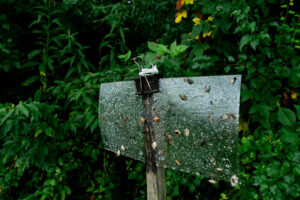
male populations. A number of different trap styles are commercially available, but the most
commonly used in apple IPM programs are tent and wing-type traps
(Figure 3.2).
When using wing-type traps, make sure that the replaceable sticky-coated bottoms are kept free
of debris or are replaced when their ability to easily trap insects is impaired. During periods of
intense flight activity, you may need to replace the sticky-coated bottoms at weekly intervals.
Replace lures at recommended intervals also.
The number of pheromone traps to erect in each block varies withdiferent insects and the
objective of the trapping program. For those insects about which enough information is known
so that trap catches can be correlated to economic threshold levels, at least two traps per block
should be erected. In large blocks (greater than 50 acres) it is not necessary to use more than four
traps. When traps are used simply to monitor population trends, fewer traps can be used. Traps
should be hung on the outside of trees but not where they will be hit by moving equipment.
Sampling For Commonly Encountered Insect Pests
The insect pests included in this category are those that commonly occur in most areas of the
southeastern United States. Although not all of these insects will require control measures in
every year or in every orchard, most have demonstrated a high potential for causing injury and
should be included in a pest scouting program.
Aphids
Both the rosy apple aphid and the complex of green apple aphid and spirea aphid are common
pests of apple. Although the same sampling method is used for the two types of aphids, a lower
threshold levelis utilized for the rosy apple aphid becuase of its greater potential for damage.
Rosy apple aphid nymphs are present during the tight cluster to pink stage, but population
estimates before bloom do not always correlate well with post-bloom densities. For this reason,
preventive control during pink is recommended rather than reliance on pre-bloom sampling to
dictate the need for control measures.
Monitoring Procedures
On each of 10 sample trees, examine 10 terminals around the periphery of the tree and record the
number of terminals infestedwith 1 or more wingless aphids.
Sampling Periods
Sample from the tight cluster stage of flower development throughthe second cover spray for
rosy apple aphid and from the firstcover spray through mid-July for green apple and spirea
aphids.
Action Threshold Level
Implement control measures when populations exceed 10 percentinfested terminals for rosy
apple aphid and 50 percent infestedterminals for green apple and spirea aphid. Mature trees
canusually tolerate high green apple and spirea aphid populationswithout adversely affecting the
yield or quality of fruit; controlis of greatest importance on young trees.
Spotted Tentiform Leafminer
Spotted tentiform leafminer (STLM) adults can be monitored withpheromone traps, but no
accurate correlation between pheromone trapcatches and subsequent larval populations has been
found. Consequently, leaves must be examined for the presence of mines todetermine the need
for control measures. If an insecticideeffective against STLM is not routinely applied at tight
cluster topink, sampling for first generation eggs may be useful to determinethe need for control
of first generation larvae. However, first generation larvae rarely build to damaging levels.
When insecticides are applied against larvae, they should be applied when the majority of mines
are in the sap-feeder stage because these larvae are more susceptible to insecticides than
tissue-feeder larvae.
Monitoring Procedures
First Generation Eggs. Select 5 terminals per tree and count the number of eggs on the
underside of the second, third, and fourth leaves (in the order they unfold). A hand or visor lens
is needed to see eggs.
First Generation Larvae. Select 5 terminals per tree and count the number of mines on the
underside of the second, third, and fourth leaves (in the order they unfold).
Rarely is control needed for first generation STLM.
Second And Third Generation Larvae. Select 5 mature leaves per tree from the periphery of the
tree and count total number of sap- and tissue-feeder mines.
Sampling Periods And Threshold Levels
The sampling periods and threshold levels differ for each generation (Table 3.1)
Table 3.1. STLM Sampling Periods and Threshold Levels.
| Generation | Sampling Period |
Action Threshold Level |
| 1st egg | Pink |
6 eggs/cluster |
| 1st larval | Petal fall-1st cover | 1 mine/leaf |
| 2d larval | 3rd and 4th cover | 2 mines/leaf |
| 3d larval | July | 5 mines/leaf |
White Apple Leafhopper
In most areas of the Southeast, white apple leafhopper completes two generations per season, but
control of only one generation is necessary. Sampling should be scheduled to coincide with
emergence of nymphal populations because higher levels of control are achieved when
insecticides are directed against nymphs as opposed to highly mobile adults. Occasionally potato
leafhoppers and possibly rose leafhoppers will also infest apples, but rarely do populations build
to damaging levels. When disturbed, potato leafhopper nymphs will walk sideways, which can
be used as a distinguishing characteristic between the two leafhopper species.
Monitoring Procedures
On each of 10 sample trees, examine the underside of 10 leaves and count the total number of
nymphs.
Sampling Period
For first generation nymphs, sample from petal fall to the second cover. The time of occurrence
of second generation nymphs varies among locations, ranging from mid to late July in North
Carolina to early July in Georgia.
Action Threshold Level
Insecticide should be sprayed for first generation nymphs when populations reach an average of
1/4 nymph per leaf and for second generation nymphs at 1 nymph per leaf. Control of first
generation nymphs usually precludes the need for second generation control.
Codling Moth
Insecticidal control is dependent on making applications during periods of egg laying or
emergence of larvae from eggs so that larvae are killed before they have the opportunity to feed
on fruit. Pheromone traps, which attract male moths, are an effective means of determining
population densities of this pest. In fact, h) 0*0*0*° ° Ô codling moth is one of the
few pests of apples that can have control measures dictated by trap catches.
Sampling Procedures
One to two pheromone traps should be placed in each block, with a maximum of four traps
placed in a 50-acre orchard. Place traps in one of the trees selected for monitoring, preferably
where damage is likely to occur first, such as those near abandoned orchards or packing sheds.
Use wing-type traps to monitor codling moths since threshold levels have been developed using
these types of traps.
Sampling Period
First generation adults begin to emerge during bloom of Delicious apples. Consequently, traps
should be erected at bloom and checked weekly up to 2 weeks before harvest.
Action Threshold Level
Action threshold levels, used to dictate the need for insecticide applications, vary among states,
but a threshold of 10 moths per trap per week has been used successfully in the Southeast. Most
insecticides recommended for codling moth provide 2 weeks protection, so do not be concerned
if catches remain high 1 week after spraying. If trap catches are still high 2 or 3 weeks after
spraying, another application should be made.
Leafrollers
A number of different leafrollers can cause damage to apples. Unfortunately, action threshold
levels based on pheromone trap catches do not exist for leafrollers. The decision to apply
insecticides for specific leafrollers should be based on the history of damage in specific orchards.
In certain orchards there may be no need to take special precautions for leafrollers while in other
orchards insecticides are routinely needed for control. Also, insecticides commonly applied for
other pests (that is, codling moth and rosy apple aphid) will also control certain leafroller species.
When control of leafrollers is warranted, insecticides should be targeted against eggs and small
larvae. Sampling for either of these life stages is generally not practical because of the difficulty
seeing them. However, monitoring adult populations with pheromone traps is useful for timing
insecticide applications against redbanded leafroller (RBLR) and tufted apple budmoth(TABM),
two of the more important leafroller pests in the South. If growers are unsure as to the need for
insecticidal control of leafrollers in the orchard, sampling for larval populations and damage
should be conducted to determine the potential for damage by various leafroller species.
Sampling Procedures
Pheromone Trapping. Pheromone trapping for male moths is possible for leafroller species most
commonly found in southeastern apple orchards, including RBLR, TABM, and variegated
leafroller (VLR). Other species that may occur in some orchards but are
usually not a serious problem include the fruit tree leafroller and obliquebanded leafroller. The
same trapping procedures outlined for codling moth should be followed for leafrollers.
Egg Sampling. Eggs may be sampled by conducting the equivalent of a 1-hour search of foliage
(upper side) for eggmasses. This is most easily accomplished by searching for 5-minute periods
in twelve different areas of the orchard. Fresh egg masses (not hatched) are difficult to detect
because they blend in well with the green foliage. Hatched egg masses have a silverlike
appearance and are more easily seen. Sampling should be conducted during adult flight periods
as determined by pheromone trap catches.
Larval And Fruit Sampling. Although sampling for larvae is not always practical as a means to
determine the density of leafrollers or the need for control measures, it does aid in determining
the status of leafrollers as a pest in individual orchards. On each of 10 trees, examine 10 leaf and
fruit clusters infested with live larvae. Larvae are most likely to be found in folded leaves or
leaves webbed to the fruit. Care must be taken when opening folded leaves because larvae may
quickly drop off the leaf when disturbed.
To sample for fruit damage, examine 25 to 50 fruit on each of 10 trees per block.
Sampling Periods and Interpretation of Results
RBLR completes three generations in the South, with the first adult flight period occurring
during the green tip to pink stages, the second flight during the third and fifth cover spray, and
the third flight throughout the harvest. Egg laying occurs during flight periods, and leaf and fruit
clusters should be examined at the completion of a flight period to sample for small larvae.
RBLR is considered a minor pest in most commercial orchards, and pre-bloom insecticidal
sprays for other pests usually suppress populations for most of the season.
TABM and VLR have a similar life cycle, both completing two generations per season with the
first adult flight period occurring during May and June, and the second flight during August and
September. Pheromone traps should be erected at bloom and checked until harvest to monitor
adult population trends (Figure 3.3). Egg laying
by first generation TABMs is not initiated until approximately 2 weeks after
peak pheromone trap catches. However, egg laying by second generation moths
starts as soon as pheromone trap catches increase. In areas where TABM is a
problem, insecticide applications should be timed to coincide with egg laying.
Apple Maggot
Apple maggot is a sporadic pest in the southern United States; it is usually only a problem in
orchards at higher elevations (greater than 3,000 feet). Unless there is a history of apple maggot
damage in a specific orchard, monitoring for this pest is probably not necessary. In the higher
elevations of western North Carolina, adult emergence begins in mid to late June, peaks during
late July, and is complete by mid-August. For effective control of this pest, insecticides should
be applied before adults lay eggs in fruit. Thus, adult flight must be closely monitored so that
insecticide sprays are properly timed.
Sampling Procedure
Red sticky spheres with an attractant lure attached should be hung on trees on the outside rows of
the block nearest an unsprayed orchard or woods. Hang one sphere on each of 3 trees spaced 3
trees apart. Traps should be placed at eye level on the outer portion of the tree canopy, and all
fruit and foliage within 1 foot of the traps should be cleared so that spheres are clearly visible to
incoming flies (Figure 3.4).
Sampling Period
Set out traps no later than mid-June and check them one or two times weekly until early August.
Remove all flies and other insects from spheres so that they do not become full of debris.
Action Threshold Level
An insecticide should be applied when 2 to 5 flies per trap have been caught. Most insecticides
provide protection for 10 to 14 days; thus, flies captured 1 week after spraying should be
discounted. Subsequent sprays are needed whenever more than 2 flies per trap are captured 10 to
14 days after the last spray.
Sampling For Sporadic Insect Pests
Other insect pests of apples cause only sporadic damage or problems in isolated orchards. While
scouting annually for these pests may not be necessary, growers should be familiar with sampling
techniques in case one of these insects is suspected of causing damage.
San Jose Scale
San Jose scale is usually not a problem in well-managed orchards. Dormant or delayed dormant
oil applications are effective against the overwintering immature stages if trees are thoroughly
covered and are not heavily infested. In situations where infested fruit was observed the previous
season or infested trees are known to occur, control measures should be aimed at overwintering
immatures (dormant or delayed dormant) and should be taken when first generation crawlers
begin to appear (May). The time of occurrence of crawlers varies locally, but crawlers can be
monitored by wrapping double-sided tape on infested branches. Insecticides should be applied
when the firs crawler is caught.
Wooly Apple Aphid
Although wooly apple aphids are usually not a problem on mature trees, younger trees should be
monitored to avoid root infestations since there is no treatment for root infestations. To sample
for aerial infestations, examine at least five pruning cuts on 10 trees.
Treatment is recommended if more than 50 percent of the pruning cuts are infested.
Tarnished Plant Bug
Tarnished plant bugs are of minor importance in most orchards, and damage is usually confined
to weedy orchards or outside rows near weedy areas. Pink and petal fall are periods for control
of plant bugs, and in most instances insecticides applied for other pests also control plant bugs.
Adult tarnished plant bug activity may be monitored with sticky-coated 6-inch by 8-inch
boards painted with a non-UV-reflecting white paint. At least three traps per block should be
placed approximately 1 to 2 feet above the ground cover. Traps should be erected at silver tip and
monitored through petal fall. An insecticide may be needed at pink if more than 3 plant bugs per
trap have been caught by tight cluster or an average of 41/2 per trap by pink.
Plum Curculio
The critical time period to be checking for plum curculio is from petal fall to first cover.
Curculio activity is correlated with weather conditions after bloom: infestations usually occur the
first day after petal fall when maximum temperatures exceed 70 degrees F. Infestations can
occur very rapidly over a 1- to 3-day period, and cool and rainy weather can prolong adult
activity for 2 weeks or more. Thus, if there is a history of damage, orchards should be checked
daily during the petal fall to first cover period. Insecticides should be applied when either adults
or freshegg-laying scars on fruit are first detected.
Green Fruitworm
Damage by green fruitworm is usually minimal in commercial orchards because insecticides
applied for other pests at pink and petal fall also control this insect if it is present. However, if
either of these applications were not made, examine the fruit bud clusters on at least 10 trees per
orchard for the presence of live larvae. An insecticide may be needed if more than 2 larvae per
tree are found.
Mite Monitoring Program
European red mite (ERM) and, to a lesser extent, the twospotted spider mite (TSSM) are serious
pests of apples throughout the Southeast. Fortunately, certain mite predators can maintain pest
mite populations below damaging levels and minimize the need for miticides if conditions are
right for predator survival. However, both pest mites and predators must be monitored regularly.
Only regular monitoring can determine whether conditions are right for biological control to
occur and when alternative control measures are needed.
Black Lady Beetle And A Phytoseiid Mite
Although the importance of predators varies among orchards, the two most important predators
in the southern region are the black ladybeetle Stethorus punctum and the Phytoseiid mite
Amblyseius fallacis.
Sampling Procedures
On each of the 10 sample trees per block, examine 5 leaves closely for the presence of live mites.
Use a visor or hand lens to scan leaves. You don't have to count the total number of mites on
each leaf because you can estimate the number per leaf by determining the percentage of
mite-infested leaves (Table 3.2). Keep a running total of the number of leaves examined and
the number infested with 1 or more motile mites. Similarly, you don't have to examine all 50
leaves during a sampling session. For example, if the decision threshold level is 75 percent
infested leaves and after examining 13 leaves you find no mites, you can be reasonably confident
that mites are below threshold levels.
Table 3.2. Relationship Between European Red Mite Densities
Per Leaf And Percentage Of Mite-Infested Leaves.
Percent Mite-Infested Leaves (> 1 Mite Per Leaf) |
Expected Number of Mites Per Leaf |
| 40 | 0.7 |
| 45 | 0.9 |
| 50 | 1.1 |
| 55 | 1.3 |
| 60 | 1.6 |
| 65 | 2.0 |
| 70 | 2.6 |
| 75 | 3.4 |
| 80 | 4.7 |
| 85 | 6.8 |
| 90 | 11.4 |
| 95 | 26.4 |
Source: 1992-1993 Tree Fruit Production Guide. Pennsylvania State University, University
Park, PA.
It is not necessary to sample for predators until mite populations have increased to action
threshold levels. (See below for discussion of action threshold levels.) When the threshold level
is reached, sample trees for S. punctum by recording the number of adults and larvae observed
during a timed, 3-minute search. Conduct searches around the periphery of the tree by
observing both the upper and lower leaf surfaces. Because S. punctum adults actively seek out
mites, sampling for this predator should be conducted in areas where mite infestations are
highest.
If S. punctum populations are determined to be insufficient to reduce mite populations, leaves
should then be examined for A. fallacis. Rather than percentage of infested leaves, actual
numbers of A. fallacis on leaves should be counted. Amblyseius fallacis are often difficult to see
even with a hand lens because of their small size and high mobility. Placing leaves through a
mite brushing machine and observing mites under a microscope is
usually necessary to accurately assess A. fallacis populations
(Figure 3.5).
Action Threshold Level
In most states, mite action threshold levels on apples increase as the season
progresses. An increasing threshold level reflects the increasing capacity for
trees to tolerate late season mite injury without fruit damage or yield
reduction. It also reflects the greater potential for biological control as the
season progresses. Recommendations vary among states, but early season
thresholds (before July 1) are in the range of 5 to 7 mites per leaf (80 to 85
percent infested leaves), and late season thresholds are 10 mites per leaf
(approximately 90 percent infested leaves). When mite populations reach
threshold levels, a decision is made whether or not predators are present in
sufficient numbers to control mites. When ERM plus TSSM populations have
reached 7 to 10 mites per leaf, the ratio of S. punctum (adults plus
larvae) to mites should be approximately 2.5:1 if S. punctum is to
prevent mites from building to damaging levels. In most situations, both
adults and larvae must be present to sufficiently reduce mite populations. For
A. fallacis, the ratio of predator (A. fallacis) to prey (ERM
and TSSM) should be 1:5 to provide acceptable levels of control. If
predator-prey ratios are between 1:5 and 1:15, biological control is possible,
but if ratios are less than 1:15, it is almost certain that biological control
will not occur.
If neither predator population is present in sufficient numbers, take
alternative control measures. This usually means applying a miticide.
Regardless of whether or not you apply a miticide, check trees again one week
later to determine the status of mite and predator populations. Also
consider weather forecasts when making decisions because cool temperatures and
rainfall can suppress mite populations.
An action threshold level is not the same as an injury threshold level.
Healthy, properly thinned trees can sustain considerably more mites than 7 to
10 per leaf. In most situations, trees can tolerate a minimum of 20 mites per
leaf without any observable effects on fruit yield or quality. The threshold of
7 to 10 mites per leaf is used because in the absence of biological control it
is difficult to prevent mites from exceeding 20 or more per leaf when miticide
applications are delayed. In most areas of the southeastern U.S., mite
populations are most likely to exceed threshold levels during June or July.
For this reason and the fact that late season mite injury is not as damaging as
early or midseason injury, alternative control measures are usually not
necessary after early August.
James F. Walgenbach
Cultural Considerations for Insect and Mite Pest Management
Orchards with poorly managed ground covers (for example, excessive broadleaf
weeds and no herbicide strip) generally have more abundant predator populations
than well-managed orchard floors. However, poorly kept orchard floors serve as
an ideal habitat for certain insect pests and are not conducive to the overall
health and productivity of the orchard. Consequently, it is difficult to meet
the demands of preserving a habitat for predators, eliminating competition
between weeds and trees, and avoiding rodent problems. Until additional
research is completed, the best approach is to maintain a clean orchard floor
but to avoid using herbicides toxic to Amblyseius fallacis when
populations are rapidly increasing in the spring.
Ground Cover and Arthropod Interactions
The orchard floor serves as a habitat for pest and beneficial arthropods, and
problems with certain arthropods are often related to ground cover management
practices. Unfortunately, a specific management strategy that preserves
beneficial and deters pest populations has not been developed and is the subject
of ongoing research in many states. Nonetheless, an understanding of how
certain arthropod populations interact with the orchard floor may enable
growers to adjust their ground cover management practices to more effectively
manage certain pest problems.
Influence of Ground Cover on Mite Populations
The orchard floor plays an important role in biological control of the European
red mite (ERM) and twospotted spider mite because it serves as an overwintering
site and potential reservoir for mite predators. The two most important mite
predators in the southeastern U.S. are the phytoseiid mite, A. fallacis,
and the black lady beetle, Stethorus punctum. Although both predators
overwinter in the ground cover, management practices appear to affect
A. fallacis more than S. punctum.
In the early spring, A. fallacis feeds predominately on twospotted spider
mites infesting broadleaf weeds. Henbit, vetch, Carolina geranium, and
chickweed have been shown to be important hosts of twospotted spider mite
populations during the winter and spring in peach orchards. Hence, the presence
of broadleaf weeds on the orchard floor during the spring appears to be
important for the survival and buildup of A. fallacis populations.
When ERM populations begin to increase in the apple canopy in the spring and
early summer, A. fallacis will migrate from the ground cover into the
tree to prey on ERM. However, biological control of ERM may be less likely to
occur if there is an abundance of prey (twospotted spider mite) in the ground
cover, because migration of A. fallacis will be delayed.
Stethorus punctum adults overwinter in debris underneath trees or other
protected habitats in or near the orchard. In Pennsylvania orchards, 85 percent
of overwintering S. punctum adults occur within fallen leaves. When
temperatures exceed 72 degrees F, adults emerge from the ground cover during
pink to petal fall.
Herbicide Effects on Mite Predators
Herbicides play an important role in the control of weeds on the orchard floor,
but certain herbicides are known to be directly toxic to predaceous arthropod
species. Stethorus punctum populations are not believed to be affected by
herbicide applications, but paraquat, 2,4-D, dalapon, and glyphosate are all
reported to be toxic to A. fallacis. In fact, higher densities of A.
fallacis have been found in trees where the ground cover had not been
treated with paraquat compared with those that were treated. While many of
these herbicides are important weed management tools, proper use patterns must
be established to minimize their adverse effects on predator populations.
Proper use patterns are currently being researched.
Influence of Ground Cover on Insect Pest Populations
A number of insects, such as tarnished plant bug and tufted apple budmoth,
either overwinter in or feed on ground cover plants. An abundance of flowering
broadleaf weeds is particularly attractive to tarnished plant bug; thus, control
of winter annual weeds is an important tarnished plant bug management practice.
Broadleaf weeds are also an important food source for overwintering tufted apple
budmoth larvae, and both dandelion and dock are important food sources.
Recognizing that the orchard floor is an important overwintering site for larvae
of the tufted apple budmoth, scientists have examined the effectiveness of
insecticide applications to the orchard floor as a management tool in
Pennsylvania. A potential problem of this management approach is that these
applications may negatively affect mite predator populations. Although petal
fall applications of certain materials did not appear to affect S.
punctum populations, the effect on A. fallacis is unknown.
Mating Disruption for Control of Codling Moth
In recent years synthetically produced female-emitted sex pheromones have been
developed as a control tool for the codling moth. The synthetic pheromones
disrupt mating by interrupting the normal in-flight mating location mechanism
and reducing the frequency of successful mating between male and female moths.
As a consequence, females do not lay viable eggs and no fruit-damaging larval
populations develop. Relatively large amounts of the synthetic pheromone are
needed to disrupt mating and act as a control in contrast to the small amounts
required as a lure in traps for monitoring purposes. The use of pheromones for
control of codling moth on apples received full registration and was available
to apple growers in 1992.
Pheromone-mediated mating disruption has been most successful under low to
moderate pest densities. As population densities increase, the distance of
communication needed for mate finding decreases, and there is a greater
probability that mates will locate one another by means other than pheromones.
For this reason, it may be necessary to initially use both mating disruption and
traditional insecticides to significantly reduce high populations so that
subsequent generations are reduced to levels where mating disruption is
effective. In addition, the effects of mating disruption can be negated when
there is a nearby source of codling moths (for example, abandoned orchards,
packing sheds, etc.) Because mated females may migrate into the treated
orchard. In this type of situation, it may be necessary to treat the periphery
of the orchard with insecticides.
Currently, one or more of the major chemical components of the codling moth sex
pheromone is loaded into dispensers that must be hung on trees. The exact
pheromone component loaded into dispensers, dispenser construction, number of
dispensers required per acre, and length of pheromone emission from dispensers
all vary among products. However, in the southeast, the codling moth completes
three generations over a period of approximately 5 months, and dispensers must
be hung prior to adult flight activity of the generations to be controlled.
Because this is a relatively new technology, continued research is necessary to
establish the most effective use of this system in the Southeast.
Only the codling moth will be controlled when using the codling moth pheromone
for mating disruption. Consequently, other insect pests will still need to be
controlled. When insecticide use is dramatically decreased, which is a
potential when using mating disruption, problems with secondary pests (that is,
leafminers, leafhoppers, and aphids) often decrease because of the increased
activity of natural enemies. However, natural enemies alone usually do not
provide the necessary level of control required for a complex of leafrollers
that infest most apple orchards in the Southeast. Although research in the area
of leafroller mating disruption is underway, it is not yet refined nor
registered for use on apples, and in orchards with leafroller problems there
will continue to be a need for insecticidal control of these pests when codling
moth mating disruption is used.
James F. Walgenbach and Clyde S. Gorsuch
Beneficial Arthropods
Naturally occurring predators and parasites can play an important role in
regulating arthropod pests in apple orchards. Control of the European red mite
on apples by predaceous mites and lady beetles is one of the most well-studied
and successful examples of biological control in all of agriculture.
However, there is usually a lag time between the buildup of a pest population
and the subsequent appearance and increase in natural enemy populations. This
lag time means that biological control of direct pests is often not economical
because even minimal damage to the marketable portion of high value crops, such
as apples, is unacceptable.
The apple crop can tolerate low to moderate populations of indirect pests (that
is, insects or mites that do not feed or directly injure the fruit) without
suffering economic damage. It is against these pests that biological control
has been most successful.
Fortunately, in the southeastern U.S., the majority of insects and mites
attacking apples are indirect pests. Notable exceptions include the codling
moth, plum curculio, and the complex of leafrollers. For these direct pests,
natural enemies can aid in the suppression of populations, but alternative
control strategies (usually chemicals) are almost always necessary to prevent
populations from reaching economically damaging levels. Conversely, natural
enemies can provide effective control of aphids, leafhoppers, leafminers, mites,
and scales, all of which are common indirect pests.
For natural enemies to be effective, select and use pesticides carefully. While
certain pesticides may be relatively nontoxic to some predators, others are
highly toxic and can eliminate almost all natural enemies. In addition,
mistiming the application of pesticides that have low toxicity to predators can
reduce biological control.
Predators
Predatory insects and mites are common on apples and can provide satisfactory
levels of control of aphids and mites. Of the aphids that infest apple,
predators are most effective against the green apple and spirea aphid complex
which occurs in late spring and summer.
To avoid unnecessary insecticide applications when predators are active, monitor
both pest and predator populations.
Lady Beetles
A number of different species of lady beetles occur on apple, but Coccinella
septempunctata and Hippodamia convergens are two common species
(Figures 3.6, 3.7).
Both adults are predaceous on aphids and lepidopterous eggs. Adults are
brightly colored, most often red to orange, while larvae are usually blue-black
with orange markings and an alligator-like
appearance ( Figure 3.8).
An important predator of the European red mite is the small, black lady beetle
Stethorus punctum. Adult beetles are oval shaped and shiny black, while
larvae are gray to blackish with numerous bristles
(Figure 3.9). As larvae become older, they may
turn reddish. Pupae are
teardrop shaped and black; they are attached to leaves, often in groups of two
to five per leaf. Both adult beetles and larvae are predaceous. Stethorus
punctum usually does not appear in trees until pest mites have become well
established in the tree canopy. However, it is a voracious predator: a single
adult may consume more than 100 mites per day. This predator is fairly tolerant
to most organophosphate insecticides; hence, only these types of insecticides
should be used when it is present in the orchard. (See Chapter 3, Mite
Monitoring Program, Black Lady Beetle and the Phytoseiid Mite.)
Syrphid Flies
Syrphid flies, or hover flies, are recognized by their habit of hovering near a
person's face and quickly moving away. Adults are not predaceous and feed on
pollen, nectar, and honeydew. Larvae, which feed on aphids, are greenish or
brown and have a slug-like appearance (Figure 3.10
). Syrphid larvae can be important predators when aphid populations are
either low or high.
Lacewings
Green lacewings, also called "aphid lions," are light green with netted wings,
which are held roof-like over their bodies when they rest. Eggs are cream
colored, laid singly, and attached to the end of a stalk. Larvae are similar in
shape to lady beetle larvae but are tan and have mouthparts that protrude
forward (Figure 3.11). Both adults and larvae
feed on aphids.
Midges
Larvae of the predaceous midge Aphidoletes aphidimyza are important
predators of aphids. Larvae are slender, bright orange, and up to 1/8 inch long
when full-grown. Larvae pierce the bodies of aphids with their mouthparts and
suck the body fluids. Adults are not readily seen but are small, long-legged,
brown flies about 1/10 inch long. They feed on honeydew excreted by aphids.
Predatory Mites
A number of predatory mites occur on applies and aid in the suppression of
European red mite and the twospotted spider mite. The occurrence and importance
of different predator species vary in different regions of the country. In the
southeast, the two most common are A. fallacis and Zetzalia mali.
Amblyseius fallacis is pear-shaped and slightly smaller than the European
red mite (Figure 3.12). Mites may appear
transparent to pinkish or red, depending on how recently they have fed. This
predator moves more quickly than pest mites and can be seen with the aid of a
hand lens when the leaf is held in the sunlight. Similar to the lady beetle
S. punctum, A. fallacis is quite tolerant to certain
organophosphate insecticides.
Parasites
Many different parasitic wasps attack insect pests in the orchard. In contrast
to most predators, which usually feed on a wide range of insect pests, parasites
are quite specific in the pests they will attack, often parasitizing a single
pest or group of closely related pests. Parasites are also specific as to the
life stage of a pest that they will parasitize; that is, some parasitize only
eggs while others attack only the larval stage. Parasites have shown their
greatest potential against indirect pests.
Trichogramma wasps are very small parasites that attack eggs of many
lepidopterous insects. These wasps are common in many agricultural crops, and
in apples they may parasitize eggs of the codling moth and many leafroller
species. Many other parasites attack the larval stage of the codling moth and
leafrollers.
Unfortunately, the level of natural parasitism is low in commercially managed or
chards. However, as more target-site specific insecticides and alternative
control strategies become available in the near future, parasitism will
undoubtedly play a more important role in the management of direct insect pests.
Leafminer Parasites
There are at least twenty different wasps that parasitize various stages of the
spotted tentiform leafminer. The two larval parasites, Sympiesis
marylandensis and Pholetesor ornigis are by far the most common and
potentially most important species occurring in the Southeast. These two
parasites have in many circumstances provided acceptable levels of leafminer
control by the third leafminer generation. The impact of various insecticidal spray programs on parasite populations is the subject of ongoing research.
Aphid Parasites
Aphids that have been parasitized by small parasitic wasps are called "mummies";
they are swollen and bronze or grayish and readily stick to the leaf surface
(Figure 3.13). Parasitization of rosy apple
aphid and the green apple and spirea aphid complex is usually low and often
limited by hyperparasites (wasps that parasitize parasites).
James F. Walgenbach and John R. McVay
Guidelines for Using Honeybees to Pollinate Apples
The management of honeybee colonies requires specialized knowledge, skills, and
equipment. The beekeeper must have knowledge of the honeybee's biology, habits,
diseases, parasites, and pesticide hazards. He or she must also develop skill
in the handling and manipulation of the hive. Because of the time and expense
required for maintenance of several bee colonies, many apple producers contract
with commercial beekeepers to ensure pollination of their crops. Successful
pollination is a partnership between the beekeeper and the grower. The grower
and the beekeeper must understand each other's needs to pollinate the crop and
to protect the bees.
Basics of Pollination
Pollination is the transfer of pollen from the anthers (male structures of a
flower) to the stigma (part of the female structure). It is also a partnership
between the bee (or other pollinizer) and the flower. The plant provides food
for the bee in the form of nectar and pollen, while the bee helps the plant to
set seed and reproduce.
Several factors in addition to bee or other insect visitations to blooms can
affect the success of pollination in apple orchards. These include
environmental, mechanical, and genetic traits of the cultivars in the orchard.
Pollinizer cultivars should be interplanted in the rows of the primary orchard
cultivar. Pollinizers are fruit tree varieties that produce suitable
pollen for cross-pollination. Pollinizers are needed because many fruit trees
produce no fruit when pollinated with their own pollen.
A general rule is that for each tree of the primary cultivar a pollinizer tree
should be within 50 feet. Extension horticulture specialists in each state can
provide general information on recommended pollinizer cultivars for their local
conditions.
Factors Affecting Bee Pollination
Honeybee pollination of apple orchards is affected by several factors: number of
colonies visiting the crop, presence of pollinizers other than bees, strength of
the bee colony, placement of the colony, timing of colony movement in relation
to bloom, competing plants, weather conditions, and pesticide use.
Number of Colonies
A rule of thumb for most crops is to start with one colony per acre. The number
of colonies needed will vary because of the factors listed above. Even though
the hive is placed near the target crop, bees may be visiting other surrounding
plants. Counting the number of bees visiting a known number of blossoms can
indicate the number of bees visiting the target crop. If native bees, several
beekeeping operations, or wild honeybee colonies (local pollinizers) are present
near the crop, the number of additional bee colonies needed can be reduced.
Strength of Colony
A colony used for pollination should have an egg-laying queen, a minimum of five
frames of brood, and enough bees to cover six to eight frames. A weak colony
with less than five frames of brood will not have enough foraging bees; most
bees will remain in the hive to raise the brood
(Figure 3.14). Stronger colonies will do a
better job of pollinating and the
beekeeper may receive a higher rental fee, especially if the crop produces
insufficient nectar or pollen to keep the bees healthy, which may require the
beekeeper to feed the colonies. The grower should ask the beekeeper to open a
few randomly selected colonies to demonstrate colony strength.
Placement of Colony
Honeybees concentrate visitation to the nearest attractive blossoms; therefore,
colonies should be placed within, adjacent to, or not more than 1/4 mile from
the orchard. If the crop is less than 40 acres, colonies can be placed in
groups of four to eight hives, spaced evenly at the border of the crop. An
ideal location would provide morning sun to the entrance, afternoon shade, a
wind break, a water source nearby, and easy access for the beekeeper to drive
behind the colonies. Colonies should be distributed inside larger acreages to
allow bees to make uniform visits throughout the orchard. Placement should be
agreed upon before bees are moved to avoid interference with cultural or pest
control measures the grower may conduct.
Timing of Placement
Timing the placement of hives with bloom is critical and can vary with crop,
cultivar, locality, weather, etc. If bees are moved intoo soon before bloom,
they may establish a visitation pattern to other blooming plants, which could
delay visits to the apple orchard. In many tree fruits, bees should be present
at 5 to 10 percent bloom. As the primary blossoms produce the choicest fruit,
bees should be present at the start of bloom or when the king bloom on the south
side of the tree is open. Generally, bees remain in the crop until petal fall
or until all blossoms have closed or withered. Colonies can be removed earlier
if the desired number of fruit have been set.
Competing Plants
Bees will actively forage on any food source within 2-1/2 miles from their
colony. They prefer flowers with a good supply of
nectar and pollen. Some commercial apple cultivars are less attractive than
surrounding vegetation including flowering weeds in or near the crop; therefore,
competing food sources should be removed. If a target crop is unattractive, it
will require more bees for successful pollination.
Weather Conditions
Rainy, stormy weather and low temperatures during bloom reduce pollination for
several reasons. Bees fly best under sunny, cloudless skies with temperatures
above 55 degrees F and wind speed less than 15 MPH. During poor conditions,
bees remain in the hive and make fewer flights near the colony. Adverse weather
also affects blossom conditions by removing petals that attract bees to the
blossom, removing pollen, and reducing nectar flow.
Summary
Guidelines for honeybee use should include the following:
- Use one or two colonies per acre.
- Use strong colonies. Strong colonies have a minimum 1-1/2 story brood
chamber (1 deep hive body plus 1 shallow super) full of bees and brood. A
strong colony will have 30,000 to 50,000 worker bees that are at least 3 weeks
old and foraging in the field.
- Locate the bees on the orchard site before or by the time 5 percent of the
blossoms are open.
- To get the best coverage, distribute the colonies throughout the orchard to
be pollinated. Honeybees usually pollinate flowers more thoroughly within 100
yards of their colony.
- In orchards of 40 or more acres, space the colonies 528 feet apart in all
directions.
- In orchards of less than 40 acres, place the colonies along the border at
the same spacing.
- Plant pollinizers in the rows so that bees will visit their flowers as well
as those of the trees that must be pollinated. Foraging honeybees move along
the row in the direction of the next closest tree rather than flying across to
the next row. They return to the same area to forage each trip.
Protecting Bees from Pesticides
Most bee poisoning incidents occur when treated plants are in bloom. Worker
bees are the ones primarily affected by pesticides. The symptoms of poisoning
can vary, depending on the developmental stage of the individual bee and the
kind of chemical employed. If precautions are taken before, during, and after
spraying and if relatively nontoxic materials are used, then bees will be
protected from pesticides.
Take Precautions
If beekeepers are notified in advance of application, colonies can be moved or
loosely covered with burlap or coarse cloth to confine the bees, allowing them
to cluster outside the hive under the cloth. Repeated sprinkling each hour with
water prevents overheating. Never screen or seal up colonies and never cover
them with plastic sheeting. This can result in overheating, leading to bee
suffocation and death.
Before treating a field with pesticides, check for the prresence of other
blooming plants and weeds which might attract bees. In many instances, bees
have been killed even though the crop being sprayed was not in bloom. Many
times these attractive blooms can be mowed or otherwise removed.
Always check a field for bee activity immediately before application. If
applications are necessary, apply pesticides when bees are not flying. Bees
fly when air temperature is about 55o to 60o F and are
most active from 8 am to 5 pm. Pesticides hazardous to honeybees should be
applied when bees are not working flowers, preferably in the early evening.
Pesticides and spray-tank contents should never be drained into standing water
or sprayed on the ground, creating puddles. Bees require water to cool the hive
and feed the brood and could drink from standing water contaminated with
pesticides.
Select Pesticides Carefully
Some pest control situations allow the grower-applicator a choice of compounds
to use. Pesticides hazardous to honeybees must state so on the label. When in
doubt, consult your county Extension agent for details, recommendations, and
further information about the toxicity of specific compounds to honeybees.
In general, botanical materials, dinitro compounds, fungicides, and herbicides
are relatively nontoxic to honeybees. However, some of these materials may
affect bee development, and environmental considerations make it mandatory that
all pesticides be used with utmost caution and only as stated on the label.
Not all insecticides have the same effects when prepared in different
formulations. Research and experience indicate the following:
- Microencapsulated insecticides are particularly toxic to honeybees. Because
of their size, capsules are carried back to the colony and can remain poisonous
for long periods. These insecticides should never be used if bees might collect
the microcapsules. Always consider using another formulation first.
- Dusts are generally more hazardous than liquid formulations.
- Wettable powders are more hazardous than emulsifiable concentrates.
- Ultra-low-volume formulations are usually more hazardous than other liquid
formulations.
Carbaryl and microencapsulated methyl parathion are two commonly used
insecticides that are toxic to honeybees.
Carbaryl is one of the nation's most widely used insecticides for a wide variety
of insect pests. It is also one of the most toxic to honeybees in certain
formulations. There are formulations, however, which are less toxic. Often the
use of carbaryl does not kill field bees immediately, but allows them time to
take contaminated nectar and pollen back to the colony. Treatment of some crops
with carbaryl under the wrong conditions (that is, when plants are in bloom or
when a dust formulation is being used with large numbers of bees in the orchard)
has been responsible for large kills. Usually, effective applicator-beekeeper
communication can protect bees from carbaryl poisoning.
The most potentially damaging pesticides to honeybees are those formulated in
small capsules (microencapsulated). Microencapsulated methyl parathion is a
liquid formulation containing capsules approximately the size of pollen grains
which contain the active ingredient. When bees are foraging, capsules become
attached electrostatically to the pollen-collecting hairs of the insects. They
may also be actively collected by the bees. When stored in pollen, the
slow-release feature of the capsules allows the methyl parathion to be toxic to
the hive for several months.
No method has yet been found to detect whether bees are indeed poisoned by
microencapsulated methyl parathion. A beekeeper potentially could lose
replacement bees for those previously poisoned by the pesticide. It is strongly
recommended that this formulation be used only when honeybee exposure is not a
possibility.
Pollination Contracts
A contract agreed upon and signed by the beekeeper and grower can be a good
business practice because it ensures that both parties understand what is
required. Misunderstandings cause problems that can be avoided. Cooperation is
the key.
Contracts can include the following key points:
- Date of colony movement to the crop with consideration of bloom status and
date of removal. Close communication should be made as the date of bloom
approaches to account for any last minute changes.
- Location of crop.
- Number and strength of colonies.
- Pattern of colony placement.
- Amount of fee for rental and date of payment.
- Grower's agreement not to apply pesticides toxic to bees while bees are
present or to notify the beekeeper 48 hours before any known spraying in the
area.
- Right of entry for the beekeeper to enter the property to manage the bees.
- Agreement of both parties to discuss and reimburse the other for any
unforeseen circumstances.
John R. McVay and James F. Walgenbach