Beneficial Insects
Beneficial insects play a significant role in suppressing
pest insect populations in alfalfa. Since alfalfa is a perennial crop,
it provides a more stable ecosystem than annual crops. This gives the balance
of nature more opportunity to work on controlling pest insects. Beneficial
insects such as lady beetles, lacewing larvae, and syrphid fly larvae can
often keep aphid populations below economic infestation levels. Beneficial
insects will not totally eliminate aphids, but they may keep populations
low.
Harvesting frequently upsets the balance of nature
in alfalfa by forcing the beneficial insects out of the field, although
most return in a short time. Insecticides can also disrupt the beneficial
insects. Insecticides should be used only when pest populations exceed
the economic threshold. When spraying with pesticides, leave an untreated
strip through the field to provide a refuge for many predators and parasites
and thus preserve their presence in the field. This is especially important
to preserve populations of the released parasites of the alfalfa weevil.
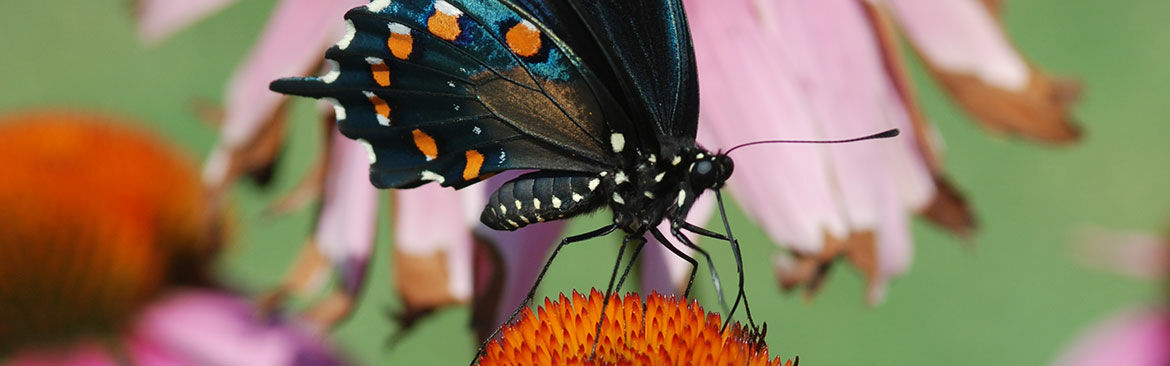
Various predators, including lady beetles, feed
on aphids in alfalfa. Several species of lady beetles will be present,
but all have a similar appearance. The adults of different species will
vary in the number of spots. Adults and larvae will reach a length of about
1/4 inch.
Common Insect Problems
Many different kinds of insects are present in alfalfa,
but fortunately only a few are harmful species. Those that are considered
pests of alfalfa can have a significant impact not only on yield, but also
on hay quality and stand longevity. The alfalfa weevil and potato leafhopper
are two of the more destructive pests. Several other insects also damage
alfalfa but on a less frequent basis. Aphids, meadow spittlebug, and fall
armyworms can cause significant crop losses when conditions favor population
increases. Scouting for these insects should be included in an alfalfa
pest management program.
Alfalfa Weevil
Alfalfa weevils damage the crop by feeding on the leaves and in the
terminals (Figure 5 and figure
6). If this insect is not controlled, losses may exceed 1,000 pounds/acre
on the first cutting. The impact of weevil feeding, however, is even greater
than this first cutting yield reduction. Since the weevil consumes the
leaves, the quality (as measured by crude protein) of the hay is reduced.
In addition, the dam- aged alfalfa stand will usually yield less on the
second cutting as a result of early-season feeding. The stress of weevil
infestations can also weaken the plants so that increased winter kill occurs.
The adult alfalfa weevil is about 3/16 inch long
and has a long snout. It is light brown with a darker stripe down the center
of its back. Larvae grow to a length of 3/8 inch. The head of a mature
larva is black, and the curved body is green with a white stripe down the
center of the back and light stripe down each side. The tiny, oval, lemon-yellow
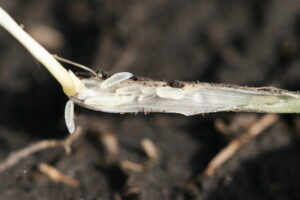
eggs darken to nearly black at hatching time. Alfalfa weevil eggs are laid
in both fall and spring inside the stem through a small puncture hole.
Damage is first done by small larvae feeding between
the folded leaves of die growing tips. Feeding damage from small larvae
may appear as pinholes in newly opened leaves. As larvae mature, feeding
holes become larger, and leaves are shredded and skeletonized. Heavily
infested fields may take on a gray appearance.
Scouting Procedure
Equipment for scouting alfalfa weevil includes a 2- gallon bucket, a
measuring tape, field report form, and a pencil for recording data. A knife
or scissors to cut stems or dig roots is also essential.
Although a fairly effective management program would
result from applying insecticide treatments according to the guidelines
below, variations in weather can cause variation in weevil populations.
By scouting for the alfalfa weevil and treating when weevils exceed the
economic threshold, the grower will gain more accurate insect control.
Potential treatment dates for alfalfa weevil control
vary with location:
|
|
|
|
|
|
|
|
|
|
|
|
|
|
|
|
|
|
|
|
Scouting should begin two or three weeks prior to these dates. Schedule
a scouting visit to each field at least once a week. Computer-generated
predictions for alfalfa weevil egg hatch have been fairly accurate over
recent years. This information should be available from county Extension
agents or state Extension specialists to help determine when larval feeding
begins each year.
In scouting for alfalfa weevil, collect a total
of 30 stems from random points in the field. When selecting a sample stem,
do not choose it by looking. Instead, look away, reach down and randomly
select one. Gently enclose the top of the stem with one hand to prevent
larvae from falling off, then carefully cut the stem at the base of the
plant. This is done to avoid jerking the plant and dislodging any of the
larvae that may be present. Place the cut stem in the bucket, top down.
Then move to the next sample site and repeat the sampling procedure.
When all 30 stems have been collected, beat them
against the inside of die bucket to dislodge the larvae. The very small
larvae are yellowish green with shiny black heads. Older larvae are fight
green with a white stripe down the middle of the back. Be careful to keep
all larvae in the bucket. Count the larvae that have been dislodged. Place
your stems and measuring equipment on a clean, flat surface such as the
hood of an automobile or the tailgate of a pickup truck. Record the following
information for each stem separately:
(a) length of stem, from the beginning of die green tissue at the base
to the end of the growing tip.
(b) stage of growth - that is, vegetative, bud, or flower.
(c) the presence or absence of alfalfa weevil damage to the growing
tip. Inspect tips for the presence of small larvae. Larval damage starts
with tiny holes in the terminal leaves. Later the larvae feed on the edges
of fully expanded leaves.
After all stems have been measured,
(d) figure the average length;
(e) count the total number of larvae in the bucket and add the number
of larvae found in growing tips and larvae dislodged while inspecting stems,
then divide by 30 to determine the average number of larvae per stem;
(f) count the number of damaged stem tips and divide by 30. Multiply
this number r by 100 to determine the percentage of stem tips with feeding
damage.
Economic Threshold
| Plant Length | Number of Larvar Per Stem | Percentage of Damaged Tips |
| Less than 6 inches | 1.0 | more than 50 percent |
| More than 6 inches | 1.5 | more than 50 percent |
Pea Aphid and Spotted Alfalfa Aphid
The pear-shaped pea aphid ranges in color from light
to dark green. Adults measure just over 1/8 inch long. The pea aphids long
legs make it look larger than most aphids. Some aphids may possess clear
wings. The pea aphid overwinters as eggs glued to the stem and to fallen
leaves of alfalfa.
Both adults and nymphs suck juices from alfalfa
leaves, petioles, stems, and flower buds. They prefer young growth and
congregate on the growing tips of plants. Heavy feeding by pea aphids causes
alfalfa to turn yellow and wilt. It Cain also cause stunted plants with
small leaves and spindly stems.
Scouting Procedure.
No specific sampling procedure has been established
for the pea aphid. Scouting may be done when sampling for the alfalfa weevil
by looking for aphids on the same stems. This should be done only after
learning to estimate aphid numbers fairly accurately.
Examine 30 randomly selected stems and count all
healthy aphids on each stem. Shake stems one at a time over a white pan
or sheet to dislodge the aphids. Then examine the stem for any young nymphs
remaining between new leaves. Most aphids will be concentrated on the upper
6 inches of the stem.
Swollen, brown, or gray aphids have been parasitized
and should not be counted. Make note of the parasitized aphids. Parasitism
rates above 10 percent may indicate that the aphids are being suppressed
already to some degree. After aphids from several stems have been counted,
it should be possible to estimate. aphid numbers accurately. Continue to
count aphids per stem from time to time as a check on the accuracy of estimated
numbers.
Using 20 of the stems, calculate average stem length
and percentage in bud or flower. Control decisions should be based on the
maturity of the alfalfa, the size of the aphid population, and the number
of natural control agents present.
The spotted alfalfa aphid, which also overwinters
in the egg stage, is smaller than the pea aphid and pale yellow to green
in color. It is characterized by four to six rows of spots on its back.
Spotted alfalfa aphids can occasionally be a problem
during hot, dry conditions. Sampling methods are the same as for the pea
aphid. However, the economic threshold should be divided by 2 for the spotted
alfalfa aphid. That is, if the pea aphid threshold is 100, then the spotted
alfalfa aphid threshold is 50.
Economic Threshold
|
|
|
|
|
|
|
|
|
|
|
|
|
|
|
|
Potato Leafhopper
Potato leafhoppers damage plants by injecting a toxin
into the plant during feeding. This toxin disrupts some of the internal
processes in the plant and reduces the crude protein content. Reductions
of 3 or 4 percent crude protein frequently occur. This insect is most damaging
in the first two weeks after cutting.
Both adults and nymphs use their piercing, sucking
mouthparts to feed on alfalfa. The feeding process distorts and blocks
the tiny tubes that distribute nutrients within the plant. initial feeding
damage appears as a triangular yellow area of "hopper bum" on the leaf
tip (Figure 7). Heavy feeding can
cause the entire leaf to turn yellow. Heavily infested fields take on a
yellow color (Figure 8). By stressing
and stunting plants, extensive leafhopper feeding can seriously reduce
the quality of the alfalfa harvested.
Potato leafhoppers are slender insects with wedgeshaped
heads. They average about 1/8 inch in length. Adults are green. Nymphs
resemble adults but are wingless and more yellow. Potato leafhoppers overwinter
in the Gulf States and move north as the season progresses. They usually
reach North Carolina in mid to late April, but have been detected as early
as mid-March. Populations usually peak in July to August but may peak as
early as mid-June.
Adults and nymphs are very active. When disturbed,
they can move sideways and backward as rapidly as for- ward. The slender,
white eggs are laid in leaf petioles and veins. Development from egg to
adult takes only three weeks, so populations can build quickly.
Scouting Procedure
Equipment required to scout alfalfa for die potato leafhopper includes
a 15-inch (38-cm) sweep net with a heavy-duty muslin bag, a field report
card for recording results, and a measuring tape.
Begin sampling three to five days after harvesting
the second cutting and maintain a regular sampling schedule because potato
leafhopper populations are very mobile and move easily from field to field.
Sweep samples can be taken at any time during the day when the plants are
not wet. Sweeping wet plants is difficult and will result in unreliable
information.
Start with the net to one side and sweep it through
the foliage from one side to the other in a 180-degree arc. Do this while
walking briskly, so each "half arc" sweep covers a different area. Twenty
sweeps will comprise one set. Complete five sets for each field.
After a set of 20 sweeps has been completed, swing
the net quickly back and forth in the air a few times to force the insects
into the bottom of the bag. Quickly grasp and close the bag 6 to 8 inches
from the bottom. Count all the potato leafhoppers above the closed portion
of the inside of the bag.
Count only the small (1/8-inch or smaller) pale
green to yellow leafhoppers that have no dark or bright markings. Do not
count the potato leafhoppers on the outside of the bag. Be sure to count
and record the number of adults and nymphs separately. When these individuals
have been counted, slowly loosen your grasp on the bag and let those insects
inside the lower portion crawl out. Regulate the number that crawl out
by tightening or loosening the grip on the bag. When no more potato leafhoppers
move out on their own, carefully check the inside of the bag. When all
have been counted, record this total. Turn the sweep net inside out after
each stop.
An alternative technique is to dump the contents of the net into a
clean, 1-gallon zipper-lock plastic bag after counting all leafhoppers
on the net above the closed portion. Leafhoppers can then be counted in
the bag and this number combined with those counted on the upper portion
of the net. To avoid counting leafhoppers in the bag more than once, squash
each leafhopper between your fingers after counting it. Use a new bag for
each stop.
Take a stem sample immediately after the last set of sweeps. Pick 20
alfalfa stems at random as you return to the point of field entry. Do not
visually choose the stem. Place die stems in the sweep net as you collect
them. When this is done, move to the edge of die field.
Record the following information for each stem separately:
(a) length of the stem from beginning of green tissue to die growing
tip;
(b) stage of stem: in bud, whether only buds are present, or if the
stem is in flower;
(c) the percentage of leafhopper nymphs in "comments" section of grower
report. A high percentage of nymphs indicates that the population is increasing.
Economic Threshold
Divide die total number of adult and nymph stage leafhoppers collected by 100 (all 5 sets of 20 sweeps) to calculate the average number of leafhoppers per sweep.
Determine the average stem length.
|
|
|
|
|
|
|
|
|
Fall Armyworm
Fall armyworm larvae reach a length of about 1 1/4
inches. They are smooth-skinned and vary in color from light tan or green
to nearly black with three yellow- white hairlines down the back from the
head to the tail. On the sides and next to the yellow lines is a wider
dark stripe. Next to this is an equally wide, wavy, yellow stripe splotched
with red. Although the fall armyworm resembles the true armyworm, the fall
armyworm usually has a prominent white inverted Y on the front of its head.
This characteristic is not always sufficiently well marked to serve as
a reliable means of identification. The moth lays spherical gray eggs in
clusters, usually on the leaves of host plants, and covers them with a
coating of body scales and hairs. Fall armyworms are usually a problem
from mid- to late season and larvae are active day and night.
Although severe damage to alfalfa is uncommon, heavy
infestations can cause complete defoliation. Fall seedlings are especially
vulnerable. Fall armyworms are most often a problem during dry years. Fields
appearing to be drought stressed may actually be suffering from armyworm
feeding damage and should be checked often. Fall armyworms may move out
of other infested crops into alfalfa fields. Though grasses are preferred,
they will readily consume die tender alfalfa foliage.
Scouting Procedure
Although no specific sampling procedure has been established, die following
is a suggested technique.
Use a frame (I foot by I foot) to measure a known
area for making counts. Either check all tillers and the soil surface or
shake the plants, then check the soil. Count the number of larvae and determine
the number per square foot. Check at least 10 separate areas and average
the results.
Economic Threshold
Treatment is indicated if there is (a) heavy foliage feeding with 10
percent of stems showing signs of feeding or (b) 2 armyworm larvae per
square foot.
Meadow Spittlebug
When fully grown, spittlebug nymphs are about 1/4
inch long. They are yellow to orange and not as narrow-bodied as potato
leafhoppers. As they develop, meadow spittlebugs become more green. Nymphs
five in moist, frothy, spittlelike masses that they secrete. Adults resemble
leaf- hoppers and are 1/4 to 3/8 inch in length. They are pale to dark
brown, and the wing covers are marked with darker spots, stripes, or bands.
Meadow spittlebugs have short, blunt heads with large eyes. Eggs are deposited
in masses close to the ground on weeds, alfalfa, or plant residue. The
eggs are pale yellow-white, oblong, and about 1/32 inch long -
Large numbers of nymphs may cause severe stunting
and yield loss. Adults do not damage alfalfa.
Scouting Procedures
No specific sampling procedure has been established.
Two techniques would work well.
Use a 1-foot-by-1-foot sampling frame and paper
and pencil for recording data. Carefully examine crowns and stems throughout
the field to determine the presence or absence of spittlebug nymphs. Ten
1-square-foot samples should be collected from representative areas of
the field. Count the number of spittle masses in each of 10 areas and determine
the average number per square foot.
As an alternative, examine 50 stems at random in
five different locations and determine the average number of spittle masses
per stem. On cloudy days spittle masses will be found higher on the plant,
while on sunny days the spittle will be down closer to the crown.
Economic Threshold
Treatment is indicated if there is (a) one spittle mass per stem or (b) 25 to 35 per square foot.