5 Scouting for Common Insect Pests 


Aphids

    Aphids (plant lice) are small sucking insects (Figure 21) that colonize small grains early in the season and may build up large populations in the fall or spring. Aphids may occur throughout the growing season, but their numbers are usually lowest in the cold winter months. Damage is done by sucking sap from the plants or by transmitting barley yellow dwarf virus. Large numbers of aphids are necessary to cause damage by removing sap whereas much smaller populations, if they occur in early fall when plants are small, can transmit a serious virus problem. The two aphids most often present in small grains are the English grain aphid and the bird cherry-oat aphid, although several others (e.g. greenbug and corn leaf aphid) may be found occasionally. Aphids are usually kept in check by weather conditions and biological control agents such as lady beetles, parasitic wasps, syrphid fly larvae, and a parasitic fungus. These biocontrol agents are often very abundant and may later move from small grains to other crops.
    Since barley yellow dwarf cannot be controlled by treating for high aphid populations, scouting emphasis is placed on detecting spring populations, which are usually much more abundant than fall populations. However, since plants are actively growing during spring months, they can support many more aphids without injury. Aphids may occur throughout a field and commonly concentrate in "hot spots." These insects are most often found on the foliage but may be found over the entire plant, including in the heads and at the base.

Scouting for Aphids Before Heading
1. Make a minimum of 10 stops in each field.
2. Examine all plants in one row foot for aphids.
3. Counting all aphids is not necessary. Count various small groups of aphids until one is found with about 25 individuals.
Remember what a group of 25 aphids looks like. As individual plants are examined for aphids use die visual image of 25 to estimate the number on each plant. Record the total found. Practice with this technique until visual estimates of numbers are close to counted totals.

Scouting for Aphids After Heading
1. Examine heads while in the milk and dough stages.
2. Counting aphids in heads is impractical, and accurate
scouting requires good skills at estimating aphid numbers. This can be acquired by examining heads closely to form a mental image of aphid numbers and then dissecting heads to determine the actual number of aphids. Practice making estimates of aphid numbers with 10 infested heads, until a reasonably accurate estimate (within 10 percent of the actual numbers) can be made.
3. When scouting commercial fields make 10 stops and examine 10 heads per stop. Record the number of aphids per head and calculate the average population per head.

Economic Threshold

Early spring foliage thresholds are based on plant size and are as follows:
Plant Height (inches) Threshold (avg. number of aphids/foot)_
3 - 6 100
7 - 10 200
11+ 300
    The threshold for head-infesting aphids is 25 per grain head.

Armyworm

    Armyworm infests small grains, usually wheat, from late April to mid-May, and can cause serious defoliation of the flag leaf and head-drop. This insect fluctuates greatly in abundance from year to year and among different areas of North Carolina. Typically, the northeastern counties of the state experience the most consistent armyworm problems.
    Young armyworms are pale green or brown and loop as they crawl. When they become larger (1 to 1 1/2 inch) they are a greenish-brown color with pale white and orange longitudinal stripes. The head is honeycombed with faint dark fines (Figure 22). Armyworm is the only caterpillar found in small grains in large numbers. Armyworm caterpillars are active at night and hide under old corn stalks or other plant litter and at the base of wheat plants during daylight hours. After dark they feed on foliage, beginning from the bottom of the plant and eventually reaching the flag leaf. Large populations of big caterpillars may cause serious defoliation of the plants in a short time. In addition, large caterpillars may also feed on the stem just below the head. This stem feeding can sometimes lead to substantial head drop, usually after defoliation or drying of the foliage.
    Infestations of armyworm are not easily detected by casual observation since the caterpillars hide during the day. Fortunately, several signs of armyworm infestation can be monitored. Black birds (grackles and red-winged black birds) commonly search for armyworms in small grain. Any field that has significant bird activity should be scouted. Armyworm feeding damage and caterpillar droppings can also be good indicators. Feeding is sometimes inconspicuous since small caterpillars do not eat much and feeding signs are low on the plant. When caterpillar populations are large, droppings are more easily seen but should not be confused with die seeds of certain weeds.

Scouting Procedure
    Scout fields weekly beginning in May. Counts need not be made until caterpillars are about 3/8 inch long. Thus, when Scouting early in the month, note the general level of this insect. Once caterpillars are 3/8 inch or larger,   take at least five samples in fields smaller than 20 acres and 10 samples infields larger than 20 acres. For each sample, examine three square feet of area (one strip three feet long containing two drill rows). Look for caterpillars in litter around the base of plants and under old crop residue.

Economic Threshold
    If the average number of armyworm exceeds three larvae (3/8 inch or larger) per stop (three square feet) then treatment should be considered.
 

Hessian Fly

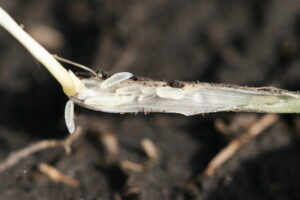
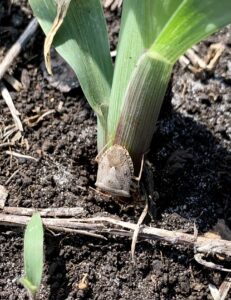
    The Hessian fly has the potential to be a serious pest of wheat. The adult (Figure 23) is a small, long-legged, two-winged insect that resembles a mosquito. The reddish female fly is about 1/8 inch long, while the male is slightly smaller and brown or black in color. Red eggs are deposited on leaves and the newly hatched larvae or maggots are also red for four or five days before turning white (Figure 24). The maggots migrate to the base of the leaf sheath where they feed between the sheath and the stalk for four to six weeks. As larvae mature, a translucent green stripe appears down the middle of the back. When fully grown, the maggot is about 1/4 inch long. The maggot turns into an adult fly inside a dark brown case (puparium) that resembles a flaxseed in size and shape (Figure 25). The puparia, or "flaxseeds," are on the leaf surfaces.
    Fall feeding by maggots, weakens and stunts plants. Stems infested in the spring may die, but they usually lodge before harvest from feeding at the first or second joint. Frequently, the heads are smaller and poorly filled with low quality grains. Chemical control practices are not practical or effective. Reducing the threat of Hessian fly in wheat production depends on cultural practices.

Scouting Procedure

    Since no insecticides control Hessian fly infestation, scouting provides information useful in planning next year's crop rotations. Wheat can be checked just after emergence, but Hessian fly is easiest to detect in the "flaxseed" stage during the late spring, prior to harvest. While checking a field, stop periodically and examine one plant stem. Look underneath the leaf sheath near the lower joints. A sharp knife can be helpful for splitting the stem and peeling back the leaves. Look for the dark brown flaxseed-like puparia containing the larvae. Collect a total of 50 stems from throughout die field, avoiding field edges. Also, note the occurrence of Hessian fly symptoms on the plants.
 

Cereal Leaf Beetle 

    The cereal leaf beetle has been on the increase in recent years and is now present throughout most of North Carolina. Adult beetles are about 3/16 of an inch long with metallic steel-blue wing covers and a rust-colored thorax. Adults usually appear in small grain fields about mid-April. Egg laying occurs during late April and early May. The individually laid eggs hatch in about five days. The brown and yellow grub-like larvae carry a glob of liquid mucus and fecal matter on their backs. They attain a length slightly greater than the adult. In highly infested fields, the mucus on larvae can severely soil the scouts clothing. Peak larval populations usually occur around mid-May. The larvae pupate in the ground and produce the new summer generation of adults as small grains are maturing. Summer adults are inactive most of the summer and in the fall move to wooded areas, hedgerows, and ditchbanks to overwinter.
    The major damage to wheat occurs from larvae feeding on leaves during May (Figure 26). Larvae eat away long strips of leaf tissue between the veins and may skeletonize entire leaves. Loss of the flag leaf is very damaging in small grains, and large numbers of larvae can completely remove the flag leaf tissue from entire fields. Adults emerge from wheat fields as die grain is drying down and are not a threat to the grain. However, adults can migrate to nearby corn fields and feed extensively on border row plants. Cereal leaf beetle feeding on corn is seldom damaging to the crop.

Scouting Procedure

    Scouting for cereal leaf beetle populations can be combined with scouting for head-infesting aphids. Late April and May scouting will detect this insect. As in scouting for aphids, take 10 samples per field, with each sample consisting of 20 individual plants. Examine the flag leaf of each plant and count cereal leaf beetle larvae and estimate the percent of defoliation. Also, note the level of cereal leaf beetle feeding on the lower leaves. Record the results of each sampling stop. Give increased attention to fields with thin stands or weak growth since these are most likely to be infested.

Economic Threshold
 
    Action thresholds depend on the condition of the plants. if the amount of healthy foliage has been reduced by leaf diseases, relatively small populations of cereal leaf beetle larvae may cause economic losses, Thickly planted stands with abundant healthy foliage can tolerate a greater number of beetle larvae without crop loss. Larvae may also feed on plentiful healthy lower leaves without moving to the flag leaf. The primary considerations in deciding whether to apply controls are the level of beetles and the condition of the flag leaf. Emphasis should be placed on protecting the flag leaf. Treatment should be considered in wheat at the level of I larva per flag leaf and in barley and oats at the level of 1.5 larvae per flag leaf.

Cereal Leaf Beetle Parasitoids

    The North Carolina Department of Agriculture is raising larval parasitoids of cereal leaf beetle (CLB) for regional distribution. Beetle larvae parasitized with Tetrastichus (Walker) may be obtained at annual field days. Growers wishing to use this type of biological control should practice no-till or minimum tillage planting, maintain an insecticide-free area, and exercise patience.
    Tetrastichus julis is a very small wasp (less than 1/8 inch long). It overwinters in the soil and emerges in April to lay four to six eggs per CLB larva. The wasps develop inside the larva, which remains on the host plant until it drops to the soil to pupate. The young wasps complete their development in the soil, but the CLB larva dies. Some wasps emerge in June and parasitize late CLB larvae, while others enter diapause and remain in the top 1 to 2 inches of soil until the next spring. Minimum or no-till cropping is recommended to protect this overwintering stage. Beetle control will not occur immediately, but after the parasitoids become established their populations will build up and disperse to other fields while CLB number decrease. Parasitized larvae cannot be distinguished from healthy larvae without dissecting them, but NCDA  personnel can assist with sampling. Site release fields to take advantage of prevailing spring winds to help disperse wasps.
    An area of small grain should be set aside for the establishment of parasitoids. A CLB population of at least 2 to 4 larvae per square foot (20.5 inches of running row) is needed to provide an adequate number r of hosts for the parasitoids. CLB prefers oats, wheat, and barley, (in that order) and prefers spring-planted crops to winter ones. After obtaining the parasitized larvae, scatter them in the field or a fescue border in a comer of the field where prevailing winds will blow emerging wasps toward the cereal leaf beetle. This should also be in the proximity to next year's small grain crop.
    It is critical to leave the soil of the release field undisturbed for 15 to 18 months after planting. Combining or mowing will not harm the wasps. Do not use any insecticides in the release field or where insecticide drift could reach the release field. The grower should be prepared to sacrifice some of the grain to allow the beneficial insects to increase.
 

Back to Table of Contents