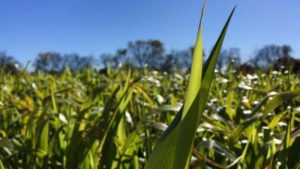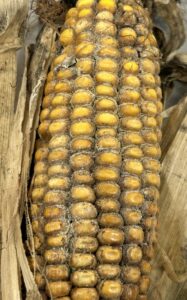
Corn fields provide both food and cover for wildlife. During the summer, deer and other wildlife find cover in corn fields. Untilled fields provide nesting areas for bobwhite quail and other birds. During winter, corn fields that have not been tilled after harvest provide about 300 pounds of spilled grain per acre as a food source. When wildlife such as deer, turkey, and quail have access to this unused grain, they are more likely to survive the winter and successfully reproduce the following spring.
Pesticides used in corn production may harm wildlife living in or around corn fields. They can affect wildlife in two ways. First, when an animal is directly exposed to a highly toxic pesticide, it can become sick or die. A study in North Carolina indicated that more than 30 percent of the quail tested were made sick by one aerial insecticide application. Once sick, wild birds may neglect their young, abandon their nests, and become more susceptible to predators or disease.
Second, pesticides affect wildlife indirectly by reducing food supplies and vegetative cover. Populations of gamebirds are reduced when herbicides and insecticides are intensively used. These pesticides can destroy brood cover and reduce insect and plant foods, lowering the survival rate of gamebird chicks.
Careful selection and use of pesticides, however, can lessen their impact upon wildlife. This publication (1) describes how pesticides used on corn fields can harm wildlife and (2) describes how farmers can minimize adverse effects of pesticides on wildlife.
Tables 1 and 2 list insecticides recommended in the North Carolina Agricultural Chemicals Manual for use on corn. Table 1 rates insecticides according to their toxicities to birds, mammals, and fish. The effects of insecticides on wildlife and fish can be minin-dzed by using the least toxic alternative. Insecticides in Table 2 are rated low, moderate, or high based on the hazard their use presents to wildlife (birds and mammals). The hazard of an insecticide is based on its toxicity to wildlife, the way it is used, and other characteristics, such as its persistence in the environment. For example, methomyl (Lannate) is acutely toxic to birds and mammals (Table 1). However, because methomyl does not persist in the field, careful use of this chemical presents only a moderate hazard to wildlife (Table 2). Wildlife exposed to insecticides rated high may die or become sick. Insecticides rated moderate may also cause death or sickness, although death is unlikely. Insecticides rated low are unlikely to harm wildlife directly.
To reduce the hazard to wildlife from granular formulations:
To reduce danger to wildlife from foliar applications:
Spray drift can be minimized by using application equipment with low drift characteristics, replacing inappropriate or wom nozzles, using appropriate pressure and volume for the chosen nozzle, and adding a drift control agent. Ultra-low-volume sprays are more likely to cause drift than low pressure sprays. Of course, avoid spraying when the wind is blowing faster than 8 mph.
Herbicides can harm or destroy wildlife habitats. Herbicide use can often be reduced by employing IPM practices. Keep records of weed problems and use postemergent herbicides only when needed. New postemergent herbicides (such as Accent or Dimension) may help to reduce costs and the total amount of herbicide needed. When applying herbicides, avoid spraying past the outer row of corn because it wastes chemical and can destroy wildlife habitats.
Also, protecting noncrop areas from herbicides is important. Wildlife, especially small game and song birds, benefit from the cover provided by strip habitats. These strips are linear noncrop areas, such as hedgerows, ditch banks, filter strips, field borders, and fencerows. The vegetation in strip habitats provides wildlife valuable cover for nesting, brood rearing, and escaping from predators. These habitats also allow wildlife safe access to corn fields during winter months when these fields provide a good source of food.
Mowing strip habitats also reduces their value for wildlife. When field borders, filter strips, ditch banks, and other fallow areas are mowed during spring and summer, wildlife cover is reduced. Consider maintaining strip habitats by mowing only once p@r year or less frequently if possible. Mow during early spring only. Mowing alternate sides of strip habitats every other year will ensure that cover will be available to wildlife year-round.
Table 1. Toxicity of Pesticides Used on Corn to
Birds, Mammals, and Fish
____________________________________________________
Pesticide (Brand Name) Birds Mammals Fish
____________________________________________________
carbaryl (Sevin) L L L
carbofuran (Furadan) Hc H H
chlorpyrifos (Lorsban) H L EH
fenvalerate (Asana XL) L L EH
ethoprop (Mocap) Hc M H
fonofos (Dyfonate) H H EH
malathion L L EH
methomyl (Lannate) H H H
methyl parathion Hc H H
permethrin (Ambush, L L EH
Pounce)
terbufos (Counter) H H EH
____________________________________________________
Wildlife hazard is based on the following toxicities:
H(highly toxic) = LD50 less than 30 mg/kg and/or
LC50 less than 500 ppm.
M(moderately toxic = LD50 > 30 mg/kg and <100 mg/kg
and/or LC50 > 500 and < 1000 ppm.
L(low toxicity) = LD50 > 100 mg/kg and LC50 > 1000 ppm.
NT(Not toxic)
Fish 96-hour LC50 toxicities are as follows:
EH(Extremely toxic) less than 0.1 ppm
H(Highly toxic) 0.1 to 1.0 ppm
M(Moderately toxic) 1 to 10 ppm
L(Low toxicity) greater than 10 ppm
To convert fish toxicities to pounds of active ingredient
per acre-foot of water, multiply by 2.7.
c= active ingredient (not necessarily a specific product)
has caused wildlife deaths.
Table 2. Hazards of Insecticides Used on Corn to Wildlife.
______________________________________________________________________________________________________
Insect Insecticide (Brand Name) Wildlife
hazard Kills Comments
_______________________________________________________________________________________________________
Billbugs chlorpyrifos 15G (Lorsban) moderate no Disk under Lorsban at row ends.
(at planting) carboftman 4F (Furadan) high yes
+ ammonium polyphosphate
_______________________________________________________________________________________________________
Billbugs chlorpyrifos 4EC (Lorsban) moderate no Fully incorporate Counter
(postemergence) torbufos 15G (Counter) moderate no granules. Exposed granules
carbofuran 4F (Furadan) high yes are a hazard to birds.
_______________________________________________________________________________________________________
Corn earworm methomyl (Lannate) moderate no
(in whorl) chlorpyrifos 4EC (Lorsban) moderate no
_______________________________________________________________________________________________________
Corn leaf aphid malathion 57EC low no methyl parathion is highly
methyl parathion 4EC high yes toxic to birds.
_______________________________________________________________________________________________________
Cutworms esfenvalerate (Asana XL) low no Directed ground application
(postemergence) permethrin (Pounce, Ambush). low no reduces wildlife hazard.
chlorpofos EC (Lorsban) moderate no Liquid formulation of methyl
methyl parathion (Penncap-M) moderate yes parathion increases hazard.
_______________________________________________________________________________________________________
Cutworms chlorpyrifos 15G (Lorsban) low no Fully incorporate granules or
(preemergence) fonofos 1OG, 2OG (Dyfonate) high no use liquid formulations,
_______________________________________________________________________________________________________
European esfenvalerate (Asana XL) low no Broadcasting Lorsban increases
corn borer permethrin (Ambush, Pounce) low no hazard to birds. Furadan is
(first gen) chlorpyrifos 15G (Lorsban) moderate no extremely hazardous to birds.
methyl parathion (Penncap-M) moderate yes
carbofuran 4F (Furadan) high yes
_______________________________________________________________________________________________________
European permethtin (Pounce) low no Broadcasting Lorsban increases
corn borer chlorpyrifos 15G(Lorsban) high yes hazard to birds.
(Second gen)
_______________________________________________________________________________________________________
Grasshoppers chlorpyrifos EC (Lorsban) moderate no Chlorpyrifos is toxic to fish.
_______________________________________________________________________________________________________
Sod webworm carbaryl (Sevin) low no Safe. Apply to the base of plants.
Chinch bug
_______________________________________________________________________________________________________
True armyworm esfenvalerate (Asana XL) low no Esfenvalerate, permethrin and
Corn earworm permethrin (Ambush,, Pounce) low no chlorpyrifos are extremely
(in whorl and carbaryl (Sevin) low no toxic to fish.
on foliage) methomyl (Lannate) moderate no
chlorpyrifos 4EC (Lorsban) moderate no
_______________________________________________________________________________________________________
wireworms chlorpyrifos 15G (Lorsban) moderate no Fully incorporate granules,
Corn rootworms terbufos 15G (Counter) moderate no including spills at row ends,
carboturan 4F (Furadan) high yes to reduce hazard to wildlife.
fonofos 10G, 2OG (Dyfonate) high no
_______________________________________________________________________________________________________
Wildlife hazards
high indicates possible wildlife deaths;
moderate indicates possible wildlife sickness, deaths less likely;
low indicates sickness unlikely.
Kills
yes indicates wildlife deaths due to use of the insecticide (active
ingredient) have been reported.
no indicates wildlife deaths have not been reported when pesticide
is used according to label.
See also: