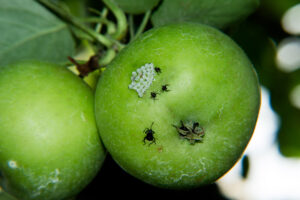
Azalea bark scale. Infested azaleas usually appear chlorotic; the bushes are often covered with a black fungus; and white cottony or matted waxy, thread-like masses may be found in crotches and on twigs.
Azalea caterpillar. The plant is defoliated or has "chewed-up" younger leaves. The length of the caterpillar varies from about 10 millimeters (reddish to brownish black with white and yellow stripes) to about 51 millimeters (black with white or yellow stripes and red head).
Azalea lace bug. The upper surfaces of the leaves are discolored in spots (mottled); the undersurfaces are often dotted with "fly specks" (excrement). Also on the undersurfaces of leaves are adult insects (3 mm long with brown and black markings on lacelike wings) and nymphs (small, dark, and spiny).
Azalea leafminer (leafroller). Brown blisters appear on leaf tips, and margins of leaves are often curled up. The small, yellow caterpillar causing the blisters is not visible because it feeds between the two leaf surfaces.
AZALEA BARK SCALE
Photo courtesy of Dr. Jim Baker, North Carolina State University
Order: Hemiptera
Family: Eriococcidae
Scientific Name: Eriococcus azaleae Comstock
Description The adult female azalea bark scale is dark red with short legs and antennae and long, sucking mouthparts. The insect is hidden from view by the egg sac, a covering of felted or matted waxy threads . The sac is about 3 millimeters long and 1 1/2 millimeters thick.
The egg is laid within the egg sac, occupying the void left by the female's shrinking body.
The tiny nymph hatches from the egg and ventures out of the egg sac. It soon penetrates the bark with its long, sucking mouthparts and begins to feed. The nymph is inconspicuous and practically free of any waxy covering.
Biology
Distribution. The azalea bark scale
occurs in the eastern United States; it has also
been reported in Belgium, Germany, and Russia.
Host Plants. The azalea bark scale has
been found on four azalea species,
rhododendron, "flowering cherry," and
huckleberry.
Damage. Since its discovery in 1881,
the azalea bark scale has become recognized as a
prominent pest of azaleas. Infested plants usually
appear chlorotic and unthrifty. The bushes are
often covered with sooty mold, a black fungus
that grows in the honeydew excreted by the
azalea bark scales as they feed. Eventually twigs
may die back.
Life History. As the female azalea bark
scale matures, it secretes white, waxy threads,
which become felted or matted into a thick
covering over its entire body. This covering is
called the egg sac, where eggs are laid after
mating. As the female lays eggs, its body
shrivels gradually until the egg sac is almost
completely filled with eggs. Eggs are laid in late
April. They hatch in about 3 weeks. This new
generation matures during the summer and
produces eggs in September. Mature females
tend to feed in crotches and on twigs. Adult
males, two-winged and tiny, tend to feed on the
leaves. Azalea bark scales overwinter as nymphs
feeding on the bark.
Control Adult females and eggs are protected by the egg sac from virtually any pesticide. The key to control is treatment in late spring and late fall when the nymphs are present. The current North Carolina Agricultural Chemicals Manual should be consulted for specific chemical controls.
AZALEA CATERPILLAR
Photo courtesy of Dr. Jim Baker, North Carolina
State University
Order: Lepidoptera
Family: Notodontidae
Scientific name: Datana major Grote and
Robinson
Description
Adult. The light-brown moth has a
wingspan of 45 millimeters.
Larva. The partly grown larva (caterpillar) is approximately 10
millimeters long and reddish to brownish black
with white and yellow stripes. The mature
caterpillar is about 50 millimeters long and
black with eight near-white, longitudinal, broken
stripes; the head and legs are mahogany red.
Biology
Distribution. Azalea caterpillars are
serious pests of azaleas in the Southeast:
Virginia, the Carolinas, Florida, Alabama,
Mississippi, and Louisiana.
Host Plants. An important pest of
azaleas, azalea caterpillars have also been
reported on blueberry in Delaware, on red oak in
Maryland, and occasionally on Andromeda and
apple in Atlantic states.
Damage. The caterpillars often
defoliate much of the plant before they are
detected.
Life History. The azalea caterpillar is
gregarious, feeding in groups; all members raise
head and posterior in unison when disturbed.
Comparatively little is known about the biology
of this insect. Apparently there is only one
generation per year. Eggs are deposited by the
female moth in masses of 50 to 100 on the
underside of the leaf. The first-instar caterpillars
feed in a cluster side by side unless disturbed.
Most of the damage occurs in August and
September.
Control Because the caterpillar is harmless to humans, it can be removed by hand. For specific chemical controls, see the current North Carolina Agricultural Chemicals Manual for recommendations.
AZALEA LACE
BUG
Photo courtesy of Dr. Jim Baker, North Carolina State University
Order: Hemiptera
Family: Tingidae
Scientific Name: Stephanitis pyrioides (Scott)
Description
Adult. The small adult, 3 millimeters
long and 1.5 millimeters wide, has lacy wings
with brown and black markings, and light-brown
legs and antenna.
Egg. The smooth, white egg, which
measures approximately 0.4 millimeters by 0.8
millimeters, is flask shaped with the neck to one
side. It is usually deposited in the tissue of a
young leaf along the midrib or a large vein. Each
egg is inserted in the tissue with its neck slightly
above the leaf surface. Up to 90 eggs have been
found in a single leaf. Most of them are placed
irregularly along the midrib.
Nymph. Commonly found on the
underside of a leaf, the nymph is almost
colorless at birth but soon turns black and spiny.
It molts six times and ranges in size from 0.4
millimeters to 1.8 millimeters before becoming
an adult. After the fourth molt, wing pads show
distinctly.
Biology
Distribution. In the United States, the
azalea lace bug occurs from New York and
Massachusetts southward into Florida and
Alabama.
Host Plants. The evergreen azalea
varieties are preferred by azalea lace bugs,
although the deciduous varieties may be
attacked. Mountain laurel is also subject to
infestation.
Damage. Injury is caused by the
nymphs and adults as they extract sap from the
undersurfaces of the leaves. The damage shows
as spotted discoloration of the upper surfaces of
the leaves. In severe infestations, the leaves
become almost white, many of them drying
completely and dropping off. The undersides of the
leaves are also disfigured by the excrement and
cast skins of the insects.
Life History. Since its introduction from
Japan in the early 1900's, the azalea lace bug has
been recognized as an important pest of azaleas.
Female lace bugs lay groups of eggs on the
undersides of the leaves, most often along the
midribs. This egg-laying takes place over an
average period of 2 weeks. These eggs require an
average of 2 weeks for hatching.
Colorless at first, the spiny nymphs hatch from the eggs, gradually darken, and go through five growth stages before becoming adults. Because of the extended oviposition period, it is quite possible to find all stages together on the undersides of the leaves at the same time. Usually two or more generations are produced in a year. The insect overwinters in the egg stage. In the South these overwintered eggs start hatching in late February, building up to a dense population during March, April, and May. A second brood comes along in July, August, and September. During early August eggs are laid. By the middle and last week in September, many adults of this brood are present, the overwintering eggs are deposited at this time and during the first part of October.
Control Repeated applications of some insecticides may be needed to control lace bugs effectively. The first application should be made as soon as nymphs appear in the spring and be followed with a second application 7 to 10 days later, if needed. Applications should be repeated as needed at monthly intervals. Thorough coverage is essential when applying sprays if good control is to be expected. The undersides of the leaves must be covered. The current North Carolina Agricultural Chemical Manual can provide recommendations for chemical controls.
AZALEA
LEAFMINER DAMAGE
Photo courtesy of Dr. Jim Baker, North Carolina State University
Order: Lepidoptera
Family: Gracillariidae
Scientific Name: Caloptilia azaleella (Brants)
Description
Adult. The adult azalea leafminer is a
small, yellow moth with purplish markings on
the wings. The wingspan is about 10 to 13 mm.
Larva. The leaf-mining larva is yellowish and about 13 mm
long. It has three pairs of prolegs found on
abdominal segments three, four, and five. The
proleg hooks (crochets) are singly arranged in a
U-shaped pattern (penellipse) with series of
crochets within the pen.
Biology
Distribution. The azalea leafminer is
found in most states where azaleas are grown.
Host Plants. Azaleas are the only
known hosts for this insect.
Damage. This leafminer larva has little
effect on plants grown outdoors, but it may do
considerable damage to cuttings in the greenhouse. Mining within the leaf, the young larva
causes the formation of brown blisters on the leaf
surfaces. As the larva matures, it emerges and
rolls the edge of a leaf around itself for
protection while feeding on the leaf surface.
Seriously injured leaves usually turn yellow and
drop, thereby causing an unsightly plant.
Life History. Eggs are deposited singly
on the undersides of leaves along the midribs,
usually one to five per leaf. The young (larvae)
hatch in about 4 days, mine into the leaves, and
feed inside them. At this stage, the leaves appear
to have blisters. If a leaf is held up to the light,
the larva can be seen inside. When about one-third grown, the larva emerges, moves to the tip
of a new leaf, and rolls it up for protection while
feeding and growing. When nearly grown, the
larva rolls up the margin of a leaf and spins a
cocoon inside. The moth emerges from the
cocoon, mates, and deposits eggs for another
generation.
Under greenhouse conditions, the larvae
may be found at any time during the year. The
insect overwinters outdoors as a larva or pupa.
Adults appear and females begin to lay eggs
about the time plants bloom in the spring.
Control Because the larva protects itself by mining into and rolling the leaf, this insect is not easy to control. Several insecticide-spray mixtures have yielded satisfactory control when applied at the first sign either of the adult moth or of foliar injury by the larva. One or two applications, 1 to 2 weeks apart, are usually sufficient. The current North Carolina Agricultural Chemicals Manual should be consulted for current recommendations on chemical control.
AZALEA STEM
BORER
Photo courtesy of Dr. David Alverson, Clemson University
Order: Coleoptera
Family: Cerambycidae
Scientific Name: Oberea myops Haldeman
Description. Azalea stem borers are slender, long-horned beetles about 1/2 inch long, with yellowish brown heads and thoraxes. The wing covers are yellowish gray with dark outer margins, and there are two black spots on the thorax. The eggs, which have been described as "yellow," occur under the bark. The grub, found inside the stem, is slender, yellow, and legless.
Biology. The azalea stem borer is found throughout the eastern United States wherever azaleas and related plants grow. Azalea stem borers infest azalea, rhododendron, blueberry and mountain laurel.
Infested twigs wilt and die as the larvae bore downward inside. Later in the season, infested stems often break off at the base, leaving the plant lopsided and unattractive. Small plants may break off completely.
Adult azalea stem borers emerge from mid-May through June. Eggs are inserted under the bark between two rows of holes chewed through the bark about 1/2 an inch apart. The larva hatches and bores down the twig into the stem and eventually all the way to the crown of the plant. The stem is greatly weakened at the base. The larvae then bore down into the roots where they spend the winter. Coarse sawdust-like frass is expelled through holes in the bark of the stem and at the base of the plant. Infested twigs wilt as the larva bores downward inside. The larvae pupate the following spring.
Control. Cutting off and burning infested stems as soon as they are noticed in the growing season is recommended for control. If shrubs have been reinfested year after year, it is probably necessary to protect the plants with an insecticide. Pesticides should give adequate control if applied in spring after the new growth has emerged and hardened off somewhat in mid-May and again in early June. The current North Carolina Agricultural Chemicals Manual should be consulted for current chemical recommendations.
OVIPOSITION DAMAGE
BY AZALEA STEM BORER (left)
Photo courtesy of Dr. Jim Baker, North Carolina State University
AZALEA STEM BORER LARVAE
DAMAGE (right)
Photo courtesy of Dr. Jim Baker, North Carolina State University
Return to Azaleas
Send comments, questions to WebManager at
webmail@ncsipm1.cropsci.ncsu.edu