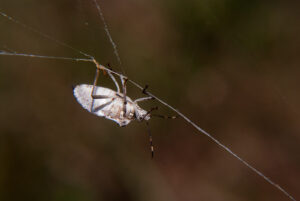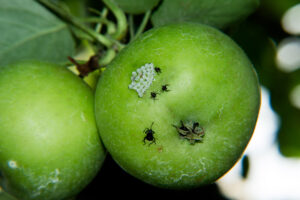
(Fig. 164A to C) and (Fig. 165A to C)
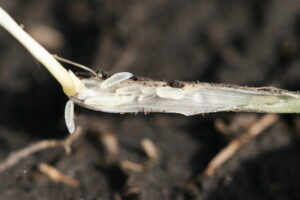
2. Soybean stem borer. This white, legless larva (Fig. 168B) ranges in length from 1.5 to 15 mm. It bores in the pith of the soybean stem, girdling it from the inside and sometimes causing the plant to lodge at harvesting.
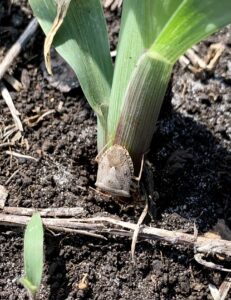
3. Threecornered alfalfa hopper. This green wedge-shaped bug (Fig. 168C) is 6.0 to 6.5 mm in length when mature. It girdles the stem by puncturing it with its "beak" to suck sap and by ovipositing within plant tissues. Stems may lodge or break easily before mature.
Adult. Though the adult varies greatly in color and markings, it is typically reddish-brown to yellowish with black margins and about 5 to 6 mm long. Each wing cover usually, but not always, is marked with three black spots. All bean leaf beetles, however, have a black, triangular-shaped spot on the forward margin of the wings.
Egg. The lemon-shaped egg is orange and about 0.85 mm long.
Larva. The larva is basically whitish with both ends colored dark brown. Conspicuously segmented, it has six tiny legs near the head. It grows to a length of about 10 mm.
Pupa. The pupa is soft-bodied, white, and about 5 mm long.
Distribution. The bean leaf beetle is abundant in the southeastern states particularly in the coastal counties. Its range, however, extends into Canada, New York, Minnesota, Kansas, Texas, and New Mexico. The insect appears to prefer poorly drained clay and organic soils.
Host Plants. Hosts of the bean leaf beetle include bean, clover, corn, cowpea, soybean, peanut, and several leguminous weeds.
Damage. Damage to soybeans appears to be due primarily to the foliar- feeding adults. Bean leaf beetles prefer the youngest plant tissue available; when vegetative growth terminates, they will consume tender pod tissue. Pod damage is usually limited to the outer layers of the pod, the developing seeds being infrequently attacked. In North Carolina, damage is usually greatest in the eastern coastal counties from July through September though some seedling damage may occur on early planted soybeans. In addition to the beetles' direct attack, the adults are also known vectors of the bean pod mottle, cowpea mosaic, and southern bean mosaic viruses.
Life History. Adults overwinter in leaf litter or other vegetation, primarily in wooded areas. They become active in April and move to the earliest host plants available. In the southeastern United States, beetles do not usually attack soybeans until early May. They feed voraciously for several days and then mate. Each female lays 175 to 250 eggs in clusters of 12 to 24 in the soil at the plant's base. Eggs hatch in 1 to 3 weeks, depending upon the temperature. The larvae find their way to the base of the stem or roots and feed there for 3 to 6 weeks. Mature larvae form earthen cells within which the pupae form. In southern states, peak periods of adult activity generally occur the last of May, the last of July, the second and third weeks in August, and the second and third weeks of September. Second generation beetles overwinter in North Carolina.
When defoliation reaches the economic threshold (35 percent foliage loss before bloom or 15 percent foliage loss after bloom), consult the current North Carolina Agricultural Chemical Manual.
Beet Armyworm Figures Adult. The beet armyworm moth has a wingspan of 25 to 32 mm. Its forewings are mottled gray or brown with a pale spot near the center of each wing. Its hind wings are white with dark veins and have a fringelike border.
Egg. The white to pink, ribbed egg is roughly spherical in shape and slightly peaked on top. Scales and hairs from the moth give the egg cluster a gray, fuzzy appearance.
Larva. This green or black caterpillar has a dark head, five pairs of prolegs, and sometimes three light colored stripes running the length of the body. On the second segment behind the head, there is a small, black spot on each side of the body. This spot usually becomes visible to the field observer when the caterpillar reaches 7 or 8 mm long; however, the spot may be difficult to see on a dark caterpillar. About 1 mm long when newly emerged, a larva may be 25 to 30 mm long when fully grown.
Pupa. About 15 to 20 mm long, the pupa is light brown with dark brown margins along the abdominal segments.
Distribution. Native to the Orient, the beet armyworm is practically a cosmopolitan species. It is common throughout the southern and western United States and occurs northward into Montana. As a pest of soybeans, it is most damaging from the Mississippi delta area eastward to Florida and northward to North Carolina and southern Virginia. This insect is a sporadic pest of North Carolina soybeans in both time and space.
Host Plants. The beet armyworm infests many weeds, trees, grasses, legumes, truck crops and field crops. It is of economic concern upon cotton, corn, soybean, tobacco, alfalfa, table and sugar beets, pepper, tomato, potato, onion, pea, sunflower and citrus. In addition, plantain, lambsquarters and redroot pigweed are attractive wild hosts.
Damage. Early instar beet armyworms most frequently damage the young terminal growth of seedling soybeans. Skeletonization and, often, a profuse silk webbing which gives the plants a shiny appearance are characteristic of this species. Although soybean plants can compensate for much foliage loss before bloom, severe beet armyworm damage will retard plant growth. Later instars do not feed gregariously and the production of webbing is discontinued.
Life History. In warm areas, such as Florida and California, the beet armyworm moths may be found year round. In less tropical areas, these insects can survive the winter as pupae in the upper 6 cm of the soil. The extent of overwintering distribution, however, has not been adequately studied. At any rate, this insect is not believed to overwinter as far north as Kentucky or North Carolina. Most states apparently become infested by migrating moths. In the spring, soon after mating, fertilized females begin laying eggs in clusters of about 80. Approximately 600 eggs per female are deposited over a 3 to 7 day period. Moths die 4 to 10 days after emerging from pupae.
Eggs hatch in 2 to 3 days. The newly emerged larvae spin loose webs around themselves, feed gregariously on the remains of the egg mass, and then attack plant foliage. They eventually scatter to different parts of the plant. After feeding for 1 to 3 weeks, larvae (fifth instars) pupate within loose cocoons composed of soil particles, leaf fragments and trash. About 1 week later moths emerge. The entire life cycle requires 4 to 5 weeks. Several generations occur each year.
The beet armyworm has few effective parasites, diseases, or predators to lower its population and is resistant to some insecticides. Therefore selection of the proper material and rate is very important when chemical control is considered. When defoliation reaches the economic threshold of 35 percent foliage loss before bloom or 15 percent foliage loss after bloom, consult the current North Carolina Agricultural Chemical Manual.
Adult. Blister beetles are slender insects 12 to 19 mm long. They have prominent heads and may be black, gray with black spots, or black and yellow striped.
Egg. The yellow, cylindrical eggs are 1.3 to 1.8 mm long.
Larva. Each of the seven larval instars differs in size, shape and color. They can be 2.5 to 13 mm long, slender to plump, and white to yellow or brown. All instars have 3 short pairs of ventral legs and 12 body segments, excluding the head.
Pupa. The white, 10 mm-long pupae darken gradually beginning with the eyes.
Distribution. Blister beetles are found throughout the continental United States and the agricultural areas of Canada. Although fairly common in North Carolina, they are not often important pests.
Host Plants. Blister beetles have a wide host range. Some economically important agricultural hosts include alfalfa, sweet clover, soybean, potato, tomato, melon, cotton, and eggplant.
Life History. Blister beetles have an unusual life cycle. They usually overwinter as sixth instar larvae 2.5 to 4 cm deep in the soil. In the spring, resting larvae molt into active, nonfeeding larvae which soon pupate. Adult blister beetles begin to emerge in June. Adults can be found well into September but are most abundant in July. During the summer months, they congregate and feed voraciously on foliage or flowers (depending upon the particular species). Two to three weeks after mating, each female deposits up to six egg masses in the soil. These masses may contain 50 to 300 eggs each. Active larvae hatch from the eggs 1-1/2 to 3 weeks later and search for grasshopper egg cases. A few days after locating and feeding on the eggs, the active larvae molt and become fairly inactive. The grubs continue to feed and molt until they are fat, almost legless, fifth instars. These larvae create oval, hibernating chambers in the soil, molt into sixth instars, and overwinter. Development usually continues the following spring but the larvae may remain inactive for as long as two years. Sometimes the fifth instar larvae molt directly into the pupal stage, bypassing the last two larval instars. As a general rule, however, blister beetles complete one generation each year.
Control of blister beetles in soybeans is seldom necessary. Only when foliage loss exceeds 35 percent prebloom or 15 percent postbloom are controls justified. Spot applications are usually adequate to divert loss. For control recommendations, consult the current North Carolina Agricultural Chemical Manual.
Adult. The corn earworm moth has a wingspan of 25.5 to 38.5 mm and is usually light yellowish-olive in color. Each forewing has a dark spot near the center. Eyes are usually light green.
Egg. The dome-shaped egg, about 0.5 mm in diameter, is pale white when first laid and develops a reddish-brown band before hatching.
Larva. The five to six larval instars vary greatly in color. Newly hatched larvae are about 1.5 mm long and yellowish-white with dark head capsules. Second instars are yellowish-green and frequently have orange and brown longitudinal stripes; their head capsules are reddish-brown or brown. Up to 44 mm long, later instars are greenish-yellow, reddish or brown with pale, longitudinal stripes, raised black spots (chalazae), and brown to orange heads. All instars have five pairs of fleshy prolegs.
Pupa. About 31.4 mm long and 6 mm wide, the pupa is reddish-brown to dark brown.
Distribution. This insect is found throughout most of the Western Hemisphere. It is a major soybean pest in the southern United States and has been found as far north as Saskatchewan. It has recently been introduced into the Hawaiian Islands. The most severe damage in North Carolina annually occurs in the Coastal Plain area.
Host Plants. During late summer, soybeans become one of the corn earworm's primary host crops. In North Carolina, late planted soybeans of maturity group VI and beans of groups VII or VIII are most likely to be moderately or severely damaged by corn earworms. Early maturing beans and beans with closed canopies usually have fewer larvae per unit area. See the corn earworm note (CORN/SORGHUM section) for more details concerning hosts.
Damage. Young larvae feed on flowers and tender foliage. Soybean defoliation by corn earworms is a problem typically confined to some areas of the South, and occasionally, the East Coast. This injury normally occurs on late- maturing varieties prior to seed enlargement.
Later in the season, corn earworms prefer to feed on soybean pods, often causing a serious yield loss. During heavy infestations (20 or more large worms per meter of row, or six or more per foot of row), most pods may be destroyed, forcing the larvae to become foliage feeders. Entire 8-hectare fields (roughly 20 acres) have been stripped of pods and foliage during such heavy infestations.
Life History. Overwintering and spring development is the same as in the other crops which serve as hosts for this insect (see CORN/SORGHUM section). However, after most corn ears begin to dry (late July), the female earworm moths deposit their eggs on other crops. Soybean, sorghum, peanut and cotton are preferred host crops at this time of year. In soybean fields, earworm eggs are laid largely on tender terminal foliage and near the blooms. Young larvae feed on the developing leaves, flowers, and pods. As the larvae develop, they feed more heavily on the pods. During heavy infestations all pods may be removed, forcing the larvae to complete development on the leaves. Soybean fields which are blooming and have an open foliage canopy during years with heavy moth flights are most likely to have damaging infestations. Apparently, this situation occurs because both egg-laying and larval development are increased under these conditions.
Not all soybean fields are heavily damaged by corn earworms. Therefore, scouting to determine the extent of the problem should be an integral part of earworm control in soybeans. In most southern states, insecticides are not applied until there are six or seven medium to large earworms per meter of row (two per foot of row). For specific information on insecticides and rates, consult the current North Carolina Agricultural Chemical Manual.
Adult. The oval, yellowish-brown beetle is 4 to 5 mm long. The wing covers appear striped due to the presence of longitudinal rows of shallow indentations.
Egg. The smooth, white to yellow egg is about 0.6 by 0.25 mm.
Larva. Measuring up to 7 mm long, the grayish-white or tan larva has a dark brown head and prothoracic shield. It is stout and grub-like in form with three pairs of legs near its head and fleshy appendages on the abdominal segments.
Pupa. Whitish at first, the 4 mm-long pupa gradually darkens.
Distribution. Fairly common in the eastern states, the grape colaspis occurs westward into Arizona and New Mexico and south into northern Alabama. Though prevalent in North Carolina, large populations most frequently occur in poorly drained, organic, or non-rotated fields.
Host Plants. The adult beetles are very general foliage feeders, and in most cases, the larvae feed on roots of the same plants. Soybeans and lespedeza seem to be preferred food plants of the adults. Other hosts (of both larvae and adults) include grape, snap bean, red and white clover, strawberry, corn, timothy, okra, beet, and the weeds dock and smartweed.
Damage. Colaspis beetles consume foliage but rarely do any appreciable damage. When large populations of larvae develop, however, damage much like that done by nematodes occurs. Larvae eat lateral roots and the soft outer tissues of underground stems. This injury becomes evident above ground as areas of yellow, stunted plants develop.
Life History. The grape colaspis overwinters in the soil as third through eight instar larvae. In spring, feeding and development resume. Most larvae pupate within 3 cm (1.5 inches) of the soil surface for a period of 3 to 7 days in June. By late June, most adults have emerged. The beetles mate several times and feed on legumes for 3 to 5 days before eggs are laid. Each female deposits approximately 75 eggs, usually in masses of about 36, near the roots of food plants. In North Carolina, only one generation is completed each year.
The grape colaspis is common in North Carolina soybean fields but rarely requires control. Since this pest thrives best on legumes, low populations can be maintained by rotating soybeans with crops like corn. Even though corn is a host plant of the colaspis, it is not a preferred host and, therefore, can still be beneficial in a rotation with soybeans.
Adult. The dark brown or black moth has spotted or mottled wings and a wingspan of about 31.5 mm.
Egg.The light green egg is hemispherical, measuring about 0.5 mm in diameter.
Larva. Varying in length from 1.5 mm (first instar) to 30.5 mm (sixth instar), the larva is pale green and often with two white, longitudinal stripes on each side. It has four pairs of prolegs and thrashes violently when disturbed.
Pupa. The pupa is dark brown and about 13 mm long.
Distribution. The green cloverworm is found from the eastern United States westward into the Great Plains states and northward into southeastern Canada. It occurs in practically every soybean field from Illinois and Maryland south at some time during each growing season.
Host Plants. The green cloverworm attacks alfalfa, bean, clover, cowpea, soybean, strawberry, vetch, many common weeds, and other legumes.
Damage. Although common throughout the soybean-growing areas of the eastern United States, the green cloverworm seldom reaches pest status. This caterpillar may defoliate soybean plants and, in some cases, warrants chemical control. Because it attacks early in the season, however, plants usually compensate for foliage loss before pods are set. Many entomologists consider the green cloverworm a valuable food source for beneficial insects and diseases. This reservoir of beneficials often controls pests of more economic importance later in the season.
Life History. Green cloverworms overwinter either as pupae or adults. In spring, moths become active about the time clover becomes abundant. After mating, the females lay their eggs singly on the underside of the host plant's leaves. Eggs usually hatch in less than a week. After feeding for about 4 weeks, larvae drop to the ground, burrow into litter or soil, and pupate. The pupal stage lasts about 10 days. Three to four generations per year occur in North Carolina. Larvae appear on soybeans during early July, peak in mid-August, and decline by late September.
Beneficial insects and diseases usually regulate the green cloverworm population below economic injury levels in most areas where soybeans are grown. When defoliation exceeds the economic threshold (35 percent foliage loss before bloom and 15 percent foliage loss after bloom or during pod bill), chemical control is recommended. For specific control information, consult the current North North Carolina Agricultural Chemical Manual.
Japanese Beetle Figures
DESCRIPTION
Approximately 13 mm long, the Japanese beetle has a metallic
green body and coppery wing covers. There are 12 tufts of white hairs bordering
the margin of the wing covers.
Egg. Each white, translucent egg is almost spherical in shape and approximately 2 mm in diameter.
Larva. The white, C-shaped grub has a dark brown head capsule and three pairs of legs. Although it is only 2 mm long when it first hatches, the grub may reach a final length of 32 mm. A V-shaped arrangement of setae on its anal segment distinguishes Japanese beetle grubs from similar species.
Pupa. The 13 mm-long, cream to tan colored pupa resembles the adult in appearance except that the appendages are pressed close to the body. It becomes metallic green just before the adult emerges.
Distribution. Since 1916, the Japanese beetle has become established from southern New Hampshire and Vermont southward into North Carolina and westward into Ohio and West Virginia. Scattered local populations have been reported in Indiana, Illinois, Tennessee, Kentucky, Michigan, Iowa, Missouri, California, South Carolina, Georgia, Maine, Ontario, and Nova Scotia. Although seldom economically important on soybeans, this beetle has caused severe defoliation in Maryland, Indiana and Illinois.
Host Plants. The list of Japanese beetle host plants is seemingly endless. Commonly attacked hosts include: cultivated and wild grapes, raspberry, peach, plum, rose, apple, cherry, corn, soybean, Virginia creeper, hibiscus, marshmallow and Indian mallow, hollyhock, dahlia, zinnia, elm, horsechestnut, linden, lombardy poplar, willow, crepe myrtle, bracken and sensitive fern, elder, evening primrose, sassafras, and smartweed.
Damage. Japanese beetles are voracious foliage and fruit feeders. Feeding in June and July causes little injury to soybeans because the plants can compensate for 35 percent or greater foliage loss. Foliage loss greater than 35 percent may occur in spots 0.4 hectares (1 acre) or less in size. Damaged foliage is characteristically ragged, with only the larger leaf veins intact. Stringy, black excrement is also present.
Japanese beetle injury poses a threat from mid-July until August. After this period, the population naturally declines. The beetles have so many host plants that they rarely confine themselves to soybeans.
Life History. Japanese beetle grubs overwinter as third instars within 13 cm of the soil surface. As the soil warms in the spring, the grubs move closer to the surface and feed on fine rootlets. Shortly thereafter, they remain inactive for a 10-day period prior to pupation. After a pupal stage of 8 to 20 days, adults emerge. Emergence usually begins in mid-May in North Carolina and as late as July in Maine. On warm days the beetles fly and often congregate on host plants to feed and mate. In the afternoon, females burrow into loose, moist soil (usually in sod), and deposit one to four eggs. Over her 1.0 to 1.5 month life span, each female produces 40 to 60 eggs. Grubs emerge 2 weeks after egg deposition, feed on rootlets, and remain active until cold weather arrives. In North Carolina, a single generation is produced annually.
Populations of this pest are cyclic. Dry weather, natural enemies, and diseases, particularly milky spore disease, help keep populations below economically damaging levels. Should defoliation of 35 percent prior to bloom or 15 percent during bloom (or pod fill) occur, control is warranted. Spot applications are usually adequate to divert loss. For further control information, consult the current North Carolina Agricultural Chemical Manual.
Adult. The dome-shaped, copper colored adult varies from 6 to 8.0 mm long. Each wing cover has eight small, black spots that form three rows across the body when the wings are at rest.
Egg. The yellow egg is about 1.3 mm long and elliptical in shape.
Larva. The yellow larva is about 8.5 mm long and covered with dark, branched spines.
Pupa. The yellow or copper colored pupa is about 6 mm long. It moves very little, has fewer spines than the larva, and is most commonly found on the lower half of the soybean plant.
Distribution. A native of Mexico, the Mexican bean beetle is now present throughout the United States except in the Pacific Coast states. Damage to soybeans has been most prevalent along the East Coast from Maryland south to Georgia, in southern Indiana, and in some parts of Kentucky. In North Carolina, the Mexican bean beetle occurs on soybeans throughout the growing season.
Host Plants. The Mexican bean beetle feeds readily on many varieties of beans (bush, soybean, lima and pole) but may also infest other plants such as alfalfa, clover, cowpea, and kudzu.
Damage. On soybeans, larvae and adults feed between the veins on the surface of leaves, leaving a lacy network of the tougher leaf tissues. These remaining tissues die in about 2 days and turn brown. Fields seriously damaged by this beetle often have a brown or "burnt" cast.
Life History. Mexican bean beetles overwinter as both mated and unmated adults under litter and other rubbish in hedgerows, ditch banks, and woods. Emergence usually begins in March and increases until April or mid-May in most southeastern and mid-Atlantic states. After a feeding period of 7 to 10 days, females begin to lay groups of 40 to 60 eggs on the underside of leaves. Each female may lay an egg mass every 2 or 3 days, producing an average of 460 eggs. Oviposition by overwintering females lasts about 18 days. In spring, eggs hatch in 10 to 14 days, while in summer they hatch in 5 or 6 days. There are four larval instars which require about 35 days for development. Mature larvae transform into the pupal stage, which lasts from 7 to 20 days. New females begin laying eggs within 8 to 13 days after emergence. There are three generations per year in North Carolina.
Several cultural practices aid in Mexican bean beetle control. Crop residue destruction, usually by plowing it under at least 15 cm, destroys all stages of the beetle. Rotation (in large blocks), resistant varieties and good early season growth are very important in the management scheme for this pest. When defoliation exceeds the economic threshold (35 percent foliage loss before bloom and 15 percent foliage loss after bloom), consult the current North Carolina Agricultural Chemical Manual.
Adult. The soybean looper moth has mottled brown forewings with a golden sheen and prominent silver markings near the center. The hind wings are dusky brown. The wingspan ranges from 30.0 to 39.0 mm.
Egg. The egg is small, round, and greenish-white.
Larva. This green caterpillar may or may not have pale, longitudinal stripes and small dark spots. The thick body of the looper gradually narrows from the rear to the small head and has three pairs of prolegs. The sixth instar may be as long as 35 mm.
Pupa. The pupa of the soybean looper is creamy white or greenish-white with irregular, black spots. Its length is approximately 16.0 mm.
Distribution. The soybean looper is found in all areas of the United States where soybeans are grown. However, damaging infestations rarely occur north of Tennessee and North Carolina.
Host Plants. The preferred hosts of the soybean looper are soybean, sweet potato, and peanut. Other hosts include cotton, tomato, crucifers, pea, tobacco, and cocklebur.
Damage. In the Southeast, soybeans are attacked by both cabbage loopers and soybean loopers, but over 90 percent of these are usually soybean loopers. Although loopers infrequently cause pod damage, they are capable of inflicting heavy foliage losses. Defoliation by these pests leaves the plants with a ragged appearance. In North Carolina, damage usually results after a prebloom insecticide application removes most of the looper's natural enemies. Soybean loopers are difficult to control with insecticides.
Life History. In North Carolina, soybean loopers have three or four generations a year. They overwinter as pupae within loosely spun cocoons which are usually attached to plant debris. Soon after adults emerge in the spring, each mated female begins laying an average of 640 eggs, singly, on the upper surface of the host plant leaf. The larvae, which emerge approximately 3 days later, pass through six instars in 2 or 3 weeks. The caterpillars then enter a pupal stage which lasts 1 week during the summer. In North Carolina, looper populations reach a peak in August or September.
Prior to full bloom, chemical control should be employed only if a foliage loss of 35 percent occurs, regardless of the defoliating pest. Fields treated with insecticides prior to bloom have a higher risk of soybean looper infestation than untreated fields. After full bloom, a foliage loss of 15 percent constitutes an economic threshold. For specific control information, consult North Carolina Agricultural Chemical Manual.
Soybean Stem Borer Figures Adult. The adult is about 15 mm long with a dark gray, elongate body. The antennae are longer than the body and lie parallel to the body when at rest.
Egg. The yellow egg is elongate, narrowed at both sides, and about 1.5 mm long.
Larva. There are four larval instars varying in length from 1.5 to 15 mm. The larval body is spindle-shaped, creamy white, legless and appears corrugated.
Pupa. The pupa, about 15 mm long, is yellowish when first formed but later turns dark brown.
Distribution. In North Carolina, the soybean stem borer was first recognized as a pest of soybeans in Beaufort County during 1968; presently it damages soybeans in at least 10 North Carolina counties, primarily the Tidewater counties. It is also considered a pest of soybeans in the following states: Arkansas, Louisiana, Alabama, Missouri, and Tennessee.
Host Plants. Known hosts of the soybean stem borer include cocklebur, ragweed, several other weeds, and soybeans.
Damage. There is some evidence that a small yield decrease may result from larval feeding within the plant; however, most damage occurs when the immature borer cuts the plant stem from the inside. The insect-induced lodging is most severe on early-planted soybeans, especially in fields where soybeans were grown the previous season and where soybeans are not harvested soon after maturity.
Life History. This pest overwinters in North Carolina as mature larvae within tunnels in the stubble of soybeans, ragweed, cocklebur, and other weeds. Pupation occurs in late spring, and adults (beetles) emerge in early summer. About 5 days later, the beetles mate. Within 10 to 14 days, the females lay eggs in cavities along leaf petioles which have been chewed out by the beetles. When the eggs hatch, the larvae tunnel through petioles into the stem and feed on pith tissues until cold weather begins. Only one larva will mature in each soybean stem. This is apparently the result of cannibalism.
This pest is very difficult to control chemically. Deep plowing and rotation are effective. For further information, contact the North Carolina Agricultural Extension Service.
Adult. All adult stink bugs are shield-shaped. Green and southern green stink bugs are bright green and measure 14.0 to 19.0 mm long. The major body regions of the green stink bug are bordered by a narrow, orange-yellow line. Brown stink bugs are dull brownish-yellow in color and 12.0 to 15.0 mm long.
Egg. When first laid, the barrel-shaped eggs of the green stink bug are yellow to green, later turning pink to gray. Eggs of the green stink bug measure 1.4 x 1.2 mm. The white, kettle-shaped eggs of the brown stink bug are slightly smaller than those of the green stink bug. The creamy, cylindrical eggs of the southern green stink bug measure 1.0 by 0.75 mm and develop a pinkish hue before hatching.
Nymph. The nymphs of all three species are smaller than adults, but similar in shape. Green stink bug nymphs are predominantly black when small, but as they mature, they become green with orange and black markings. Nymphs of the brown and southern green species are light green. Southern green stink bug nymphs, however, have two series of white spots along their backs.
Distribution. Brown and green stink bugs have been reported as far north as Quebec. In the United States, however, they are more often injurious in the South. Although the southern green stink bug occurs outside the United States, in this country it occurs only from Texas to the Atlantic coast and northward to Virginia. It is an important pest in the Gulf Coast states. In North Carolina, however, the green stink bug is the predominant species.
Host Plants. Stink bugs feed on over 52 plants, including native and ornamental trees, shrubs, vines, weeds, and many cultivated crops. The preferred hosts are nearly all wild plants. Stink bugs build up on these hosts and move to soybeans late in the season as their preferred foods mature.
Damage. Stink bugs inflict mechanical injury to the seed as well as transmit the yeast-spot disease organism. The degree of damage caused by this pest depends to some extent on the developmental stage of the seed when it is pierced by the stink bug's needlelike mouthparts. The younger the seed when damaged, the greater the yield reduction. Although late season infestations may not affect yield, bean oil content and germination will be reduced.
Life History. Stink bugs overwinter as adults and become active in spring when temperatures rise above 21 degrees Centigrade (above 70 degrees F). Each female deposits up to several hundred eggs, usually in mid- or late June. These eggs are laid in clusters (averaging 36 eggs) primarily on leaves and stems but also on pods. Nymphs hatch from these eggs and pass through five instars before becoming adults. Approximately 5 weeks elapse between hatching and adult emergence. Two generations per year occur in Arkansas while only one generation per year has been reported in Virginia. In any case, stink bugs generally reach high population levels in late September or early October. It is then that stink bugs may become a problem on soybeans.
Stink bugs have some natural enemies, including several common species of birds. As their name implies, stink bugs emit an unpleasant odor and repel many predators. To determine when chemical control is necessary, shake the plants on about 1 meter (3 feet) of row over a muslin cloth and count the number of stink bugs. The economic threshold varies from 1 stink bug per 0.3 meter (1 ft) of row to 1 bug per 0.9 meter (3 ft) of row, depending upon state extension service recommendations. In North Carolina, the first threshold value applies. For additional information and current control recommendations, consult the current North Carolina Agricultural Chemicals Manual.
Adult. This green, wedge-shaped bug ranges from 6.0 to 6.5 mm in length. The male is slightly smaller than the female and has a red or orange stripe on its "shoulders."
Egg. The white, oblong-oval egg is 0.9 to 1.3 mm long. It is slightly larger at one end, that end having a rough surface.
Nymph. The straw-colored, wedge-shaped, and heavily spined nymph has white legs, antennae, eyes, and abdomen. The mature nymph is active and about 4.6 mm long.
Distribution. Threecornered alfalfa hoppers occur as far north as Canada, but they are an occasional or potential problem only in the southern United States and in northern Mexico. They are prevalent from southern California to North Carolina, usually in early soybean plantings.
Host Plants. Threecornered alfalfa hoppers prefer leguminous plants such as alfalfa, soybean, bean, cowpea, and sweet clover. Other plants occasionally infested include tomato, melon, wheat, barley, oat, Bermuda grass, and Johnson grass, as well as some trees and shrubs.
Damage. Threecornered alfalfa hoppers girdle stems by their feeding and egg-laying activities. Nymphs and adults weaken the lower stem by piercing it with their needle-like mouthparts and extracting plant juices. As a result, lodging and breaking usually occur weeks after attack. There is some evidence that if damage is randomly scattered and occurs before bloom, in an optimum stand, reduction of at least 25 percent may be necessary to reduce yields. Therefore, these pests rarely cause economic damage.
Life History. Threecornered alfalfa hoppers overwinter as eggs in plant tissues or as adults protected by clumps of grasses. Young nymphs from overwintering eggs and overwintered adults begin feeding on weedy plants along field borders in the spring. During May or June, they migrate to soybean seedlings. Females then deposit 30 to 40 eggs, singly, in host plant stems. Nymphs hatch from the eggs 2 to 6 weeks later. They feed for 3 to 10 weeks before fifth instar nymphs molt into adults. On the average, 50 days elapse between egg deposition and adult emergence. The adults are strong flyers and readily migrate to new fields. Although the biology of this pest has not been studied in North Carolina, there are probably at least two generations each year.
Damaging infestations of the threecornered alfalfa hopper can be avoided by destroying weedy borders around fields and by seeding a little more heavily. The first practice eliminates overwintering sites from which the bugs will migrate to soybeans. The second practice reduces the importance of the loss of a few plants.
For specific chemical control information, consult the current North Carolina Agricultural Chemical Manual.
Adult. This moth has a wingspan of 30 to 38 mm. The forewings are ash gray, light yellowish-brown, or dark reddish-brown. The hind wings are cinnamon brown with a row of light spots near the margin. When the wings are fully extended, a dark diagonal line extending across both sets of wings is evident.
Egg. The white, prominently ribbed egg is flattened on the lower surface and turns pink before hatching. Its diameter is about 2 mm.
Larva. The sparsely haired larva, 2.5 to 48.0 mm long, varies in color from green to brown or black. It has a light, dorsal stripe bordered by broad, dark stripes, and a broad, white, longitudinal stripe on each side. The larva has five pairs of prolegs and thrashes vigorously when disturbed.
Pupa. The pupa, 18 to 20 mm long, is light green or brown and has three pairs of hooked spines at the end of the abdomen.
Distribution. The velvetbean caterpillar is a permanent inhabitant of tropical America. It migrates northward into the southeastern United States each year. Overwintering is known to occur in the southern tip of Florida most years. Populations in North Carolina begin developing during late August.
Host Plants. Although the soybean is the preferred host, velvetbean caterpillars occasionally feed on kudzu, peanut, and velvetbean. They are occasionally reported on cotton, cowpea, coffeeweed, and black locust.
Damage. The caterpillars first feed on tender leaves, gradually move to older leaves, and when foliage is removed, attack tender stems, buds, and small bean pods. Eventually, they can completely defoliate the plants. Velvetbean caterpillars are an annual problem June through September in Florida, Georgia, and Alabama. Further west, infestations are usually less severe. Sporadic damage to late-maturing soybeans occurs in North Carolina from late August into October.
Life History. The velvetbean caterpillar is the larva of a small night- flying moth which overwinters in the tropics and southern Florida. Adults migrate into the Georgia Piedmont during June or July, laying eggs singly on the underside of soybean foliage. The eggs hatch approximately 3 days later. The first instar larvae feed on the egg capsules. The second to sixth instars attack tender soybean foliage when available. After 3 to 5 weeks of feeding, the larvae pupate either in the soil or in folded leaves on the host. One week later, moths emerge. Several generations of the velvetbean caterpillars occur annually in the South.
Velvetbean caterpillar populations are usually held in check by natural enemies in North Carolina. If populations reach the economic threshold of 35 percent defoliation prebloom or 15 percent defoliation postbloom, chemical control is necessary. For recommended insecticides and rates, consult the current North Carolina Agricultural Chemical Manual.
Back to IPM Home Page
Back to IPM Contents