Scouting Small Grains in North Carolina
North Carolina Cooperative Extension
Prepared by
H. M. Linker, Extension Integrated Pest Management Specialist
J. W. Van Duyn, Extension Entomology Specialist
S. Bambara, Extension Entomology Specialist
J. E. Bailey, Extension Plant Pathology Specialist
W. M. Lewis, Extension Weed Specialist
R. E. Jarrett, Extension Specialist - Small Grains
K. A. Kidd, NCDA Biocontrol Specialist
S. Leath, Research Plant Pathologist
M. E. Zarnstorff, Extension Associate - Integrated Pest Management
Published 10/94
Put on Web 2/95 by the Center for Integrated Pest Management, NCSU
Contents
- Small Grain Pest Management
- Integrated Pest Management
- Scouting
- Economic Thresholds
- Pesticide Selection and Application
- Responsible Use of Pesticides
- Pesticides and Water Quality
- Pesticides and Wildlife
- Pesticides and Food Safety
- Common Agronomic Problems
- Environmental Conditions
- Agronomic Conditions
- Scouting for Weeds
- Scouting for Diseases
- Scouting Procedures for Common Diseases
- Barley Yellow Dwarf
- Septoria Glume Blotch
- Loose Smut
- Powdery Mildew
- Root Rots and Seedling Diseases
- Rust
- Scab or Head Blight
- Wheat Soil-Borne Mosaic Virus
- Major Diseases and Management Methods (Summary)
- Scouting for Common Insect Pests
- Aphids
- Armyworm
- Hessian fly
- Cereal Leaf Beetle
- Weed and Disease Mapping
- Soil Sampling
Prepared by:
H. M. Linker, Extension Integrated Pest Management Specialist; J. W. Van Duyn, Extension Entomology Specialist; S. Bambara, Extension Entomology Specialist; J. E. Bailey, Extension Plant Pathology Specialist; W. M. Lewis, Extension Weed Specialist; R. E. Jarrett, Extension Specialist - Small Grains; K. A. Kidd, NCDA Biocontrol Specialist; S. Leath, Research Plant Pathologist; M. E. Zarnstorff, Extension Associate - Integrated Pest Management (N.C. Extension Service Bull. AG-521)
Small grain yields can be lowered by diseases, insects, and weeds. Careful monitoring of fields to identify pest problems early can help prevent economic losses. This guide will help scouts and growers know when to look for major pests and how to scout for them. No pesticide recommendations are included. Refer to the current issue of Extension's Small Grain Production Guide and the North Carolina Agricultural Chemicals Manual or contact local Extension Service agents for specific pesticide recommendations.
1 Small Grain Pest Management
Integrated Pest Management
What is integrated pest management (IPM), and how can it help me produce a profitable small grain crop? These are logical questions often asked by growers. Integrated pest management is a systematic way of controlling pests that combines tried-and-true pest control methods with new approaches. The objective of IPM is to help growers produce crops more profitably. To do this, IPM will (1) use all proven methods of lowering pest levels (rather than relying solely on chemicals), (2) use pesticides according to need, and (3) help growers consider all aspects of pesticide use.
Pests can lower crop yield and quality and reduce profits. Less obvious, but just as important, is that profits also may be lost when money is spent unnecessarily to control pests. To avoid unnecessary expenses, growers must determine pest levels in each field and compare the potential damage to the cost of control. The economic threshold is that point where the predicted cost of pest damage to a crop is higher than the cost of treatment for the pest.
IPM is designed to help growers protect their crops at the lowest possible cost. A successful IPM program has two elements:
- The crop is checked or scouted regularly and systematically to search for, identify, and count pests.
- Decisions about pesticide applications and other control measures are based on scouting results and economic thresholds for each pest population. Pest populations must reach a certain level, the economic threshold, before the cost of control measures is justified.
If no economic threshold has been established for a pest or if chemical applications must be used preventively, then the pesticide used should be carefully matched to the pest and the situation and all efforts made to time the application correctly. Regular scouting for these pests should still be used to evaluate control efforts.
Scouting
The purpose of field scouting is to detect the presence and concentration of pests. Scouting is not a casual or spontaneous procedure. Small grains must be checked regularly using methods described in this manual. The information gathered while scouting can be used to help make immediate pest control decisions. Scouting observations may also become part of a field history that can be used to make pest control decisions in the coming years.
An important aspect of scouting is identifying pests accurately. Lumping insects into a general category such as worms or identifying weeds only as grasses is not adequate. Knowling precisely which insect, weed, or disease is present in a field is important to making management plans. When control decisions are made on the basis of accurate information, a wasteful "shotgun" approach to control can be replaced with a specific treatment plan.
Avoid the temptation to make pest control decisions for all fields based on information from only one or two fields. Pest levels can vary greatly from one field to another, even though the fields appear similar. Each field should be scouted closely according to the schedule prescribed in this manual.
Economic Thresholds
It seems logical to think that if pests are present they must be damaging the crop or interfering with its growth, thus causing a yield loss. Actually, in some cases, pests can be in the crop weeks before it pays to control them. For example, plants may simply outgrow a low level of insects. Another point to consider is that nature has ways of working against an increase in pests (through natural predators or diseases, for example). In other words, the presence of a pest in a field does not necessarily mean that the pest population will ever reach damaging levels. Treating for a pest that will not reduce the quality or yield of the crop is a waste of money. It may also cause unwanted residues and increase the possibility of off-site problems. IPM saves money by helping to determine if there are enough pests to warrant treating the crop.
Keep in mind that although the thresholds given in this manual have worked very well, they were developed as guidelines for average conditions. In unusual situations, such as periods of drought stress or when multiple pests are present, thresholds may have to be altered. Consult an experienced advisor when such situations occur.
Pesticide Selection and Application
Once a pest exceeds the economic threshold, it is necessary to determine the best and least expensive way to prevent unacceptable losses. If treatment is needed, the pesticide and its rate and method of application must be customized to the pest. Making these decisions carefully is probably the surest way to save money. High pesticide rates are not needed if the correct pesticide is chosen and the method of application delivers the right amount of chemical to the pest. For pesticides to be applied properly and efficiently, the sprayer pressure and volume must be correct; the right nozzle type, arrangement, and number must be used; and the sprayer must be accurately calibrated. Pesticides may cause other pests, called secondary pests, to increase and require treatment. This treadmill effect, where one application of pesticide causes the need for another, must be avoided.
Specific pesticide recommendations are not included in this guide. When deciding on a pesticide, talk to your county Extension Service agent and consult the North Carolina Agricultural Chemicals Manual before talking to your chemical supplier.
Responsible Use of Pesticides
Pesticides have become an important tool in producing crops. But like any tool, they can be overused and misused. New rules concerning registration of pesticides, public concern, cost, environmental contamination, water resource degradation, and a host of other issues require that all growers reexamine their pesticide use. Responsible use of pesticides will help ensure that growers continue to have access to these tools.
Pesticides and Water Quality
Pesticides have been found in groundwater in many states, including North Carolina. There is good evidence that this situation can be avoided if a few precautions are taken when loading and using pesticides.
One of the most likely locations for off-site movement of pesticides is at the loading station. This location is often near a residence and close to the wellhead because it is convenient. During the season small amounts of pesticide are spilled. After a number of growing seasons, pesticide begins to accumulate in the soil. The natural chemical and biological systems that normally neutralize pesticides are overwhelmed. Rain moves these chemicals down through the soil. If there is enough pesticide and enough rain, groundwater may be permanently contaminated. This situation is even worse if the well is improperly cased, the case is cracked, or the well is shallow (less than 50 feet).
This situation is easily avoided. Mixing and loading stations should be a minimum of 150 feet from a wellhead. A concrete pad should be constructed so that spilled pesticides can be collected for proper disposal.
Many farms are close to surface water, including rivers, streams, and lakes. These resources are valuable and should be protected from pesticide contamination. There are two primary ways that pesticides move off site: by spray drift and runoff with rain water.
Spray drift is difficult to control because wind can carry a pesticide a great distance before depositing it. Small grain spraying is especially susceptible to this problem since high pressure is often used. Obviously this situation can be avoided by spraying when it is calm. But often the wind continues to blow even when pesticide applications are necessary. This is a difficult situation and there are no sure solutions. Consider spraying fields that are not close to water or that have a hedge row or some other buffer. Then try to spray the fields next to water resources early or late in the day when the wind is calmest. Reduce spray pressure to the lowest setting possible. This will decrease the number of small droplets that are easily moved by the wind. A conscientious effort by growers to reduce drift will greatly reduce the chance of water resource pollution.
Pesticide runoff with rainwater may be the primary way pesticides move off site. As little as 0.1 inch of rain can wash pesticides off plants. This can cause two problems. First, it removes pesticides from the target plant and leaves it unprotected. Second, the pesticide may contaminate nearby water. The easiest solution to these problems is not to use a pesticide just before rain is expected.
However, this strategy presents two more problems. First, summer thunderstorms are hard to predict. However, many growers are familiar with the patterns of rainfall on their farm and are pretty good at figuring out where it is going to rain, if it rains. Second, some pesticides, such as preemergence herbicides, require rainfall to be effective. Of course, too much rain will reduce the effectiveness of these materials. Avoid application just before anticipated rains of 1 inch or more. Doing this will allow the pesticide to be incorporated and will lessen the likelihood of off-site movement.
Pesticides and Wildlife
Wildlife is an important and valued resource for all citizens and should be protected as much as possible. Wildlife can be affected both directly and indirectly by pesticides. When an organism is directly exposed to a pesticide -- when a bird eats a granule of pesticide, for example -- the direct effects of such exposure include death, weakening, or behavior change. An organism is indirectly affected by a pesticide when its habitat or food source is removed.
This can happen when herbicides kill plants that are vital to an organism's habitat or when an animal eats prey that has consumed a pesticide. Using the least toxic material possible will also help minimize the toxic effects of pesticide use on wildlife. Look at the LD50 for any pesticide that is begin considered.
Generally the more toxic the material (the lower the LD50), the more likely it is to affect wildlife. If there is a choice among pesticides, choose the one with the highest LD50. Reducing drift and off-site movement of pesticides will also lower the possibility of affecting nontarget species and help preserve our rich wildlife heritage.
Pesticides and Food Safety
There are concerns that residues in small grains may present a health hazard to consumers. Although scientific evidence does not support this contention, the perception is enough to deter some consumers. The best way to avoid potential problems is to minimize pesticide use and use pesticides properly (at the correct rate and timing). This is assure potential buyers that small grains are the safest possible.
2 Common Agronomic Problems
Although small grains are adapted to a wide range of climates and soils, they are sensitive to various agronomic and environmental conditions. Among factors to consider when evaluating small grains are temperature, rainfall, humidity, sunlight, fertility, herbicide carryover, insects, and diseases. Most of these factors cause the same kinds of reaction and general appearance in small grains. Under stress, the leaves of small grains will generally turn yellow, brown, red, or purple. It is very important to be able to eliminate certain factors in order to pinpoint others as the real cause of observed problems.
Different varieties and kinds of small grains may respond in different ways to agronomic and environmental conditions. In general, early maturing varieties tend to be more susceptible to problems, while mid- to late-maturing varieties tend to be more winterhardy and benefit from late-season showers. However, late varieties may not be as suitable for double cropping.
Since small grains display symptoms in reaction to many different problems, careful attention is needed to identify the causes of any problems. A general knowledge of how small grains grow is essential (see the Feekes Scale of Wheat Development,
Fig. 1
). Keep records on temperature and rainfall; maintain field histories with crop rotation and pesticide applications. Always have soil tested before planting any crop and use results from soil tests and tissue analysis to provide adequate nutrition. Remember, no one can identify a problem without scouting thoroughly.
Environmental Conditions
Temperature. Small grains grow well between 50 and 75 degrees F. High temperatures can slow growth, reduce yields, and cause insect problems. Depending upon the status of certain agronomic factors, temperatures below freezing (32 degrees F) can cause some damage, and temperatures below 15 degrees F can kill. A sudden change in temperature, from 75 degrees F during the day to 30 degrees F at night, for example, can cause more damage than gradual change.
Symptoms of cold damage will vary depending upon the type of grain, variety, fertility level, and the growth stage of the small grain (
Figure 2 and Figure 3
). Generally, more damage will occur in the later growing stages. For example, the heading stage (G.S. 10.1 to 10.5) would suffer more damage than the boot stage (G.S. 10) and the boot stage would suffer more damage than the jointing stage (G.S. 6 to 8). Symptoms of cold damage include dark brown to black discolorations on the
lower stems. Leaves will show a burning effect similar to nitrogen burn and may have brown tips that begin to twist. Split the stems open and look for dark areas around the nodes. Damage to the heads will cause a bleached or white-colored appearance over the entire head or just the tips. It will take about four or five days for conclusive visible symptoms to appear. Rye is the most winterhardy small grain followed by wheat, triticale, barley, and oats.
Rainfall and Humidity. Small grains (except oats) do not require much water for good growth and high yields. Rainfall of 25 to 30 inches will produce adequate yields. However, 70 percent of the water is needed in the actively growing stages (jointing through dough, stages 7 to 10.5). Too much water early in the
season will cause leaves to turn yellow, stunt growth, and in severe cases, reduce yields. Too much rain and high humidity will also contribute to a high incidence of diseases such as powdery mildew and glume blotch. Small grains very seldom show signs of drought. When water is needed, leaves will begin to turn yellow or reddish-purple and twist or fold as in corn.
Sunlight. Fields of small grain often change appearance for better or worse. Small grains will appear normal when sunlight is adequate for photosynthesis. During long cloudy periods, however, small grains sometimes grow poorly or develop off colors.
Environmental Condition What to Expect
Too Wet - precipitation of 20 to 30 Severe diseases; slow growth; late
inches is adequate if well distributed. planting, top dressing and weed
More than that can cause problems. control; poor test weights.
Dry (but not droughty) Little or no disease; good yields.
Management usually on schedule.
Too cold -- (below 20 degrees F in Reduces disease development; crop
winter or below 40 degrees F in April injury may occur if at wrong stage
and May) of growth; alters some pesticide
results.
Too hot -- (40 to 50 degrees F fall/ Rapid growth and respiration
winter; above 80 degrees F in April resulting in low yields; optimum
and May) for leaf rust, but reduces mildew
and growth of winter annual weeds;
poor test weights.
Cool and wet -- (40 to 50 degrees F Moderate diseases; some delay of
fall/winter; 60 to 70 degrees F in management practices; slightly
April and May) better than average yields.
Cool and dry -- (38 to 48 degrees F Ideal conditions for excellent crop
in fall and winter; 60 to 70 degrees and high yields.
F in April and May
Hot and wet -- (over 30 inches of Severe insect and disease problems,
precipitation; temperatures above poor yields, disaster for small
50 degrees F in fall/winter; above grains.
80 degrees F in April and May
Agronomic Conditions
Fertility. Small grains need adequate nutrients to produce good yields. Most nutritional problems in small grains will be caused by low pH, high pH, or nutrient deficiencies of copper(Fig. 4
and Fig. 5),
manganese(Fig. 6 and
Fig. 7), or
sulfur (Fig. 8 and
Fig. 9).
In general, nutrient deficiency problems can be corrected by applying the nutrient before or at planting or during the growing season as a foliar spray. For more information on fertility refer to:
Small Grain Production Guide;
Soil Fertility Management, AG 419-4.
Herbicide Carryover. Several classes of herbicides such as dinitroanilines, triazines, and some amides can kill or cause damage to small grains when residues remain from a previous crop. If the plants live, conditions should improve with each rain. Of the small grains, oats are most likely to be susceptible to herbicide injury, followed by barley, wheat, and rye. Triticale, when showing symptoms of herbicide injury, should react in a manner similar to other small grains.
Agronomic problem Most frequently occurs: Symptoms
Low pH Stunted plants; poor
root system
Copper deficiency In coastal plain and Yellowing on leaf edges;
organic soils twisted leaf tips; grayish-
green or yellow color,
"burning" of leaf tips; death
Manganese deficiency When pH is high Light yellow-greenish color;
localized spots; circular
patterns in field
Sulfur deficiency In sandy soils Similar to manganese
symptoms. Growth retarded
because plant cannot use
nitrogen
Herbicide injury Following dinitroani- Yellowing; stunted growth;
lines, triazines, and poor root system; roots
some amides stubby, not fibrous
3 Scouting for Weeds
Weeds in small grain reduce yield and quality. A weed control program should involve:
- Good seedbed preparation
- Effective fertilization
- Seeding at the proper time and rate
- Herbicide applications when needed.
The most serious weeds in small grains are winter annuals that germinate in the fall or early winter and perennials such as wild garlic and curly dock. Winter annuals include broadleaf weeds and annual (Italian) ryegrass. Many of the weeds found in small grains are described and pictured in Identifying Seeding and Mature Weeds Common in the Southeastern United States (your local Cooperative Extension Office can tell you how to obtain this book).
If the soil is moist, winter annuals usually germinate soon after emergence of the small grain. Inspect fields in the fall and early winter and identify the various weeds present. The weed spectrum will determine the herbicide rate and whether or not a tank-mix of two herbicides is needed for control. Since small grains differ in their sensitivity to herbicides, it is critically important to apply at the lowest effective rate. Phenoxy herbicides for broadleaf weeds are applied to small grains in the fully tillered stage before plants begin to joint.
Curly dock and wild garlic are the principal perennial weeds found in small grains. They require higher phenoxy herbicide rates for control. Treat when grains are in the fully tillered stage. A new herbicide has proven to be more effective on wild garlic control and can be applied in wheat from the two-leaf stage to detection of flag leaf, and in barley from the two-leaf stage but before the first node is detectable. This herbicide also controls several winter annual broadleaf weeds and curly dock.
Make a decision to apply a herbicide to control Italian ryegrass on the basis of previous knowledge of infestations and examinations of the field for 6 to 8 weeks following planting. Only wheat may be treated preemergence. Wheat and certain barley cultivars may be sprayed after emergence to the fully emerged stage when the ryegrass is in the two- to five-leaf stage. However, the herbicide rate increases with an increase in number of ryegrass leaves. Wheat yields are reduced 4.2 percent for every 10 ryegrass plants per square yard.
4 Scouting for Diseases
Small grain diseases vary in intensity and severity each year depending on the weather, cultural practices, variety of small grain grown, and the presence of a disease-causing agent. Efficient disease management of small grains requires that growers anticipate disease problems well in advance. For example, planting disease-resistant varieties in the fall will minimize disease problems the following spring and summer. Proper crop rotations will also reduce the likelihood of disease occurrence in the future.
Growers should have an organized method of scouting fields and should take the time to learn how to identify disease problems correctly. Small grain fields should be monitored during the season to detect any developing problems. Learning about weather conditions that favor diseases will help growers know when to scout fields or apply crop protection chemicals. In order to justify disease control measures, identify any diseases present and determine the severity of each. County Cooperative Extension Service agents can provide further information on small grain disease identification, scouting techniques, and a list of resistant varieties suited for your production area.
Beginning in mid-March, fields should be scouted for diseases every week. Take care to identify the disease correctly so that the proper fungicide can be selected (order Extension Service Publ. no. AG-419-7, Disease Identification, from Box 7603, NCSU, Raleigh, NC 27695-7603).
Scouting Procedures for Common Diseases
A good disease-scouting procedure follows these steps:
- 1. Review the field history. Identify fields that have had chronic disease problems. Make sure to check for these diseases when scouting.
- 2. Scout weekly starting in mid-March. Check the most disease-prone locations first. Foliar diseases tend to be worse in thick growth. Row ends where seeding and fertilizer rates are inadvertently high often have the heaviest disease pressure. Soil-borne viruses often occur in low, wet areas.
- 3. Identify all diseases present as soon as possible. Some diseases increase quickly (i.e., rust) and must be dealt with promptly. Multiple diseases sometimes require different control measures.
- 4. Map the areas where diseased plants are found to determine where treatments should be applied, to monitor any disease increase, and to assist in planning future crops.
Barley Yellow Dwarf (BYDV)
Barley yellow dwarf, also called oat red leaf, is the most important virus disease of wheat, oats, barley, and rye in North Carolina. The virus is transmitted by aphids from grasses such as orchard grass, tall fescue, and ryegrass. It must survive in a living host and cannot live in plant debris or the soil. Barley yellow dwarf virus is most likely to occur after a warm fall and mild winter which favors grass (the alternate host), cereal growth, and aphid multiplication. Symptoms are often overlooked or mistaken for nutritional problems. Leaves may be shades of yellow, red, or purple, especially from the tip to the base and from the margin to the midrib
(Fig. 10
and Fig. 11
). Plants are stunted if infected early in the fall and are progressively less stunted if infections take place as the plant matures.
Infected plants normally are found in small areas (usually only a few feet in diameter) within the field (
Fig. 12).
Controlling aphids with insecticides has not proven to be effective. The greenbug aphid is not a transmitter. The bird cherry-oat aphid (in the fall) and the English grain aphid (in the spring) are the most important transmitters. There are no practical control measures at this time.
Septoria Glume Blotch
Symptoms of septoria glume blotch may occur at any time during the growth of the plant and on any portion of the plant (
Fig. 13
and Fig. 14
). Lesions are round to lens shaped and appear on the oldest leaves first. Lesions begin with a water-soaked appearance, later drying and turning a yellow or red-brown color. Tissue death eventually extends beyond the lesion, sometimes to the entire leaf. Older lesions have small, dark, pimple-like spots called pycnidia, which are diagnostic for glume blotch. The fungus is dispersed by wind-blown rain. Wet, windy weather that favors spore dispersal increases the severity of this disease. Dry periods not only prevent infection, but halt disease development.
Loose Smut
Symptoms of loose smut occur between heading and maturity. At first, the blackened, diseased heads are clearly visible among newly emerged, green, healthy heads (Fig. 15).
Infected heads emerge slightly earlier than normal and have their spikelets, except for a delicate membrane, entirely transformed into a dry olive-black spore mass. The membrane tears easily as heads emerge, and once the spores are dispersed by wind, all that remains is the stem or rachis (stem of the head). Infections occur only during flowering and are favored by wet weather and cool
to moderate temperatures (61 to 72 degrees F). Within one week after flowering, the ovary and attachments become resistant. Infected seed appear normal. When infected seed are planted, the fungus, which is found inside the embryo, will grow within the seedling when it begins to germinate. Smutted grains appear only after seed heads emerge from plants that came from infected seed. This means that an infection is not seen until plants from the infected seed mature the following year.
Powdery Mildew
Lesions are first noticeable as white, powdery spots on the lower leaves and stems (Fig. 16). As the lesions mature they become darker, sometimes salmon colored, with black spots (perithecia). If there is a heavy infestation, clouds of white spores can be seen as someone walks through the wheat. Spores are dispersed by wind. High humidity (with or without rain) and cool temperatures (59 to 72 degrees F) favor disease development. The disease slows markedly at temperatures above 77 degrees F.
Root Rots and Seedling Diseases
Some areas of the field may be sparsely populated with wheat. This may be noticed first as a weedy area. Seedlings will be rotted or will have lesions and be generally unthrifty. Root rots cause plants to be stunted, wilted, and/or discolored. The roots will have an unhealthy, darkened appearance. Since the fungi that cause these problems are rather common in most fields, dispersal is not as important as with other diseases. Exceedingly wet and cool weather favors root rot. Any conditions that retard seed germination can result in seedling disease.
Rust
Lesions are small, circular, and vivid orange-red in color(
(Figure 17). They may occur on stems, but are most common on the upper surface of the leaves.
When heavily infected, the whole leaf will die. Winds can carry rust spores for great distances.
Rapid development occurs between 59 and 72F when moisture is available.
Scab or Head Blight
Scab is seen as prematurely bleached heads or spikelets (
Fig. 18 and
Fig. 19).
If the rachis is infected, everything above that point will be faded. Small dark spots (perithecia) and superficial pink or orange fungal growth (mycelium and spores) can be seen at the base of the spikelets. Only partly filled seed will be found in the infected spikelets. The fungus is spread by air currents. Warm (77 to 86 degrees F), moist weather favors scab.
Wheat Soil-Borne Mosaic Virus
The symptoms of Wheat Soil-Borne Mosaic Virus (WSBMV) are most obvious in the early spring months. The virus which causes WSBMV is transmitted by a soil-inhabiting fungus present in many fields of small grain. Symptoms often appear in low, wet areas, but may also cover all or most of a field. Symptoms range from mild green to prominent yellow leaf mosaic blotches, longer than wide (
Fig. 20). Plants may also be stunted. Symptoms usually go away once warm conditions arrive in the spring. WSBMV also infects barley and rye.
Wheat Spindle Streak Mosaic Virus (WSSMV) looks exactly like WSBMV and is transmitted in the same manner, but infects only wheat. Control of these two diseases is difficult. Rotations are not effective since the virus can remain infective in the soil for many years inside the soil fungus. Oats do not show symptoms of WSBMV or WSSMV and may be substituted for wheat.
Oat Soil-Borne Mosaic Virus, which infects only oats, is transmitted by the same soil-borne fungus.
Major Diseases and Management Methods
Disease
Barley yellow dwarf 1. Plant as late as practical
Septoria glume blotch 1. Apply seed treatment
2. Use certified seed
3. Plow under infested residue
4. Lengthen rotation (plant crops other than
small grains)
5. Keep potash, copper, and magnesium at
recommended levels
6. Use foliar fungicides
Loose smut 1. Seed treatment (carboxin or triadimenol)
2. Use certified seed
Powdery mildew 1. Plant resistant varieties
2. Lengthen rotation (crops other than
small grains)
3. Plow under volunteer plants where feasible
4. Use foliar fungicides
5. Apply seed treatment (triadimenol)
Root rots and seeding diseases 1. Apply seed treatment
2. Lengthen rotation (crops other than
small grains
Scab (Fusarium blight) 1. Apply seed treatment
2. Lengthen rotation (do not plant wheat after
corn
3. Plow under infected residue to hasten
decomposition
4. Do not spread manure that contains corn
stalks
Rust (leaf) 1. Plant resistant varieties
2. Plant late
3. Use foliar fungicides
4. Apply seed treatment (triadimenol)
Scald 1. Rotate with crops other than barley
2. Destroy crop residue by plowing or burning
3. Plant resistant varieties
Helminthosporium leaf spot 1. Plow down residue before planting
Wheat soil-borne mosaic virus 1. Rotate with crops other than wheat
2. Plant resistant varieties
Oat soil-borne mosaic virus 1. Plant resistant variety (Coker 716 =
resistant; Brooks = very susceptible;
others = susceptible)
Poor plant color 1. Good growing conditions or correction of
fertility imbalances (not due to
infectious diseases) will improve
appearance
5 Scouting for Common Insect Pests
Aphids
Aphids (plant lice) are small sucking insects (
Fig. 21) that colonize small grains early in the season and may build up large populations in the fall or spring. Aphids may occur throughout the growing season, but their numbers are usually lowest in the cold winter months. Damage is done by sucking sap from the plants or by transmitting barley yellow dwarf virus. Large numbers of aphids are necessary to cause damage by removing sap whereas much smaller populations, if they occur in early fall when plants are small, can transmit a serious virus proglem.
The two aphids most often present in small grains are the English grain aphid and the bird cherry-oat aphid, although several others (e.g., greenbug and corn leaf aphid) may be found occasionally. Aphids are usually kept in check by weather
conditions and biological control agents such as lady beetles, parasitic wasps, syrphid fly larvae, and a parasitic fungus. These biocontrol agents are often very abundant and may later move from small grains to other crops.
Since barley yellow dwarf cannot be controlled by treating for high aphid populations, scouting emphasis is placed on detecting spring populations, which are usually much more abundant than fall populations. However, since plants are actively growing during spring months, they can support many more aphids without injury. Aphids may occur throughout a field and commonly concentrate in "hot spots." These insects are most often found on the foliage but may be found over the entire plant, including in the heads and at the base.
Scouting for Aphids Before Heading
- Make a minimum of 10 stops in each field.
- Examine all plants in one row foot for aphids.
- Counting all aphids is not necessary. Count various small groups of aphids until one is found with about 25 individuals.
Remember what a group of 25 aphids looks like. As individual plants are examined for aphids, use the visual image of 25 to estimate the number on each plant. Record the total found. Practice with this technique until visual estimates of numbers are close to counted totals.
Scouting for Aphids After Heading
- Examine heads while in the milk and dough stages.
- Counting aphids in heads is impractical, and accurate scouting requires good skills at estimating aphid numbers. This can be acquired by examining heads closely to form a mental image of aphid numbers and then dissecting heads to determine the actual number of aphids. Practice making estimates of aphid numbers with 10 infested heads, until a reasonably accurate estimate (within 10 percent of the actual numbers) can be made.
- When scouting commercial fields, make 10 stops and examine 10 heads per stop. Record the number of aphids per head and calculate the average population per head.
Economic Threshold
Early spring foliage thresholds are based on plant size and are as follows:
Plant Height Threshold (avg. number of
(inches) aphids/foot)
3 - 6 100
7 - 10 200
11+ 300
The threshold for head-infesting aphids is 25 per grain head.
Armyworm
Armyworm infests small grains, usually wheat, from late April to mid-May, and can cause serious defoliation of the flag leaf and head-drop. This insect fluctuates greatly in abundance from year to year and among different areas of North Carolina. Typically, the northeastern counties of the state experience the most consistent armyworm problems.
Young armyworms are pale green or brown and loop as they crawl. When they become larger (1 to 1-1/2 inch), they are a greenish-brown color with pale white and orange longitudinal stripes. The head is honeycombed with faint dark lines (
Fig. 22). Armyworm is the only caterpillar found in small grains in large numbers. Armyworm caterpillars are active at night and hide under old corn stalks or other plant litter and at the base of wheat plants during daylight hours. After dark they feed on foliage, beginning from the bottom of the plant and eventually reaching the flag leaf. Large populations of big caterpillars may cause serious defoliation of the plants in a short time. In addition, large caterpillars may also feed on the stem just below the head.
This stem feeding can sometimes lead to substantial head drop, usually after defoliation or drying of the foliage.
Infestations of armyworm are not easily detected by casual observation since the caterpillars hide during the day. Fortunately, several signs of armyworm infestation can be monitored. Black birds (grackles and red-winged black birds) commonly search for armyworms in small grain. Any field that has significant bird activity should be scouted. Armyworm feeding damage and caterpillar droppings can also be good indicators. Feeding is sometimes inconspicuous since small caterpillars do not each much and feeding signs are low on the plant. When caterpillar populations are large, droppings are more easily seen but should not be confused with the seeds of certain weeds.
Scouting Procedure
Scout fields weekly beginning in May. Counts need not be made until caterpillars are about 3/8 inch long. Thus, when scouting early in the month, note the general level of this insect. Once caterpillars are 3/8 inch or larger, take at least five samples in fields smaller than 20 acres and 10 samples in fields larger than 20 acres. For each sample, examine three square feet of area (one strip three feet long containing two drill rows). Look for caterpillars in litter around the base of plants and under old crop residue.
Economic Threshold
If the average number of armyworm exceeds three larvae (3/8 inch or larger) per stop (three square feet), then treatment should be considered.
Hessian Fly
The Hessian fly has the potential to be a serious pest of wheat. The adult (
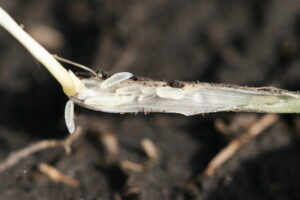
Fig. 23) is a small, long-legged, two-winged insect that resembles a mosquito. The reddish female fly is about 1/8 inch long, while the male is slightly smaller and brown or black in color. Red eggs are deposited on leaves and the newly hatched larvae or maggots are also red for four or five days before turning white (Fig. 24). The maggots migrate to the base of the leaf sheath where they feed between the sheath and the stalk for four to six weeks. As larvae mature, a translucent
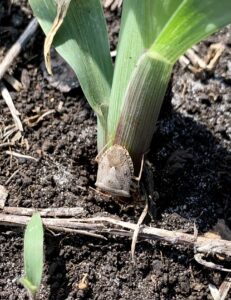
green stripe appears down the middle of the back. when fully grown, the maggot is about 1/4 inch long. The maggot turns into an adult fly inside a dark brown case (puparium) that resembles a flaxseed in size and shape (Fig. 25). The puparia, or "flaxseeds," are on the leaf surfaces.
Fall feeding by maggots weakens and stunts plants. Stems infested in the spring may die, but they usually lodge before harvest from feeding at the first or second joint. Frequently, the heads are smaller and poorly filled with low quality grains. Chemical control practices are not practical or effective. Reducing the threat of Hessian fly in wheat production depends on cultural practices.
Scouting Procedure
Since no insecticides control Hessian fly infestation, scouting provides information useful in planning next year's crop rotations. Wheat can be checked just after emergence, but Hessian fly is easiest to detect in the "flaxseed" stage during the late spring, prior to harvest. While checking a field, stop periodically
and examine one plant stem. Look underneath the leaf sheath near the lower joints. A sharp knife can be helpful for splitting the stem and peeling back the leaves. Look for the dark brown flaxseed-like puparia containing the larvae. Collect a total of 50 stems from throughout the field, avoiding field edges. Also, note the occurrence of Hessian fly symptoms on the plants.
Cereal Leaf Beetle
The cereal leaf beetle has been on the increase in recent years and is now present throughout most of North Carolina. Adult beetles are about 3/16 of an inch long with metallic steel-blue wing covers and a rust-colored thorax. Adults usually appear in small grain fields about mid-April. Egg laying occurs during late
April and early May. The individuallty laid eggs hatch in about five days. The brown and yellow grub-like larvae carry a glob of liquid mucus and fecal matter on their backs. They attain a length slightly greater than the adult. In highly infested fields, the mucus on larvae can severely soil the scout's clothing. Peak larval populations usually occur around mid-May. The larvae pupate in the ground and produce the new summer generation of adults as small grains are maturing. Summer adults are inactive most of the summer and in the fall move to wooded areas, hedgerows, and ditchbanks to overwinter.
The major damage to wheat occurs from larvae feeding on leaves during May (Fig. 26). Larvae eat away long strips of leaf tissue between the veins and may skeletonize entire leaves. Loss of the flag leaf is very damaging in small grains, and large numbers of larvae can completely remove the flag leaf tissue from entire fields. Adults emerge from wheat fields as the grain is drying down and are not a threat to the grain. However, adults can migrate to nearby corn fields and feed extensively on border row plants. Cereal leaf beetle feeding on corn is seldom damaging to the crop.
Scouting Procedure
Scouting for cereal leaf beetle populations can be combined with scouting for hard-infesting aphids. Late April and May scouting will detect this insect. As in scouting for aphids, take 10 samples per field, with each sample consisting of 20 individual plants. Examine the flag leaf of each plant and count cereal leaf beetle larvae and estimate the percent of defoliation. Also, note the level of cereal leaf beetle feeding on the lower leaves. Record the results of each sampling stop. Give increased attention to fields with thin stands or weak growth since these are most likely to be infested.
Economic Threshold
Action thresholds depend on the condition of the plants. If the amount of healthy foliage has been reduced by leaf diseases, relatively small populations of cereal leaf beetle larvae may cause economic losses. Thickly planted stands with abundant healthy foliage can tolerate a greater number of beetle larvae without crop loss. Larvae may also feed on plentiful healthy lower leaves without moving to the flag leaf. The primary considerations in deciding whether to apply
controls are the level of beetles and the condition of the flag leaf. Emphasis should be placed on protecting the flag leaf. Treatment should be considered in wheat at the level of 1 larva per flag leaf and in barley and oats at the level of 1.5 larvae per flag leaf.
Cereal Leaf Beetle Parasitoids
The North Carolina Department of Agriculture is raising larval parasitoids of cereal leaf beetle (CLB) for regional distribution. Beetle larvae parasitized with Tetrastichus (Walker) may be obtained at annual field days. Growers wishing to use this type of biological control should practice no-till or minimum tillage planting, maintain an insecticide-free area, and exercise patience.
Tetrastichus julis is a very small wasp (less than 1/8 inch long). It overwinters in the soil and emerges in April to lay four to six eggs per CLB larva. The wasps develop inside the larva, which remains on the host plant until it drops to the soil to pupate. The young wasps complete their development in the soil, but the CLB larva dies. Some wasps emerge in June and parasitize late CLB larvae, while others enter diapause and remain in the top 1 to 2 inches of soil until the next spring. Minimum or no-till cropping is recommended to protect this overwintering stage. Beetle control will not occur immediately, but after the parasitoids become established, their populations will build up and disperse to other fields while CLB numbers decrease.
Parasitized larvae cannot be distinguished from healthy larvae without dissecting them, but NCDA personnel can assist with sampling. Site release fields to take advantage of prevailing spring winds to help disperse wasps.
An area of small grain should be set aside for the establishment of parasitoids. A CLB population of at least 2 to 4 larvae per square foot (20.5 inches of running row) is needed to provide an adequate number of hosts for the parasitoids. CLB prefers oats, wheat, and barley (in that order), and prefers spring-planted crops to winter ones. After obtaining the parasitized larvae, scatter them in
the field or a fescue border in a corner of the field where prevailing winds will blow emerging wasps toward the cereal leaf beetle. This should also be in the proximity to next year's small grain crop.
It is critical to leave the soil of the release field undisturbed for 15 to 18 months after planting. Combining or mowing will not harm the wasps. Do not use any insecticides in the release field or where insecticide drift could reach the release field. The grower should be prepared to sacrifice some of the grain to allow the beneficial insects to increase.
6 Weed and Disease Mapping
During one of the last visits to the field before harvest, draw a disease and weed map. Use an Agricultural Stabilization and Conservation Service map (if available) to mark infested areas. If a map is not available, draw an outline of the field and circle the location of trouble spots that have been identified. On each circle, note diseases or weeds found and the level of infestation. Do not try
to identify each specific spot observed but the general area of the field in which the problem occurred. This map will help in planning weed management programs for subsequent crops. For several pests and for certain agronomic problems, the stage of growth is important.
7 Soil Sampling
Nematodes
Nematode sampling is an important part of monitoring small grain. Although many people take nematode and soil samples at the same time, better results will come from samples taken at different times. Nematode samples should be taken while the crop is still in the field and nematode populations are at a peak. Once the crop is harvested, nematode populations are greatly decreased, and samples are less likely to reflect damaging levels. To take samples for nematode testing, use a soil sampling tube. Insert the tube at a slight angle under the plant so that it cuts through the root zone and collects roots as well as soil. Take 10 samples per 5 acres.
For correct identification, nematodes must arrive at the nematode lab alive. Protect nematode samples from extreme temperatures and hold them for no longer than two days. Store samples in a cool storage room or in a refrigerator until ready for shipment.
Fertility
The best fertility samples are obtained after the crop has been harvested and, preferably, after the field has been lightly disked. Take 10 samples per 5 acres. Using a soil probe, take samples 8 to 10 inches deep. After all samples are taken, mix the soil thoroughly before taking a sample for shipment to the soil analysis lab.