Pesticide Broadcast

Volume 11, Number 2, June 2000


In This Issue


EPA's Chlorpyrifos Revised Risk Assessment and Agreement with Registrants

EPA has released its revised risk assessment and announced an agreement with registrants to eliminate and phase out certain uses of the organophosphate pesticide chlorpyrifos. Also known as Dursban, Lorsban, and other trade names, chlorpyrifos is one of the most widely-used insecticides in the U.S., both in agriculture and in and around the home. The Food Quality Protection Act, enacted in 1996, sets a more stringent safety standard for most pesticides and offers special protection for children. In meeting the tough safety standard, EPA believes it can do a better job of protecting children and others by further reducing exposure to chlorpyrifos, and providing the increased margins of safety now mandated by Federal law. These use modifica-tions also will improve safety for workers who apply chlorpyrifos and for the environment.

Risk Mitigation

EPA and the registrants have agreed to the following modifications:

* Reducing Food Risks... The agreement will expeditiously address food uses posing the greatest risks to children. It decreases the use of chlorpyrifos on apples, terminating or canceling all post-bloom applications, and cancels the use on tomatoes. EPA will also propose to: 1) lower the tolerance or maximum residue limit on apples to reflect this change in use; 2) revoke the tolerance on tomatoes; and 3) lower the tolerance on grapes to a level that will allow for dormant applications (the only use allowed domestically), but not foliar applications typically made in foreign countries on grapes that are imported into the U.S. These actions will reduce acute dietary risk by 75 percent, effectively eliminating dietary risk concerns for children and others.

* Reducing Residential Risks . . . About 50 percent of chlorpyrifos is used in and around the home. The agreement will cancel and phase out nearly all indoor and outdoor residential uses. It effectively eliminates the use of chlorpyrifos by homeowners, limiting use to certified, profession-al, or agricultural applicators. Those uses that pose the most immediate risks to children, including home lawn, indoor crack and crevice treatments, and whole house post-construction termiticide treatments, will be canceled first. Spot and local post-construction and pre-construction termiticide uses will be phased out over the next several years.

* Reducing Drinking Water Risks . . . The actions on residential uses also will reduce exposure to chlorpyrifos through drinking water, since residential applications are potentially a major source of drinking water contamination.

* Reducing Non-Residential Risks . . . Chlor-pyrifos use in schools, parks, and other settings where children may be exposed will be canceled. Only use in some limited commercial settings, like warehouses, ship holds and railroad boxcars, may continue.

* Reducing Worker Risks . . . Risks to workers who apply chlorpyrifos also are of concern. The agreement will help mitigate worker risks by implementing Restricted Entry Intervals (REIs) for agricultural uses. By August 1, 2000, chlorpyrifos registrants also will be proposing lower application rates, lower frequencies of treatment, and longer time periods between applications and harvest (pre-harvest intervals) for some agricultural uses. These and other measures to reduce both worker and ecological risks will be discussed further in consultation with stakeholders as EPA develops an interim reregistration eligibility decision for chlorpyrifos.

* Protecting Public Health Uses . . . Under the agreement, public health uses including applications to fire ant mounds and ultra low volume applications for mosquito control will be allowed to continue. These applications do not pose risks of concern and provide important public health benefits.

* Supporting Low-Risk Uses . . . The agreement allows several other non-agricultural uses to continue, with appropriate risk mitigation. Golf course applications, for example, may continue with application rates reduced by 75 percent. Low risk uses like containerized baits in child resistant packaging, and non-structural wood treatments such as treatments of utility poles and fenceposts, will not be affected by the agreement.

Phased In Approach

The agreement phases in the various restrictions and cancellations to address higher risk uses of chlorpyrifos first. Because much of the risk reduction involves increasing margins of safety, it is reasonable to focus first on the uses that achieve the greatest risk reduction for children. Allowing other uses to continue for a specific period of time will help ensure that appropriate alternatives are available for a reasonable and orderly transition.

For additional materials on the chlorpyrifos decision, or for information on other aspects of the Agency's pesticide regulatory program, contact EPA's Office of Pesticide Programs at (703) 305-5017, or visit the web site, http://www.epa.gov/ pesticides. For information on pesticides and their toxicity, contact the National Pesticide Telecom-munications Network at 1-800-858-7378.

Source: U. S. Environmental Protection Agency, Prevention, Pesticides and Toxic Substances, Fact Sheet, June 2000


Understand Agriculture's Value
by Lu-Ann Coe, Executive Vice-President
of the North Carolina Agribusiness Council

What North Carolina industry contributes the most to our state's economy? Hint: It's the same industry that contributes the most to our most basic necessities of life - food, clothing and shelter.

Final answer: agriculture and agribusiness.

According to Dr. Mike Walden, extension economist specialist at N.C. State University, agribusiness accounts for more than 22 percent of the state's income. Of the $217 billion gross state product, $48.8 billion comes from food, fiber and forestry. These industries account for more than 780,000 of the state's 3.6 million employees - 21 percent.

Yet North Carolina's largest industry is struggling. Regulatory pressures, urban sprawl and all-time-low commodity prices threaten the livelihood of the people who provide our food, fiber and forestry products.

Many have had to sell their farming operations and pursue other lines of work. In the face of adverse times, we should take stock of what we as citizens and consumers stand to lose.

Our environment will lose: The U.S. Department of Agriculture's five-year review shows that North Carolina is fifth in the amount of rural acreage converted to urban uses. Between 1992 and 1997, North Carolina converted almost a million acres (945,300). This is 160,000 acres more than California converted over the same period. It is astounding that North Carolina converted 2.3 percent of its total acreage - much of it farmland, of course, used for agricultural production - to developed use in a five-year-period.

Let's look at this trend in term of numbers of farms. In 1950, North Carolina boasted 201,000 farms. Today there are fewer than 60,000. The state is losing an estimated 2,000 farms per year. Since 1985, we have lost over half our farms. In many rural areas, the standard reply to, what do you do for a living? used to be, I work the land. Where will consumers get their food and fiber when there is no one left working the land?

This loss of farmland should concern us all.

Local economies will lose: Farmers spend about 80 percent of every dollar earned on production. These dollars go back into the local economy. If we continue to gobble up farmland at an ever-increasing pace and farmers cease to farm, for whatever reason, what will replace these dollars in the local economy?

The consumer will lose: In 1950 Americans spent 22 percent of their income on food. Today, we spend less than 10 percent of our expendable income on food. By February 9 of each year, the average American citizen has earned enough to buy food for the entire year. It takes the same American until May 9 to earn enough to pay taxes. One U.S. farmer produces enough food for 130 people to consume in one year.

What's the point? Americans are getting a tremendous bargain when they go to the grocery store because our agricultural industry is probably the most efficient in the world. It's a model for the rest of the world. Shouldn't we be concerned about protecting and sustaining it?

Our economy will lose: North Carolina's top farm commodities in terms of cash receipts for 1997 were hogs, broilers, tobacco, greenhouses/nurseries, turkeys, cotton, soybeans and cattle and calves. In 1997, the total income from farm and commercial forestry was $1.4 billion. The manufacturing process added another $6.6 billion. Forestry's total contribution in 1997 was $8 billion. In short, agriculture and agribusiness are mainstays of our state's economy.

The hard-working women and men of North Carolina's agriculture/agribusiness industry provide food, fiber and forestry products for us in North Carolina and for the global market. Let's make sure we acknowledge their significant, continuing contributions to our daily lives.

Source: Charlotte Observer, April 7, 2000 via Crop Protection Association of North Carolina


Field Crops - 2000 Prospective Plantings

An unpredictable winter came to a close with mild temperatures and farmers thinking about the 2000 planting season in North Carolina. Spring planting of Irish potatoes and cabbage is nearing completion, well ahead of schedule. Farmers have taken advantage of nice weather to get fields prepared for plantings. Statewide, topsoil moisture conditions as of the last full week of March are 10% short, 59% adequate, and 31% surplus after three consecutive weeks of widespread rainfall.

For the fourth straight year cotton plantings will increase in North Carolina. An estimated 940,000 acres of cotton will be planted, 60,000 acres above last year. If the growing season cooperates, the State may realize a record high cotton crop.

The trend in reduced corn acreage continues in 2000. Plantings are expected to drop to 700,000 acres, the lowest on record and 50,000 acres below 1999. Soybean plantings, at 1.38 million acres, are expected to decrease 1% from a year ago. Since the planting window for soybeans is longer, farmers may shift cropland acres from other crops to soybeans if the weather does not allow those crops to be planted.

Flue-cured tobacco farmers intend to set 168,000 acres, down 16% from last year and down 31% from 1998. This decrease in planting intentions roughly reflects the decrease in the effective quota for 2000. Burley tobacco growers expect to harvest 7,500 acres, down 9% from 1999 harvested acres. Like flue-cured tobacco, the quota for burley has decreased substantially (45%) from 1999, but burley growers have not planted the corresponding acreage levels since 1982. Below normal yields for the last several years due to blue mold and/or dry weather had growers planting below their quota rather than contend with these problems.

Peanut growers in the State intend to plant 125,000 acres, down 1% from 1999 planted acres. There was virtually no change in the quota from 1999. Current soil moisture conditions are very good as the planting season approached.

Sweetpotato growers intend to plant 36,000 acres, down 1,000 acres from 1999.

Hay producers expect to cut 720,000 acres, 1% above 1999.

Wheat acreage in North Carolina is unchanged from the December estimate of 720,000 acres. However, plantings are up 70,000 acres from the previous year. Crop Weather reports show current conditions of wheat to be mostly good.

United States intentions of planted acres with percent changes from 1999 are as follows: corn 77.9 million, up 1%; all cotton 15.6 million, up 5%; flue-cured tobacco 253,900, down 16%; burley tobacco 207,700, down 31%; soybeans 74.9 million, up 1%; peanuts 1.47 million, down 4%; sweetpotatoes 93,700, up fractionally; and winter wheat 43.2 million, virtually unchanged from 1999, but fractionally higher than the December 1 forecast.

The acreage estimates in this report are based on a survey conducted during the first two weeks of March. The next Acreage report will be released June 30, 2000.

A table with North Carolina and United States acreage numbers can be found on the web at: http://www.agr.state.nc.us/stats/crop_fld/fldprsyr.htm.

Source: North Carolina Department of Agriculture & Consumer Services


Bt Corn: Less Insect Damage, Lower Mycotoxin Levels, Healthier Corn

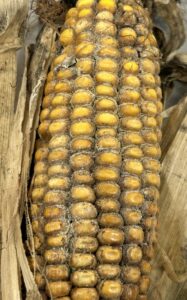
Bt corn that has been genetically modified to prevent damage by European corn borers may also be less likely to harbor mycotoxins, toxins produced by fungi on corn ears, according to an Agricultural Research Service entomologist. Mycotoxins like fumonisin, a potential cancer-causing agent often found at elevated levels in insect damaged kernels, are both a health issue and an export issue. European and Asian markets can refuse to import U.S. corn because of what they rate as unacceptable levels of mycotoxins.

Scientists have suspected higher mycotoxin levels may follow increased insect damage, but ARS entomologist Patrick F. Dowd found fumonisin levels 30- to 40-fold lower in Bt corn than in non-Bt varieties in Illinois cornfields. Bt stands for the biopesticide Bacillus thuringiensis. Environmental conditions and the specific Bt corn hybrid play roles in the actual amount of reduction seen, but corn varieties that expressed the Bt protein throughout the plant rather than in specific areas were the least likely to have significant fumonisin levels, according to Dowd, who is with ARS' National Center for Agricultural Utilization Research in Peoria, Illinois. ARS is the U.S. Department of Agriculture's chief in-house research agency.

While Bt corn is modified mainly to resist European corn borers, Bt corn also showed lower levels of mycotoxins when corn earworms were present in fields, although not as significant a reduction as when European corn borers were the primary insect pest. This may encourage the creation of corn varieties with more resistance to a variety of insects in order to provide more protection from mycotoxins. Small plot studies by Iowa State University plant pathologist Gary Munkvold appear to confirm Dowd's findings.

Source: U. S. Department of Agriculture, Agriculture Research Service News Service, April 26, 2000


Organic Food: Food for Thought?
by David M. Klurfeld, Ph.D.

Sales of organic foods have soared in recent years. They are touted as cleaner, more nutritious and better for the environment than foods produced by conventional means. But are such claims really true? People are finally starting to examine these questions.

On February 4, 2000, the ABC News show 20/20 presented a report about organic foods by John Stossel a report that asked these questions about cleanliness, nutritional value and environmental impact of organic versus conventionally-grown produce.

The 20/20 investigators examined produce for cleanliness by measuring the bacterial count in water used to wash it, as well as the presence of pesticide residues. They found that only about five percent of all food samples were contaminated with bacteria. But, organic produce had more bacterial contamination than conventional products. Specifically, sprouts and precut salad greens from organic suppliers had more bacteria. One-third of all sprouts sampled had E. coli bacteria on them and organic ones had twice the number of bacteria as the nonorganic vegetables. E. coli bacteria are markers of fecal contamination probably due to the use of manure as fertilizer.

Interestingly, there were not any pesticide residues on any of the produce sampled organic or conventional, collected in two states. This is an important point. Relatively small percentages of produce have detectable levels of pesticides. This same result was found by Consumers Reports in March 1999, but that publication emphasized the presence of the pesticides which came from only a few products.

If we look at these results on cleanliness in terms of current risks, it is important to note that we have an estimated 5,000-10,000 deaths a year in the United States from food-borne bacteria but none from pesticides. Does it make sense to use organic farming methods if it even slightly increases risk of infection? Should we fear pesticides because they are artificial? The science-based answer to both questions seems to be a clear no. Is it conceivable that there could be long-term risks of harm from pesticides? It is possible, but the data are not consistent and available information on eating lots of fruits and vegetables strongly suggests there is no long-term risk.

One of the more solid findings on the relationship of diet and cancer is that the more fruits and vegetables eaten, the lower the risk of a variety of cancers including stomach, colon, prostate and lung. If artificial pesticide residues on plants are so harmful and carcinogenic, why do the people who eat the most wind up being the healthiest? In fact, Dr. Bruce Ames, a leading biochemist at the University of California at Berkeley, has stated that 99.99% of pesticides in plants are naturally occurring. This is precisely how today's plants have survived and evolved - making their own defenses against being eaten by insects. Commercial quantities of produce need extra protection to reduce crop loss.

What about the nutrition issue? There is no evidence that organic food is more nutritious or healthier for people even though they pay a high premium. Not a single published study has shown any difference in the nutrient content of organic versus conventional farm products. This contradicts the widespread belief that our soils are depleted of nutrients and thus plants grown in them are deficient in a variety of vitamins and minerals. Commercial fertilizers are not simple combinations of the elements nitrogen, potassium and phosphorus - they contain a variety of other minerals that are naturally occurring and taken up by plants. One problem with organic fertilizer (known in polite company as manure) is that it contains heavy metals, bacteria, and viruses. In fact, garden centers sell processed sludge from several cities and labels on the bags warn customers not to use these products on vegetable gardens because of these risks.

Organic farming seems intuitively better for the environment due to the lack of chemicals used, but the reduced yields compared to conventional farming are an important trade-off in deciding if this is really an improvement. Organic farmers justify higher prices because they have lower yields; weeds and insects compete with the crops more effectively. It has been estimated that twice as much land would have to be farmed with organic methods to produce the same amount of food we currently grow. That much farmable land does not exist.

It is self-centered of the better-off to demand all growers adopt organic farming methods. The poor in this country and in most of the developing world would not be able to buy enough of any food if the entire system were changed. Modern agricultural methods provide the only system that can support the current, and likely increasing world population. While there is room for organic alternatives, they cannot replace the conventional system.

Organic crops do not score better than traditional ones in terms of safety, nutrition, or the environment. In fact, sometimes they may not be as safe and they almost always cost more. This is not usually a sales plus but the average consumer, believing that organic foods are more healthful and better for the environment, seems willing to pay. This is truly food for thought.

Source: American Council on Science and Health, Editorial (Dr. Klurfeld is Scientific Advisor to the American Council on Science and Health, and Professor and Chair of the Dept. of Nutrition and Food Science at Wayne State University.)


California Releases Pesticide Illness Data

The California Department of Pesticide Regulation (DPR) released statewide pesticide illness data for 1997 and 1998. The 1997 illness report data showed 1,319 potential or confirmed cases of pesticide illness, down 16.5 percent from 1996. The decline continued in 1998, with 998 potential or confirmed pesticide illnesses reported. In both years, more than half of the reported illnesses occurred in non-agricultural settings. A DPR staff analysis found no specific factors to account for the decline. Statistics from the Pesticide Illness Surveillance Program vary from year to year, but field worker illnesses have trended downward since the 1980s.

Illness report data for 1997 and 1998 were finalized after DPR upgraded computer programs to organize the data. The new system provides more reporting details on occupation, exposure circumstances, and equipment involved in accidents. The new system also records more specific information on pesticide products and uses. ("Pesticide" is a general term for substances that kill or control pests. Pesticides include insecticides, herbicides, rodenticides, disinfectants, and sanitizers.) In 1997, some 774 illnesses -- about 59 percent -- resulted from non-agricultural applications, while 545 reports involved agricultural settings. In 1998, some 632 illnesses (63 percent) were non-agricultural, while 366 cases involved agricultural pesticides.

Under state law, county agricultural commissioners act as local enforcement agents for pesticide laws and regulations. They investigate all pesticide-related illnesses or injuries reported in their counties. DPR specialists then analyze each case to determine if pesticide exposure played a role in an illness.

State law also requires physicians to report to local health officers any illness that may be related to pesticide exposure. Such direct illness reporting allows DPR to investigate cases promptly. Absent physician reports, DPR identifies possible illnesses through physician reports to the worker compensation program, although such reports typically are more than a month old.

DPR began an education and outreach program for physicians in 1994. Only 16 percent of the illnesses investigated that year came through physician reporting. Since then, physician reporting has increased. DPR received physician reports for 30 percent of the cases investigated in 1997.

DPR's illness report data helps identify trends, guide enforcement activities, and when appro-priate, fine-tune safety rules. For example, the Department has made pesticide drift incidents a priority, based on illness data collected in recent years. In 1997, DPR issued a Pesticide Drift Enforcement Policy to better define drift and summarize regulatory standards. Elements of this policy will be codified in regulations under development and expected to be noticed later this year.

In 1998, DPR took action against illegal sales of insecticidal chalk after a child became ill from eating chalk. In addition to a public awareness campaign, DPR conducted 31 retailer inspections in a five-month period and issued 19 violation notices for sales of the product. DPR also urged the U.S. Environmental Protection Agency to begin a nationwide crackdown on illegal sales of insecticidal chalk.

California's Pesticide Illness Surveillance Program is generally acknowledged as the nation's best. Data generated from illness reports has made DPR's worker protection program a model for other states. The program does not attempt to track every pesticide-related incident, since unreported illnesses cannot be documented.

For synopses of the 1997 and 1998 data, and a brochure describing the illness surveillance program, contact DPR's Worker Health and Safety Branch, 830 K Street, Sacramento CA, 95814-3510; phone (916) 445-4222. The material can also be accessed from the publications section of DPR's Web site: http://www.cdpr.ca.gov.

One of six departments and boards within Cal/EPA, DPR regulates the use of pesticides to protect human health and the environment.

Source: California Department of Pesticide Regulation, February 15, 2000


New Household Chemical Web Site For Children

EPA has created a new interactive web site, Learn About Chemicals Around Your House, to teach children about ordinary household pesticide products that may contain harmful chemicals. The web site includes information about toxic substances stored in different rooms in the house, and answers commonly asked questions on safe use and storage of these pesticides and other toxic products. The site also contains educational games, and tells children what to do if accidents occur. The site is available at: http://www.epa.gov/opptintr/kids/hometour/index.htm.

Source: U. S. Environmental Protection Agency, April 20, 2000


First Aid Instructions Revised for Pesticide Product Labels

On April 11, EPA proposed to revise the format and content of first aid advice on all pesticide product labels to make them easier to read. While companies could start to use this revision immediately, the Agency accepted public comments for 30 days. The revision incorporates recommendations by the medical community and the Consumer Labeling Initiative. Changes to labels will include: section headings labeled First Aid instead of Statement of Practical Treatment; new format designs; as well as first aid advice for each pathway of exposure through the mouth, skin, inhalation, and eye. The goal is to revise all product labels by October 1, 2001. For more information, please contact Amy Breedlove in the Office of Pesticide Programs at (703) 308-9069, or by e-mail at: breedlove.amy@epa.gov. For a copy of the notice, see: http://www.epa.gov/PR_Notices/.

Source: U. S. Environmental Protection Agency, April 20, 2000


USDA ERS Report: Economic Implications of the Methyl Bromide Phaseout

The U. S. Department of Agriculture's Economic Research Service (ERS) has issued a report titled Economic Implications of the Methyl Bromide Phaseout. According to the report's abstract, The pesticide methyl bromide is being phased out internationally under the Montreal Protocol. Methyl bromide has been used for over 50 years to control insect, nematodes, pathogens, and weeds. It is used for soil fumigation before planting many fruits, vegetables, ornamentals, and agricultural nurseries; for post-harvest fumigation of commodities in storage and prior to shipment; and for government-required quarantine treatment to prevent the spread of regulated exotic pests. Many U.S. users are concerned that existing alternatives to methyl bromide will be less effective and cause financial losses. To help mitigate the impacts of the phaseout, USDA, the U.S. Environmental Protection Agency (EPA), universities, and private firms are working to develop new alternatives and make them available to methyl bromide users. A copy of the report is posted at the following web site: http://www.ers.usda.gov/epubs/pdf/aib756/.


EPA Issues Special Review Status Report

EPA has revised the report Status of Chemicals in Special Review. The 65-page report provides information on pesticides that are or have been undergoing special review under the Federal Insecticide, Fungicide, and Rodenticide Act. The Special Review process is set in motion when EPA has reason to believe that the use of a pesticide may result in unreasonable adverse effects to people or the environment. The goal of this process is to reduce the risks posed by a pesticide to an acceptable level while taking into consideration the benefits provided from the use of the pesticide. More than 100 pesticides have been examined in the Special Review process. This report provides brief summaries of those reviews and the risk concerns that prompted them and cites EPA decision documents that provide more detailed discussion. The report is available on the Office of Pesticide Programs' Internet web site: http://www.epa.gov/oppsrrd1/SpecialReview/index.htm. Printed copies of the document will be available from EPA's National Service Center for Environmental Publications, telephone 1-800-490- 9198 (request publication number EPA 738-R-00- 001).

Source: U. S. Environmental Protection Agency, Office of Pesticide Programs, EPA Pesticide Program Update, April 17, 2000


EPA Proposes Revoking Methyl Parathion Tolerances

EPA is proposing to revoke or amend the maximum pesticide residue limits (called tolerances) for the organophosphate insecticide methyl parathion on many fruits and vegetables children frequently eat, including apples, broccoli, brussels sprouts, carrots, celery, cherries, grapes, nectarines, peaches, pears and plums. EPA announced this in a Federal Register notice on Friday, June 2. This proposal follows up on the cancellations by the registrant of the use of methyl parathion on these and other commodities that EPA announced on August 2, 1999. This decision was based on EPA's determination that showed acute dietary risks from methyl parathion in food did not meet current requirements for an extra margin of safety to protect children under the Federal Food, Drug, and Cosmetic Act as amended by the Food Quality Protection Act of 1996 (FQPA). EPA made that determination after completing a comprehensive review of methyl parathion's uses. EPA proposes to make these revocations and amendments effective upon publication of the final rule. EPA is working with the Food and Drug Administration, who also on June 2 issued guidance on how it will handle situations involving methyl parathion residues in foods that were legally treated with methyl parathion before January. The Federal Register is available at: http://www.epa.gov/fedrgstr/ EPA-PEST. For more information on EPA's reassessment of methyl parathion, visit: http://www.epa.gov/pesticides/op.

Source: U. S. Environmental Protection Agency, June 1, 2000


EPA Publishes Notice of Use Deletions for Azinphos-methyl

On April 19, 2000, EPA announced use deletions and registration cancellations for products con-taining azinphos-methyl. The use deletions and cancellations are consistent with the agreement between EPA and the registrants of azinphos-methyl announced August 2, 1999. EPA is implementing the agreement to reduce risks associated with azinphos-methyl to humans and the environment. Affected uses are cotton in Louisiana and east of the Mississippi River, sugarcane, ornamentals (except nursery stock), Christmas trees, shade trees, and forest trees. As of April 19, 2000, sale, distribution, or use of azinphos-methyl products affected by this cancellation order is only permitted in accordance with the terms of the existing stocks provisions of the cancellation order. Existing stocks of azinphos-methyl already in the possession of growers may be used until depleted, provided the use is in accordance with the existing label or the August 2, 1999 risk reduction agreement.

The Federal Register notice (65 FR, Number 76, pages 20966-20968) providing details of this cancellation is available on EPA's web site at: http://www.epa.gov/fedrgstr. EPA plans to issue a final rule regarding changes to tolerances for azinphos-methyl in April 2000. For more information, contact Barry O'Keefe, Special Review and Reregistration Division, at 703-308-8035 or via electronic mail at: okeefe.barry@epa.gov.

Source: U. S. Environmental Protection Agency, Office of Pesticide Programs, EPA Pesticide Program Update, April 24, 2000


EPA Develops New Fact Sheets on Mosquito Control Pesticides

On May 11, 2000, EPA released new consumer fact sheets addressing the role pesticides play in mosquito control programs. These documents answer basic questions about EPA's role in supporting state and local mosquito control programs, the risks and benefits of pesticides used in mosquito control, and how pesticides are used in combination with mosquito prevention techniques. The titles include: Questions and Answers: Pesticides and Mosquito Control; For Your Information: Larvicides for Mosquito Control (735-F-00-002); For Your Information: Synthetic Pyrethroids for Mosquito Control (735-F-00-004); For Your Information: Naled for Mosquito Control (735-F-00-003); For Your Information: Malathion for Mosquito Control (735-F-00-001). All documents are now available on EPA's web site at: http://www.epa.gov/ pesticides/factsheets/skeeters.htm.

Source: U. S. Environmental Protection Agency, Office of Pesticide Programs, EPA Pesticide Program Update, May 18, 2000


Recommendations for the use of chemicals are included in this publication as a covenience to the reader. The use of brand names and any mention or listing of commercial products or services in this publication does not imply endorsement by the North Carolina Cooperative Extension Service nor discrimination against similar products or services not mentioned. Individuals who use chemicals are responsible for ensuring that the intended use complies with current regulations and conforms to the product label. Be sure to obtain current information about usage and examine a current product label before applying any chemical. For assistance, contact an agent of the North Carolina Cooperative Extension Service in your county.

Employment and program opportunities are offered to all people regardless of race, color, national origin, sex, age or handicap. North Carolina State University, North Carolina A&T State University, U.S. Department of Agriculture, and local governments cooperating.

Last modified on June 26, 2000 by Stephen J. Toth, Jr.

North Carolina State University North Carolina Cooperative Extension Service College of Agriculture and Life Sciences Department of Entomology Department of Horticultural Science