![]() | Field and Forage Crops |
![]() | Ornamentals and Turf |
![]() | Insect Trap Data |
From: Jack Bacheler, Extension Entomologist
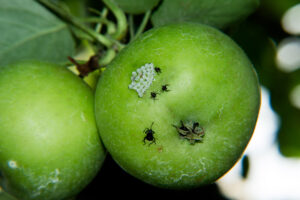
Stink bug levels are definitely higher than last year, particularly where timely rainfall has occurred. We have looked at several cotton fields that have internal boll damage from stink bugs in the 10 to 25 percent range this week. This amount of damage may not a big concern during the first two weeks of bloom, but producers should be aware that our suggested threshold during the third through fifth or sixth week of bloom drops to 10 percent, and that stink bug levels in cotton often build up during this time period. So my guess is that we’ll have a number of cotton fields in need of treatment in the coming weeks. The good news is that in many fields the internal damage levels from stink bugs are in the single digits, so we appear to have quite a range of damage so far, as opposed to last year in which the damage was minimal essentially everywhere in the state.
Should I spray? The only correct way to answer that question is to cut open or squash quarter-sized bolls to check for internal damage – either stained lint or internal boll wall warts. Recent stink bug or plant bug damage to these young bolls may be subtle.
If stink bug sprays are made with an organophosphate insecticides such as Bidrin prior to or during the bollworm moth flight, be aware that the probably of a follow-up treatment for bollworms may well occur earlier than would have otherwise have been the case without the stink bug spray. In these cases, a pyrethroid insecticide plus Bidrin tank mix may be in order. If the stink bug population is composed of primarily green stink bugs, a pyrethroid alone will do a nice job with this species, although we still seem to have quite a few brown stink bugs in the mix at this time in most areas. In testing here, although Bidrin typically provides the best control of brown stink bugs, a pyrethroid at the highest rate usually controls 65 to 80 percent of brown stink bugs.
We can’t overemphasize the importance of scouting for and responding to stink bugs for the next four to five weeks.
The bollworm moth flight appears to be up through Pitt, Lenoir, Greene and Wayne counties on July 23. Expect bollworm moths to be pushing our northern tier of cotton counties by about this time next week. Be particularly cautious with non-Bt or conventional cotton, as this year’s flight appears to be large at this time.
Mite levels are down. However, we have received more reports of cotton aphids this last week. Fortunately, this late July time period and high humidity favors the development and spread of the aphid fungus, which has already occurred in a number of cotton fields throughout the state.
From: Steve Koenning Extension Soybean Pathology Specialist, Department of Plant Pathology, and Jim Dunphy, Soybean Specialist, Department of Crop Science
Soybean rust (SBR) is viable in 15 Florida counties (only two are soybean, the rest are kudzu or coral bean), and has been found on soybean in one county in Georgia, located on the Florida line. Alabama, Louisiana, and Texas have reported soybean rust on kudzu (kudzu only) in one or two counties.
Sentinel plots in North Carolina have all been planted and are currently being monitored on a weekly basis. Soybean rust has not been detected at this time in North Carolina. Brown spot, frogeye leaf spot and soybean downy mildew have been detected in sentinel plot samples. Conditions for soybean foliar diseases have been favorable and a number of diseases will be more evident. Although recent conditions have been good for rust development in North Carolina, the rust spore production south of North Carolina remains minimal since there are so few sources for spores at this time.
Florida and areas along the Gulf Coast are now receiving rainfall typical for this time of year with afternoon showers being common. These are ideal conditions for development of soybean rust. With a large late season soybean crop in Georgia, Alabama, and Mississippi, the potential need to make fungicide applications for rust in North Carolina on our late crop is at least moderate assuming that we continue to receive adequate rainfall and temperatures remain moderate.
The fungicide Folicur has still not received a new Section 18 label or a Section 3 label. Growers have not been advised to spray for rust at this time in Georgia. All sentinel plots in Mississippi are at reproductive stages and a late soybean crop has been planted. Much of the soybean crop in Mississippi receives an application of strobilurin fungicides (Headline or Quadris) at the R3-R4 reproductive stage. Strobilurin fungicides are good rust preventatives.
Soybean Rust Management in the Mid-Atlantic Region (old version and new), as well as the Soybean Disease Atlas, can be found at the Southern Soybean Disease Workers web site at http://cipm.ncsu.edu/ent/SSDW/. The Soybean Rust Management guide is paid for with United Soybean Board funds. We will distribute 600 copies of the publication Using Fungicides to Manage Soybean Rust to county agents, CCAs, and dealers. A PDF version of the publication can be obtained at http://oardc.osu.edu/soyrust/. The Fungicide Manual actually contains more information than most growers are likely to need.
Some sources for more detailed information are listed below:
The USDA soybean rust web site: http://www.sbrusa.net/cgi-bin/sbr/public.cgi
The North Carolina Crop Protection Manual: http://ipm.ncsu.edu/agchem/6-9.pdf
From: Barbara Shew, Extension Plant Pathologist
We have started to see outbreaks of Sclerotinia blight on peanut. Active Sclerotinia blight has been observed in Bertie, Chowan, Edgecombe, Gates and Northampton counties. Fields with a history of disease should be scouted carefully. In many fields and locations, rows are now six inches or less apart, which creates conditions favorable for Sclerotinia blight. Sclerotinia advisories also have been recommending sprays in many areas, although conditions were less favorable during the recent hot weather. The return to cooler weather and rain showers again favors disease development. Fields with a history of Sclerotinia blight should be sprayed following a favorable advisory or sooner if the disease is observed. Calendar sprays at 60 and 90 days after planting can also be used.
For growers who applied the first leaf spot spray at R3, the time for the second leaf spot spray of the year is approaching. Watch disease advisories or spray at two-week intervals. The second spray is critical for protecting the crop against stem rot as well as leaf spot so fungicides with activity against these diseases should be used, especially in fields with a history of stem rot.
See the North Carolina Agricultural Chemicals Manual (http://ipm.ncsu.edu/agchem/6-7and6-8.pdf) or 2008 Peanut Information (http://www.peanut.ncsu.edu/PeanutInfo2008/TOC.pdf) for information on specific fungicides for peanut disease control. Growers should contact their county Extension agent or send an e-mail message to barbara_shew@ncsu.edu if they would like to receive leaf spot and Sclerotinia advisories. Peanut disease photos are now available on-line at http://www.cals.ncsu.edu/plantpath/extension/commodities/Peanut_disease_photos.pdf.
From: Michael G. Waldvogel and Stephen B. Bambara, Extension Entomologists
Velvet ants have been active for a few weeks. Some are the size of a large ant, and some are as large as the end of your little finger. We sometimes receive telephone calls from concerned citizens who spot what looks like an ant on steroids. What people are seeing are velvet ants, also known as cow killers. Velvet ants are not actually ants, but wingless wasps in the family Mutilidae. Male velvet ants have wings, but the wingless females (image from the University of Tennessee, Knoxville) are the ones most often spotted by people in their yards.
The body of the velvet ant is covered with coppery red and black hairs that give it a velvety appearance. Most species of velvet ants are parasites of other bees and wasps, including formidable creatures like cicada killers. The female velvet ant is often seen scurrying over open, sandy stretches of soil that is the preferred nesting sites for many ground-dwelling bees and wasps. She lays her eggs on or near developing bees (not on the adults) and her hatching offspring proceed to feed on the helpless host insects.
Velvet ants are not social insects. We're not referring to their nasty dispositions, but to the fact that they are solitary wasps like cicada killers and mud daubers. They do not live in a colony. So, even if you see several velvet ants (which is quite likely the case), they are all individual females doing their own thing and roaming about in search of prey.
Dousing your yard with pesticides is not going to be effective because there is no nest of these things for you to target. In fact, they should be beneficial because they some may eat yellow jackets and other stinging creatures.
Female velvet ants make a squeaking sound if they are handled. This is may be closely followed by a distinct scream from the unfortunate person who picked her up and got stung in the process. Most inquiring minds ask about the severity of the stings. We would say that they are about on par with any bee or wasp sting. Of course, people who are hypersensitive to bee and wasp stings may have a more severe reaction than most of us and should avoid close encounters with the cowkiller. Treatment for velvet ant stings is the same as for any bee/wasp sting.
The velvet ant also has a tough exoskeleton which protects her from stings by the host wasps in the nests that they invade and it similarly provides some protection from light-hearted (or light footed) attempts to crush her. Never employ this control method while barefoot. This technique is best applied while wearing work boots or shoes. Sandals or flip-flops are not recommended protective equipment for velvet ant control.
There hasn't been a shortage of black widow spiders in the landscape this summer. We have two species in North Carolina. This average sized spider has normal behavior. It makes a small, unremarkable web in partially protected places in the garden and next to the house. The reaction of most people upon seeing a black widow spider is the immediate need to kill it before it bites them. These spiders were not trained to attack and bite the first person they see. They'd prefer to be left alone. Reported bites are usually from accidental contact. There is no practical, generalized treatment that can be used to prevent these spiders from being in the landscape. The best remedy is to keep alert where you place your unprotected hand or where you sit. Black widow spiders are found in places like underneath decking, under window sills and eaves of houses, around infrequently used playground equipment or lawn furniture, in wood piles, under beehives and rocks, and in garages. Armed with this knowledge, just check these places beforehand. Wear gloves when handling firewood or materials stored outdoors. If you find one around your house and wish to eliminate it, a stick works. There are thousands of spider bites reported to the poison control center each year and deaths are very rare. For additional information on-line, see http://www.ces.ncsu.edu/depts/ent/notes/Urban/blackwidow.htm.
How can you save energy with your pest management in the home landscape? Basically, "sustainability" translates into energy savings. (Well, not always human energy savings.) Anything that reduces pesticide applications reduces the fuels needed to apply the product and the fuels needed to manufacture the product. If you use sustainable pest management practices, your landscape will more closely maintain itself (I don't mean the lawn will mow itself) and you will have fewer problems from the start.
There are other things home gardeners can do to more directly save energy.
From: Mike Carroll, Agricultural Extension Agent, Craven County
*************************************************************************
Number of Adult Insects
**************************************************************
Date THW TBW CEW GSB BSB ECB FAW BAW Looper
*************************************************************************
July 18 4 0 28 4 1 2 7 - -
July 21 0 0 6 6 1 5 3 1 1
July 23 3 0 21 1 1 2 4 0 1
July 25 3 1 29 4 0 3 1 1 0
*************************************************************************
THW = tobacco hornworms; TBW = tobacco budworms; CEW = corn earworms;
GSB = green stink bugs; BSB = brown stink bugs; ECB = European corn
borers; FAW = fall armyworms; BAW = beet armyworms
Location of trap: Cove City
Cooperators: R&W McCoy Farms and Cove City Fertilizer
From: Colby S. Lambert, Agricultural Extension Agent, Cumberland County
*****************************************
Number of Adult Insects
*******************************
Date THW CEW GSB BSB
*****************************************
July 23 1 8 1 0
July 25 2 29 1 0
*****************************************
THW = tobacco hornworms; CEW = corn earworms;
GSB = green stinks bugs; BSB = brown stink bugs
Trap located in Godwin at Cumberland/Harnett County Line
at Lewis Farms off of Highway 301
From: Curtis D. Fountain, Agricultural Extension Agent, Duplin County
***********************************
Number of Adult Insects
************************
Date BW GSB BSB
***********************************
July 2 0 0 0
July 4 1 4 0
July 7 1 8 0
July 9 0 6 0
July 11 0 12 1
July 14 2 1 0
July 16 1 1 0
July 18 4 0 0
July 21 12 2 2
July 23 21 0 1
July 25 48 5 0
***********************************
BW = cotton bollworms; GSB = green
stink bugs; BSB = brown stink bugs
Trap location: approximately two miles east of Albertson
Cooperator: Justin Murphy
From: Alan A. Harper, Lenoir County
June
******************************************************************
Number of Adult Insects
****************************************************
Date HW CEW ECB AW AWC GSB BSB TBW
******************************************************************
June 1 0 2 0 0 0 0 0 0
June 2 0 3 0 0 0 1 0 0
June 3 0 1 0 1 0 3 0 0
June 4 0 1 0 0 0 3 0 0
June 5 0 2 0 0 0 2 0 0
June 6 0 3 0 0 0 0 0 0
June 7 1 1 0 0 0 2 4 0
June 8 1 2 1 1 0 1 1 0
June 9 0 2 0 1 1 4 2 0
June 10 1 2 0 1 1 2 1 0
June 11 1 2 0 1 1 1 1 0
June 12 0 1 0 1 1 0 0 0
June 13 0 2 0 1 1 0 0 0
June 14 0 1 1 0 2 0 0 0
June 15 0 2 2 0 0 2 2 0
June 16 0 3 1 0 0 1 0 1
June 17 0 0 0 0 2 1 0 0
June 18 1 2 0 0 2 1 0 1
June 19 0 0 0 0 1 0 0 0
June 20 0 2 2 0 1 0 0 0
June 21 0 3 0 0 3 0 0 0
June 22 0 6 1 0 0 2 0 0
June 23 1 3 1 0 2 3 0 0
June 24 0 2 0 0 3 0 0 0
June 25 0 4 2 0 3 0 1 0
June 26 1 1 0 0 4 1 0 0
June 27 0 1 1 0 0 0 0 0
June 28 0 2 0 0 0 1 0 0
June 29 0 2 0 1 3 2 0 0
June 30 1 0 0 0 2 0 0 0
******************************************************************
July
******************************************************************
Number of Adult Insects
****************************************************
Date HW CEW ECB AW AWC GSB BSB TBW
******************************************************************
July 1 0 4 0 2 5 0 0 1
July 2 1 1 1 0 3 0 0 0
July 3 0 1 2 0 7 0 0 0
July 4 3 1 3 0 4 2 0 0
July 5 1 0 0 0 2 0 0 0
July 6 2 6 4 0 4 1 0 0
July 7 1 4 0 0 3 0 0 0
July 8 3 2 2 0 0 2 0 0
July 9 2 2 3 0 2 0 0 0
July 10 3 2 1 0 0 0 0 0
July 11 3 2 3 2 1 0 0 0
July 12 4 0 1 2 0 0 0 1
July 13 3 2 1 1 1 0 0 0
July 14 5 1 3 0 2 1 0 0
July 15 5 3 3 0 3 0 0 1
July 16 3 3 1 3 1 1 0 0
July 17 0 2 0 0 0 0 0 0
July 18 0 4 0 0 0 3 0 0
July 19 1 4 0 0 0 0 0 0
July 20 1 7 1 0 0 1 0 0
July 21 1 10 0 0 1 4 0 0
July 22 0 4 1 0 1 1 0 0
July 23 1 16 0 0 0 1 0 0
July 24 1 19 0 0 0 2 0 0
July 25 1 47 1 2 1 0 0 1
******************************************************************
Abbreviations: HW = hornworms; CEW = corn earworms; ECB = European
corn borers; AW = true armyworms; AWC = armyworm complex; GSB =
green stink bugs; BSB = brown stink bugs; TBW = tobacco budworms
From: Kevin Johnson, Agricultural Extension Agent, Wayne County
**********************************************************
Number of Adult Insects
***********************************************
Seven Springs Goldsboro
********************** *********************
Date GSB BSB CEW HW GSB BSB CEW HW
**********************************************************
July 9 - - - - - 1 - -
July 11 - - - - - 1 - 1
July 14 - - - - 4 2 2 1
July 16 - - - - - 1 - -
July 18 - - - - 3 - - -
July 21 - - - - 17 4 - -
July 23 2 0 1 9 - - - -
**********************************************************
GSB = green stink bugs; BSB = brown stink bugs;
CEW = corn earworms; HW = hornworms
Cooperators: D. M. Price (Seven Springs); Willie Howell (Goldsboro)
From: Norman E. Harrell, Agricultural Extension Agent, Wilson County
***************************************************************
Number of Adult Insects
***********************************************
Lucama Pender's Xrds Sims Fountain
******** ************* ******** ********
Date CEW GSB CEW GSB CEW GSB CEW GSB
***************************************************************
July 21 - - 5 0 - - 3 5
July 23 4 5 7 0 1 1 7 5
July 25 6 5 2 0 0 0 16 4
***************************************************************
CEW = corn earworms; GSB = green stink bugs
Locations: Lucama, Pender's Crossroads, Sims and Fountain
Monitored by: Chris Bass, Adam Gardner, Thad Sharpe and Barbara Smith
Employment and program opportunities are offered to all people regardless of race, color, national origin, sex, age or disability. North Carolina State University, North Carolina A&T State University, U.S. Department of Agriculture, and local governments cooperating.
Last modified on July 26, 2008 by Stephen J. Toth, Jr.