Stephen J. Toth, Jr., editor
Volume 23, Number 15, July 18, 2008

Caution!
The information and recommendations in this newsletter are applicable to North Carolina and may not apply in other areas.


In This Week's Issue . . .

Field and Forage Crops

Ornamentals and Turf

Insect Trap Data


FIELD AND FORAGE CROPS

From: Jack Bacheler, Extension Entomologist

Stink Bugs in Cotton

Although it’s hard to say whether spider mites, cotton aphids, plant bugs or stink bugs will try to grab the headlines in the coming weeks, but so far it looks like plant bugs and stink bugs have the best chance.

Brown stink bugs are still hanging around at high enough levels to be a moderate concern in the coming weeks, at least where rainfall is been adequate or better. Also, scattered reports of green stink bugs are also beginning to arrive. As we approach the third week of blooming for some producers, history and research tell us that this time through about the sixth week of blooming is when stink bug damage can be most yield reducing. In our stink bug threshold tests in Bertie and Wayne counties this week, very few bolls were quarter-sized yet. Extensive evaluations of smaller bolls revealed average internal boll damage by bugs of less than 1 percent in Bertie and just over 12 percent in Wayne County, with the lower damage probably coinciding with the dry conditions in Bertie County. With a suggested threshold of 50 percent internal boll damage during this initial week of blooming, even the field in Wayne County was safe from economic damage for now.

Remember that quarter-sized bolls are the best size for revealing recent stink bug damage, and that we tend to select bolls that are larger than this size unless we occasionally recalibrate ourselves with either a quarter or with an flat object with a 15/16-inch hole through which bolls are passed. There are no shortcuts in making sound stink bug treatment decisions – it takes the cutting open of at least 25 quarter-sized bolls per cotton field and looking for stained lint or warts on the internal boll wall surface. By observing the above sampling methods and by following dynamic internal boll damage thresholds of 50, 30, 10, 10, 10, 30, 30, and 50 percent by week of bloom, producers will be very close to making the correct decisions about stink bug treatments.


Plant Bugs in Cotton

Although plant bugs were not an economic concern at either the Bertie or the Wayne County site, in Wayne County the overall dirty bloom count was approximately 30 percent. However, upon closer inspection, this field had only 6 plant bugs per 100 sweeps and a square retention rate of 96 plus percent. Because plant bugs, in addition to stink bugs, contribute to damaging small bolls, it will be interesting to see what sort of boll damage is present next week when the internal boll damage threshold drops to 30 percent.

Given North Carolina’s diversity of cultivated and wild hosts, our rainfall patterns around the state, and the susceptibility of our crop to bug damage over the next month to 5 weeks, this would be a particularly good time to be sure that routine scouting is underway. Our Cotton Insect Corner webpage posts both a Cotton Scouting Guide and the Cotton Information booklet to review pest descriptions, damage and thresholds.


Tobacco Budworms and Corn Earworms

On our conventional, non-Bt cotton acreage, tobacco budworms seem to be present at particularly early high levels this year. Also, judging from corn, it appears that our corn earworm moth flight could be somewhat on the early and hefty side as well. Remember that our suggested threshold of only 10 eggs per 100 terminals or 2 to 3 eggs per 100 fruit is still in place. For conventional cotton, it’s not a matter of if, but when to spray. With budworms around in such high numbers, also watch for “worms” developing on fruit occurring just prior to the major bollworm moth flights. Three percent “worms” on fruit also should trigger a spray. A second application 5 to 7 days after the first is a sound approach here in conventional cotton, especially this year.


Mite and Cotton Aphid Levels Down?

At least where we’ve visited this past week and where rainfall has occurred, mite levels are down. Also, cotton aphids are also on the low side over most of the state.


Upcoming Cotton Scouting Schools

We’ll provide three additional cotton scouting schools this coming week; one each in Halifax County at 9:30 a.m. and in Northampton County at 1:00 p.m. next Tuesday, July 22 at the county extension offices; and a third school in Wilson County at 10:00 a.m. in the American Legion Hall in Elm City on Thursday, July 24. Contact the respective county agent for further details. Soybean insect scouting will also be covered at the Halifax school.

That’s about it for this week. See you next Wednesday, July 23 for our next cotton insect update.


ORNAMENTALS AND TURF

Photo Gallery of Insects and Mites on Ornamental Plants

From: Steve Bambara, Extension Entomologist

A Good Assassin Bug

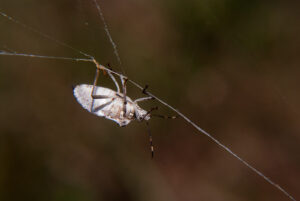
Assassin bug adults and nymphs are slender, colorful insects, often blackish, reddish or brown in color. They have long legs, a long narrow head, round beady eyes, and an extended, 3-segmented, needle-like beak. Nymphs are quite small, 5 mm (1/4 inch) in length when they hatch and grow to an adult size measuring approximately 2 cm (3/4 inch). Adults are poor fliers, and both adults and nymphs move rapidly when disturbed. All assassin bugs are predators. Insect-feeding species eat a variety of prey such as aphids, caterpillars and other bugs, good or bad. Nymphs and adults are often stalking or laying-in-wait for prey. They inject their catch with toxin. Assassin bugs are fairly common in the landscape, but rarely abundant.

Assassin bugs in the genus Pselliopus are distinguished by their black-banded, bright orange bodies (image by Derek Hogan, Campbell University). The adult is about one inch in length.


Euonymus Scale Can Be Heavy

We've received a few samples of euonymus scale recently. The euonymus scale (image by John A. Weidhass; http://www.forestryimages.org/) is a common and sometimes very damaging armored scale pest of euonymus and a few other ornamental plants. It is found throughout North Carolina wherever euonymus, pachysandra and celastrus grow. Yellow spots first appear on the leaves. Leaves and stems may become encrusted with the scales to such an extent that whole branches or the entire plant may die. This scale usually has two or three generations per year. The females lay eggs under their protective shell, and the tiny crawlers hatch and emerge from the mother's armor in April, May and June, which means they are active any time now. They crawl along the leaves and stems before inserting their microscopic, threadlike mouthparts and settling down to grow and secrete the armor. Another brood hatches in late summer, and a partial third brood may appear even later so that all stages of development are present during most of the year. Although this scale is small, infestations are often plainly visible particularly with dense populations in which males usually greatly outnumber female scales. We usually recommend the use of oil for euonymus scale suppression as these pesticides should also control spider mites and other pests of euonymus as well. Commercial operations have additional choices such as Safari. In severe and recurring cases, consider removing the plant from the landscape. Choose another plant or one less susceptible. Ornamental and Turf Insect Information Note No. 15 on the euonymus scale gives some information about its control and links to plant alternatives. It is available on the web at http://www.ces.ncsu.edu/depts/ent/notes/O&T/shrubs/note15/note15.html.


Yellow Jackets Warming Up

Yellow jackets are now reaching noticeable numbers in the landscape and nests may make themselves known.

Yellow jackets (image from USDA’s Agricultural Research Service) are wasps about the size of a large house fly, with distinct yellow and black markings and a few hairs. Their nests are found in the ground 99 percent of the time. They are not good diggers. Therefore, they choose cavities which were formerly rodent burrows, buried rotted logs, bases of nursery grown shrubbery, or gaps under masonry to start their new nests. Underground they construct a paper nest (image by M. Waldvogel) similar to a common hornet. However, it will be tan in color and large (grapefruit size). Occasionally, yellow jackets will nest in attics or wall voids of houses or storage buildings. Colonies normally die in winter. Some more southern states report rare nests that have managed to survive mild winter temperatures in protected areas. This figure (image by Charles Ray; http://www.aces.edu/department/extcomm/npa/daily/archives/002193.php) gives new meaning to the old slogan "See the USA in your Chevrolet."

Yellow jackets may also be late-season pests around picnics, trash cans, ripened fruit and humming bird feeders as they scavenge for food or moisture. The only way to manage this situation is to locate the nest (which is very difficult) and destroy it. Yellow jacket traps are not effective in this part of the country.

If the location of the nest is known, do not pour gasoline down the hole to destroy it. Use an aerosol hornet and wasp killer sprayed directly into the hole at night. A second treatment is sometimes necessary.

Do not forget that yellow jackets are helpful because they prey on other insects. You can find information about yellow jackets at http://www.ces.ncsu.edu/depts/ent/notes/Urban/horn-yj.htm. Methods of reducing the probability of stings by insects can be located on the web at http://www.ces.ncsu.edu/depts/ent/notes/Beekeeping/bee15.html.


INSECT TRAP DATA

From: Mike Carroll, Agricultural Extension Agent, Craven County

Light Trap Data from Craven County

*************************************************************************
        Number of Adult Insects
           **************************************************************
Date        THW   TBW    CEW    GSB    BSB    ECB    FAW    BAW   Looper
*************************************************************************
July 18       4     0     28      4      1      2      7      -        -
*************************************************************************

THW = tobacco hornworms; TBW = tobacco budworms; CEW = corn earworms;
GSB = green stink bugs; BSB = brown stink bugs; ECB = European corn
borers; FAW = fall armyworms; BAW = beet armyworms

Location of trap: Cove City
Cooperators: R&W McCoy Farms and Cove City Fertilizer


From: Curtis D. Fountain, Agricultural Extension Agent, Duplin County

Light Trap Data from Duplin County

***********************************
           Number of Adult Insects
           ************************
Date        BW       GSB       BSB
***********************************
July 2       0         0         0
July 4       1         4         0
July 7       1         8         0
July 9       0         6         0
July 11      0        12         1
July 14      2         1         0
July 16      1         1         0
July 18      4         0         0
***********************************

BW = cotton bollworms; GSB = green
stink bugs; BSB = brown stink bugs

Trap location: approximately two miles east of Albertson
Cooperator: Justin Murphy


From: Alan A. Harper, Lenoir County

Light Trap Data from Lenoir County

June

******************************************************************
            Number of Adult Insects
              ****************************************************
Date         HW    CEW    ECB     AW    AWC    GSB    BSB    TBW
******************************************************************
June 1        0      2      0      0      0      0      0      0
June 2        0      3      0      0      0      1      0      0
June 3        0      1      0      1      0      3      0      0
June 4        0      1      0      0      0      3      0      0
June 5        0      2      0      0      0      2      0      0
June 6        0      3      0      0      0      0      0      0
June 7        1      1      0      0      0      2      4      0
June 8        1      2      1      1      0      1      1      0
June 9        0      2      0      1      1      4      2      0
June 10       1      2      0      1      1      2      1      0
June 11       1      2      0      1      1      1      1      0
June 12       0      1      0      1      1      0      0      0
June 13       0      2      0      1      1      0      0      0
June 14       0      1      1      0      2      0      0      0
June 15       0      2      2      0      0      2      2      0
June 16       0      3      1      0      0      1      0      1
June 17       0      0      0      0      2      1      0      0
June 18       1      2      0      0      2      1      0      1
June 19       0      0      0      0      1      0      0      0
June 20       0      2      2      0      1      0      0      0
June 21       0      3      0      0      3      0      0      0
June 22       0      6      1      0      0      2      0      0
June 23       1      3      1      0      2      3      0      0
June 24       0      2      0      0      3      0      0      0
June 25       0      4      2      0      3      0      1      0
June 26       1      1      0      0      4      1      0      0
June 27       0      1      1      0      0      0      0      0
June 28       0      2      0      0      0      1      0      0
June 29       0      2      0      1      3      2      0      0
June 30       1      0      0      0      2      0      0      0
******************************************************************

July

******************************************************************
            Number of Adult Insects
              ****************************************************
Date         HW    CEW    ECB     AW    AWC    GSB    BSB    TBW
******************************************************************
July 1        0      4      0      2      5      0      0      1
July 2        1      1      1      0      3      0      0      0
July 3        0      1      2      0      7      0      0      0
July 4        3      1      3      0      4      2      0      0
July 5        1      0      0      0      2      0      0      0
July 6        2      6      4      0      4      1      0      0
July 7        1      4      0      0      3      0      0      0
July 8        3      2      2      0      0      2      0      0
July 9        2      2      3      0      2      0      0      0
July 10       3      2      1      0      0      0      0      0
July 11       3      2      3      2      1      0      0      0
July 12       4      0      1      2      0      0      0      1
July 13       3      2      1      1      1      0      0      0
July 14       5      1      3      0      2      1      0      0
July 15       5      3      3      0      3      0      0      1
July 16       3      3      1      3      1      1      0      0
July 17       0      2      0      0      0      0      0      0
July 18       0      4      0      0      0      3      0      0
******************************************************************

Abbreviations: HW = hornworms; CEW = corn earworms; ECB = European
corn borers; AW = true armyworms; AWC = armyworm complex; GSB = 
green stink bugs; BSB = brown stink bugs; TBW = tobacco budworms


The information presented in this newsletter is for educational purposes only and represents the opinions of the respective authors. Any reference to trade names is made with the understanding that no discrimination is intended and no endorsement by the North Carolina Cooperative Extension Service is implied. Use pesticides safely. Read and follow all label directions.

Employment and program opportunities are offered to all people regardless of race, color, national origin, sex, age or disability. North Carolina State University, North Carolina A&T State University, U.S. Department of Agriculture, and local governments cooperating.

North Carolina Cooperative Extension Service

Last modified on July 19, 2008 by Stephen J. Toth, Jr.

This Web version is a cooperative effort between the North Carolina Cooperative Extension Service and the Center for Integrated Pest Management
North Carolina State University College of Agriculture and Life Sciences North Carolina Cooperative Extension Service Department of Entomology Department of Plant Pathology