![]() | Announcements and General Information |
![]() | Field and Forage Crops |
![]() | Fruit and Vegetables |
![]() | Ornamentals and Turf |
![]() | Insect Trap Data |
Due to the Fourth of July holiday on Friday, next week’s issue of the North Carolina Pest News will be published on Thursday, July 3. The contributors and editor of the newsletter wish everyone an enjoyable and safe Fourth of July holiday!
From: Jack Bacheler, Extension Entomologist
Despite being short to very short on moisture in most areas of the state, cotton is still coming along reasonably well with most of our crop probably in the fair to good category (though a bit behind due to cool spring temperatures). With some luck, blooming will be underway in a few cotton fields by early next week. For most cotton fields, bloom initiation will be after our July 4 standard.
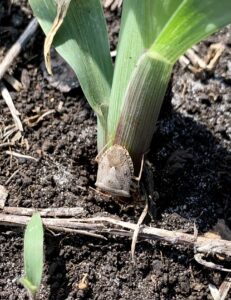
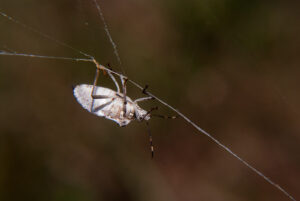
False chinch bugs (image by Colby Lambert on June 24, 2008) have been showing up in somewhat higher numbers than in the past few years. These are about the size of plant bugs, but, where present, occur in far higher numbers and for the most part do only minor economic damage to cotton and soybean seedlings.
If you’re accustomed to plant bugs and their quickness, false chinch bugs are far slower. An initial exposure to this insect can be frightening; sometimes hundreds or even thousands may be present in a square meter. They tend to move in from field edges, but may also be present throughout reduced tillage fields that still have plenty of refuse from the previous year’s crop. Treatment for false chinch bugs is not generally recommended as economic damage is uncommon and control is often poor to mediocre.
Plant bugs have approached economic thresholds in scattered cotton fields, primarily in the far eastern counties, but also in other areas of the state. If upper squares are retained at over 80 percent with no evidence of blackened squares in the terminals, additional, more detailed assessments like ground cloth or sweep net sampling are not needed at that time. If very small blacked squares are noted along with square retentions less than about 90 percent, I’d look further, probably with a sweep net. One consultant reported on June 26 a few fields in which the square retention was still well above 80 percent, but blackened squares were present. Sweeping revealed over 20 plant bugs per 100 sweeps, or about 2.5 times the recommended treatment threshold here. Another consultant in the Edgecombe and Halifax County area reported square retention in the 70 to 80 percent range in 100 to 200 acres. In this case lower square retentions appeared to be associated with proximity to wheat. Additionally, DP-141 appeared to be more attractive and/or susceptible to plant bugs than other varieties, perhaps due to hairiness. As far as we know, plant bug resistance to the insecticides listed in the 2008 North Carolina Agricultural Chemicals Manual has not occurred here, so all of the materials listed should work. Although very active against plants bugs, all of the listed materials except for the chloronicotinoids like Trimax Pro and Centric are disruptive and may increase the odds of cotton aphid and/or spider mite outbreaks, particularly following a prior application of Orthene or other organophosphate insecticide for thrips. Generally speaking, but not always, plant bugs gravitate towards lush cotton fields.
A few spider mite outbreaks have also been reported in eastern North Carolina. Economic levels of spider mites are not fun to deal with, as they are often hard to kill with expensive materials, and sometimes require a second application. Kelthane (now sold as dicofol) has been our old standby and still performs well, even compared to the newer materials like Oberon and Zeal. However, the effectiveness of these and other materials in tests conducted throughout the cotton belt varies greatly. Because of our generally high humidity and the possibility of a fungus coming to the rescue, we generally regard a mite population as treatable when leaf discoloration (such as yellow speckling or bronzing) and live mites are present in 25 percent or more of the field. If rain is immanent, delay the application and reevaluate 3 to 4 days after the rain.
Our initial tri-county area (Hoke, Robeson and Scotland counties) cotton scouting school will be held on Wednesday, July 2 from 10:00 a.m. until noon in the Scotland County Extension office in Laurinburg. Contact David Morrison by telephone (910-277-242) or electronic mail (david_morrison@ncsu.edu) for details.
I will post information about upcoming cotton schools in Northampton and Halifax counties (separate schools to be held on July 22) and in the Edgecombe, Nash and Wilson county area (one school to be held on July 24) in next week’s issue of the North Carolina Pest News.
Remember, you can get weekly cotton insect updates on Thursdays at our Cotton Insect Corner web page (http://ipm.ncsu.edu/cotton/insectcorner/radio/index.html) or in by calling Teletip at 1-800-662-7301 in North Carolina.
Finally, if you would like to get more details about cotton insect scouting procedures with images of most of the insects and their damage to cotton throughout the growing season, see the insect scouting guide available at http://ipm.ncsu.edu/cotton/insectcorner/scouting_guide.htm. A Spanish language version of the guide is also available.
From: Barbara Shew, Extension Plant Pathologist
Peanut leaf spot advisories are now available. Advisories are based on conditions measured at 14 ECONet and airport weather stations located in eastern North Carolina. Advisories are issued by daily email from the Department of Plant Pathology and the State Climate Office. Using a leaf spot advisory instead of a biweekly spray schedule can save one or two sprays in most seasons. Contact Barbara Shew (barbara_shew@ncsu.edu) if you would like to receive leaf spot advisories this year. In well-rotated fields, leaf spot sprays (biweekly or advisory) should begin at R3, very early pod stage (see attachment on peanut development).
From: Rob Welker, Department of Plant Pathology, Katie Jennings, Department of Horticultural Science, and Frank Louws, Department of Plant Pathology
After many years of discussing the end of methyl bromide, we are nearing the actual end of methyl bromide for use in crops. Shortages will occur, and cost is going to be a factor as demand for the limited supply drives up the price. If you have not tried alternative fumigants on your farm, this is the time to seriously think about why you fumigate and switch a portion of your production to an alternative. The opportunity to test an alternative on a portion of your crop on your farm before being forced to use something is running out.
If you use a good crop rotation, or are moving onto new production land, then the need to fumigate is minimal. It might not even be needed at all. For many growers, though, rotations are not practical, and the same crop has been on the same fields for years, making fumigation the answer to reduce pathogens and weeds.
How can you make a good decision about what to use? Think about why you fumigate on your farm. What are the soil issues that make fumigation desirable? If you are unsure of your problems and have been fumigating simply because it is part of the plasticulture system, then try leaving some of your production unfumigated and see what the results are. You might be surprised. In an on-farm strawberry trial in the western piedmont of North Carolina, a nonfumigated treatment yielded statistically the same as the methyl bromide treatment. For most cases, however, we have seen approximately 20 percent reduction in yield when strawberries have not been fumigated. So what should you use? Rate your production field for the four problems in the chart below using a 0 to 5 scale, where 0 is not a problem at all, and 5 is a problem that will cause significant yield loss if not controlled. If you marked 3 or higher for a problem, then it should be treated with fumigation; 2 or lower can be managed in a different manner.
|
|
No Problem to Huge Problem |
|||||
|
Fungal Disease 1 |
0 |
1 |
2 |
3 |
4 |
5 |
|
Nematodes |
0 |
1 |
2 |
3 |
4 |
5 |
|
Annual and Biennial Weeds |
0 |
1 |
2 |
3 |
4 |
5 |
|
Perennial Nutsedge (yellow and purple) |
0 |
1 |
2 |
3 |
4 |
5 |
1 e.g., Black Root Rot Complex; Phytophthora crown rot
What is currently labeled for use that might be used for your pest problems? Use the chart below to find a product or combination of products that treats the problems rated at 3 or higher.
|
Fumigants |
Fungal Disease |
Nematodes |
Annual/biennial weeds1 |
Perennial Nutsedge |
|
Chloropicrin |
E |
N |
N |
N |
|
Metam Sodium2 (MS) |
F to G |
P to F |
G to E |
F |
|
Chloropicrin + MS |
E |
P to F |
G to E |
G
to E or |
|
Telone C-35 |
E |
E |
P to F |
P |
|
Telone C-35 +
VIF3 |
E |
E |
G to E |
P to F |
|
PicClor 60 |
E |
E |
P to F |
P |
|
PicClor 60 + VIF |
E |
E |
G to E |
P to F |
|
MIDAS + VIF |
E |
E |
G to E |
G to E |
|
Paladin4 + VIF |
E |
E |
G to E |
G to E |
|
Herbicides6 |
|
|
|
|
|
|
|
|
|
|
|
Goal herbicide (under plastic) |
|
|
G to E |
N |
|
Stinger herbicide (Very specific weed spectrum) |
|
|
G to E |
N |
|
Chateau herbicide (under plastic) |
|
|
G to E |
N |
1 Limited data is available on control of annual and biennial weeds by these fumigants.
2 Vapam, Sectagon or other registered formulations.
3 VIF refers to Virtually Impenetrable Film which allows lower fumigant application rates but at the same time has improved efficacy of fumigants.
4 Paladin is a new fumigant currently being used under an experimental use permit in North Carolina, Georgia and Florida and could potentially be available soon on the open market.
5 When applied in the spring control is Good to Excellent, however when applied in the fall control is reduced because the fumigant gasses off due to the warm soils.
6 See respective labels to determine the specific weeds each herbicide controls.
Key:
E = excellent control, 90% or better
G = good control, 80% to 90%
F = fair control, 50% to 80%
P = poor control, 25% to 50%
N = no control, less than 25%
The herbicides listed above have had success in our trials and can be a great compliment to fumigation. Goal herbicide (chemical name oxyfluorofen) is a broad spectrum preemergence herbicide that provides good control of some stubborn weeds including Carolina geranium. It does have a 30-day preplant application interval, however, and soil disturbance after application must be minimized in order to obtain good weed control. Chateau (chemical name flumioxazin) is a new herbicide that is marketed by Valent Corporation. Recently, this herbicide received a supplemental label for use in strawberry. The label allows for three types of applications. They are: 1) Chateau is registered to apply preemergence to the soil a minimum of 30 days prior to transplanting strawberries in plasticulture production; 2) it can be applied to dormant strawberries in matted row production systems for the preemergence control of weeds; or 3) it can be applied to row middles with a shielded or hooded sprayer for the preemergence control of weeds. Chateau controls many broadleaf weeds including wild mustard, common and mouseear chickweed, cutleaf eveningprimrose, henbit, horseweed (marestail), wild radish, shepherd’s-purse and many others. To avoid spotting on fruit, Chateau should not be applied to the row middles after fruit set. Spotting on the strawberry leaves and fruit may also occur if Chateau is mixed with an adjuvant (crop oil or surfactant). Devrinol (chemical name napropomide) manufactured by UPI can be applied to the pre-formed bed prior to laying plastic. However, there is the potential for crop injury. Devrinol controls annual broadleaf weeds. Stinger (chemical name clopyralid) manufactured by Dow AgroSciences is registered for a postemergence application to strawberry in North Carolina. Although Stinger controls a narrow spectrum of weeds, it controls two very troublesome weeds in strawberry production including vetch and curly dock. To avoid potential crop injury Stinger should not be tank mixed with any other pesticides and an adjuvant (surfactant or crop oil) should not be included with Stinger. Poast (chemical name sethoxydim) and Select Max (chemical name clethodim) are registered for postemergence control of annual and perennial grasses.
If you decide to try one of these herbicides, we suggest that you apply the herbicide to a small portion of your strawberry crop to gain experience and as always, read the label prior to use of any pesticide and follow all label precautions and instructions.
The fumigants above are all currently registered chemicals that can be applied using a shank application with minor adjustments to your equipment. Paladin is available through an Experimental Use Permit and can be used through a special program that provides training and guidance for the chemical use. MIDAS is available as a fully labeled chemical, but it also requires applicators to attend a training session before application. Several of these chemicals are also available for use through a drip application system if that method of application fits your production system better. Be aware that labels for several of these chemicals have been revised recently, and more revisions are expected soon. Please pay close attention to the labels and be sure and follow the buffer requirements and wear all the required personal protective equipment. New requirements, for example, may have all personnel in the field during application wearing respirators and long pants and shirts. These requirements are for your protection and are also the law, so adhere strictly to their labels.
With methyl bromide availability dwindling, the time to transition to alternatives is here. We are currently setting up a new group of on-farm strawberry trials in the Southeast for 2008-2009. If you are interested in participating in a trial, please contact Rob Welker by telephone at (919) 306-0941 or by electronic mail at rob_welker@ncsu.edu. Also watch for field days near you next spring when we will visit these on-farm trials and look at the results.
From: Steve Bambara, Extension Entomologist
Bagworms have been actively feeding for several weeks, but I've delayed recommending any control because they are often too small to be noticed. You should now be able to see small bags (image by Steve Bambara), perhaps 1/2 inch, on the junipers, leyland cypress, or any susceptible plant. The appetite of these insects is still small, but this is the time to treat. If you wait too many more weeks they'll be eating as much as Bill Dauterive (http://en.wikipedia.org/wiki/Bill_Dauterive) in a hot dog eating contest. Evergreen trees and shrubs could be severely defoliated.
Roses are red, grass is green. So are green June beetles (image by James R. Baker). Expect to see them in one to two weeks. They do little harm to plants and do no harm to people. They can be handled without fear. Though there are possible control measures available for turf (later in the season). I have rarely ever seen this justified in residential turf (unless your backyard used to be a pasture). Grubs are sometimes a problem in pastures and heavy manure-applied fields. Adults are sometimes a problem in fruit trees and vines. Adult populations should start to decline after two weeks and they should be gone after three to four weeks. Patience is the best recommendation. For more information about patience, see an anger management counselor. For more information on green June beetle, see the following insect notes available on the web:
http://www.ces.ncsu.edu/depts/ent/notes/O&T/lawn/note67/note67.html
http://www.ces.ncsu.edu/depts/ent/notes/forage/gjbnote02/note02.htm
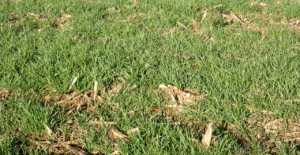
We have recently seen several samples of chinch bugs (image from the University of Nebraska) in home lawns. Reports have been more of concern, rather than damage, so far. Chinch bugs are small (about 1/6 inch), slender insects with black and white markings. This bug is a severe pest of St. Augustinegrass in North Carolina. It also attacks centipedegrass. Chinch bugs cause yellowish spots in lawns that rapidly turn into brown, dead areas. Most of the damage is caused by the young, bright-red nymphs. Chinch bugs seem to be worse in lawns that have a layer of thatch. Good thatch management helps not only by making the lawn less attractive to the bugs, but it also makes it easier for the pesticide to reach the chinch bugs when they are treated. The treatment threshold is 20 to 25 bugs per square foot. Don't treat unless needed.
For additional information on chinch bugs, see Ornamentals and Turf Insect Note No. 112 on the web at http://www.ces.ncsu.edu/depts/ent/notes/O&T/lawn/note112/note112.html.
Now that the “buzz” about periodical cicadas has hushed, it is time for the common annual cicadas to appear. Cicadas are part of charm of summers in North Carolina. The males sing high in trees with long, loud songs composed of buzzes and clicks. The songs are distinct for each species.
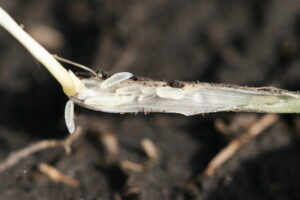
Most of the summer cicadas are in the genus Tibicen. Tibicen cicadas are large, robust, dark insects with lighter markings and greenish-colored margins on the wings. The female is mute (no comments, please) and is attracted to the male by his singing. The only real damage cicadas do is during egg-laying when females jab their eggs into small stems. When the tiny cicada nymphs hatch, they fall to the soil and burrow in where they spend the next few years feeding on the roots of various plants (the nymphs are not considered pests as they cause no noticeable injury). Sometime during the summer, mature nymphs emerge from the soil, crawl upward and cling to the bark of trees while they molt into the adult stage. The papery skins of the nymphs are left behind (image by James R. Baker) for children to gather up in boxes and cups to bring inside where they are eventually discarded by mothers who have no appreciation for cicada nymphal skins. Cicadas that emerge during the summer (image by James R. Baker) are never abundant enough to cause noticeable damage.
Ornamentals and Turf Insect Note No. 17 has additional information on cicadas and is available at http://www.ces.ncsu.edu/depts/ent/notes/O&T/shrubs/note17/note17.html.
From: Alan A. Harper, Lenoir County
June
******************************************************************
Number of Adult Insects
****************************************************
Date HW CEW ECB AW AWC GSB BSB TBW
******************************************************************
June 1 0 2 0 0 0 0 0 0
June 2 0 3 0 0 0 1 0 0
June 3 0 1 0 1 0 3 0 0
June 4 0 1 0 0 0 3 0 0
June 5 0 2 0 0 0 2 0 0
June 6 0 3 0 0 0 0 0 0
June 7 1 1 0 0 0 2 4 0
June 8 1 2 1 1 0 1 1 0
June 9 0 2 0 1 1 4 2 0
June 10 1 2 0 1 1 2 1 0
June 11 1 2 0 1 1 1 1 0
June 12 0 1 0 1 1 0 0 0
June 13 0 2 0 1 1 0 0 0
June 14 0 1 1 0 2 0 0 0
June 15 0 2 2 0 0 2 2 0
June 16 0 3 1 0 0 1 0 1
June 17 0 0 0 0 2 1 0 0
June 18 1 2 0 0 2 1 0 1
June 19 0 0 0 0 1 0 0 0
June 20 0 2 2 0 1 0 0 0
June 21 0 3 0 0 3 0 0 0
June 22 0 6 1 0 0 2 0 0
June 23 1 3 1 0 2 3 0 0
June 24 0 2 0 0 3 0 0 0
June 25 0 4 2 0 3 0 1 0
June 26 1 1 0 0 4 1 0 0
June 27 0 1 1 0 0 0 0 0
******************************************************************
Abbreviations: HW = hornworms; CEW = corn earworms; ECB = European
corn borers; AW = true armyworms; AWC = armyworm complex; GSB =
green stink bugs; BSB = brown stink bugs; TBW = tobacco budworms
Employment and program opportunities are offered to all people regardless of race, color, national origin, sex, age or disability. North Carolina State University, North Carolina A&T State University, U.S. Department of Agriculture, and local governments cooperating.
Last modified on June 28, 2008 by Stephen J. Toth, Jr.