Stephen J. Toth, Jr., editor
Volume 22, Number 6, May 18, 2007

Caution!
The information and recommendations in this newsletter are applicable to North Carolina and may not apply in other areas.


In This Week's Issue . . .

Field and Forage Crops

Fruit and Vegetables

Ornamentals and Turf


FIELD AND FORAGE CROPS

From: Jack S. Bacheler, Extension Entomologist

Thrips on Cotton

On Tuesday, May 15, we looked at test plots planted 2˝ weeks earlier in Edgecombe County. In the untreated checks, the expanded cotyledons still looked reasonably healthy, but we were able to find 6 to 8 adult thrips per plant. With further feeding, additional migrating adults and immature thrips coming in the next few days, I would expect these untreated plants to sustain significant damage in the next week, or less.

Although some areas of the state received rainfall on Wednesday evening (May 16), dry weather in general has been the norm. The possible continuation of a dry trend would likely release moderate to high levels of thrips across much of the state as crop (e.g., wheat) and non-crop (e.g., weedy ditch banks) thrips hosts continue to dry down. On the plus side, cotton so far appears to be “growing off” much better that in 2005 or in 2006, though it’s still early.

Expect thrips damage to increase sharply during the next two weeks in situations in which a foliar spray is not made within approximately three weeks following a seed treatment such as Cruiser, Gaucho Grande, Avicta, or Aeris. In a replicated test last year, Virginia Tech University’s Ames Herbert evaluated several different nozzle configurations for thrips control, including some flat fan nozzles better suited for weed control. Surprisingly, all provided similar thrips control. This suggests that correct timing and a good insecticide rate (e.g., 0.25 active ingredient per acre of Orthene, or the equivalent) are the primary considerations in thrips control.

If cotton planted is planted after about May 20, producers can probably reduce the at-planting rate of Temik 15G to 3 pounds of product per acre, or use a seed treatment without a follow-up foliar spray.


Spider Mites on Cotton

Judging from the five reports I have received from the Plant Disease and Insect Clinic at North Carolina State University in the past 10 days showing very high levels of spider mites on strawberries, perhaps cotton scouts should be on the lookout for mites in cotton, particularly following foliar treatments for thrips. Mite problems on cotton are most likely to begin approximately two to six weeks after the foliar spray in North Carolina, although both earlier and later outbreaks are possible. Look for yellow stippling on cotton foliage, followed by a reddening of interior parts of the leaf as damage progresses (Image from Jack Bacheler; http://cottoninsectcorner.org).

Defoliation of yellowing bottom leaves is possible if mite levels are high and associated with plant stressors such as drought. If lower leaf drop is beginning throughout the cotton field, this is often a trigger for treatment. Inspection of the undersides of leaves along the mid vein for the tiny mites, their round pearly eggs, and associated webbing confirms the presence of mites. Although mites can occur in a variety of situations, their levels more commonly build during hot, dry conditions.


FRUIT AND VEGETABLES

From: Gerald J. Holmes, Extension Plant Pathologist

Pumpkin Disease Control Q&A

QUESTION: Can you give me a basic spray program to follow for controlling diseases of pumpkin?

ANSWER: This is a common question for any crop. I understand “basic spray program” to mean a product(s) that can be sprayed on a calendar basis to cover most diseases in most years. Such a program is difficult to devise because of the number of diseases that pumpkins might get and the year-to-year variations in weather that influence those diseases.

My experience suggests that the important pumpkin diseases in North Carolina (i.e., those that occur with some regularity and can be very destructive) are damping-off, root-knot, mosaic viruses, Phytophthora blight, downy mildew and powdery mildew. These diseases are very different from each other in terms of their causal agents and methods of control. Therefore, a single, calendar-based spray program is not advised for all pumpkin growers in North Carolina. Rather, growers should assess conditions on their farms to determine which control measures should be taken and when. A set of tables has been developed to help growers determine the best course of action for the long list of diseases that cucurbits can get in the Southeast. They are available to growers in the North Carolina Agricultural Chemicals Manual (http://ipm.ncsu.edu/agchem/agchem.html) and the 2007 Vegetable Crop Handbook for the Southeastern U.S.. What follows are some guidelines for each of the diseases mentioned above.

To prevent damping-off, growers should plant when conditions favor rapid germination. Seed should of high quality and treated with a fungicide (e.g., Apron and/or Thiram) as an added measure of protection. Since pumpkins are generally planted in June, the threat of Pythium damping-off from cool, wet conditions is low.

Root knot is often overlooked because of its below-ground nature, but can cause significant losses. Growers should take soil samples in the fall and send them to the North Carolina Department of Agriculture & Consumer Services for a nematode analysis. This will indicate whether or not the field should be rotated to another crop or if fumigation is needed. Once the crop is planted, nothing can be done against root knot nematode.

Mosaic viruses are frequently a problem and can be devastating. Because pumpkins are planted late, they are more likely to get mosaic viruses than cucurbits planted in the spring. Unfortunately, they mosaic viruses cannot be controlled with sprays. Growers should be reminded that spraying insecticides to kill the vector (e.g., aphids) will not control viruses. Some virus-resistant cultivars are being developed and growers should check with their seed suppliers for available virus-resistant cultivars.

Phytophthora blight is a devastating disease that is present in some fields and is very dependent on rainfall. Growers should avoid planting pumpkins in fields with a history of this disease. Unfortunately, there are currently no highly effective control measures. Preventing standing water in the field is the best way to minimize losses. Control with fungicides is generally poor and inconsistent.

Powdery mildew is difficult to control because our currently registered fungicides (Bravo, Quadris, Cabrio, Flint, Nova and Procure) do not work well. In several trials, our best results have been achieved by alternating Flint and Nova on a 7-day interval beginning at the first sign of the disease. However, the difference between using these products and doing nothing is getting smaller each year. Quintec is a new product that we expect to be registered for use in 2008. This product is outstanding against cucurbit powdery mildew.

Unlike powdery mildew, downy mildew is less predictable, more destructive, progresses faster and relies more heavily on preventive action to effectively control. Several fungicides are effective against downy mildew, but they must be used prior to the appearance of the disease. Effective fungicides include Previcur Flex, Ranman, Tanos, Curzate and Gavel. These should be tank mixed with protectant fungicides such as chlorothalonil (Bravo, Echo, Equus or Terranil) or maneb.

In order to avoid unnecessary sprays, growers can follow the Cucurbit Downy Mildew forecasts on the web at http://www.ces.ncsu.edu/depts/pp/cucurbit/. Forecasts are issued on Tuesdays and Thursdays each week and include a map of currently reported outbreaks of this disease in the U.S. Downy mildew and powdery mildew often occur at the same time, in which case both spray programs should be combined. An effective downy mildew spray program will not be effective against powdery mildew and vice versa.


ORNAMENTALS AND TURF

Photo Gallery of Insects and Mites on Ornamental Plants


From: Stephen B. Bambara, Extension Entomologist

Lesser Canna Leafroller Time

If your canna plantings (Image by Steve Bambara) have been heavily attacked by the lesser canna leafroller in the past, it may soon be time to treat. It would be later in western counties. As leaf whorls begin to open, attack by the leafroller becomes more likely.

Early larvae may appear, like leaf miners. This pest is more prominently recognized in the fall as the second generation damage becomes more noticeable and that's when county Extension agents are more likely to receive telephone calls regarding this pest.

Lesser canna leafrollers are small caterpillars (Image by James R. Baker) related to European corn borers, pickleworms, coneworms and sod webworms. Lesser canna leafrollers overwinter as larvae in the leaves and stems of canna and the moths emerge to mate and lay eggs after the new growth emerges in the spring. When the larvae hatch, they feed within the new, rolled leaves. Older larvae can actually tie the edges (Image by James R. Baker) of older leaves together and roll the leaf! One mistake canna growers make is to leave the old dead growth on the canna bed as mulch. Canna seems to be the only host plant for this pest. If the plants are isolated from other cannas, it may be possible to drastically reduce the lesser canna leafrollers by carefully removing all dead leaves and stems in the fall after the frost has killed it back.

It is possible to eliminate this pest by spraying Orthene several times at 10-day intervals. Bacillus thuringiensis (B.t.) insecticides are also effective for this pest. Landscapers are encouraged to spray the dilute pesticide mixture directly down into the rolled leaves so that the pesticide can soak into the shelter around the caterpillars. They are especially encouraged to gather and destroy all of the dead tops this winter after frost. For more information on lesser canna leafrollers, see Extension Publication AG-136 available on the following web site: http://ipm.ncsu.edu/AG136/cater12.html.


Green Lacewings

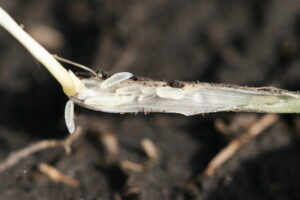
Green lacewings are appearing now that aphids and other small soft-bodied insects have been in the landscape for a while. The common green lacewing occurs throughout North America. The light green adult (Image by Steve Bambara) has long, slender antennae, golden eyes, and large, veined, gauze-like wings that are 1/2 to 1/3 inch in length. It is a slow-flying, nocturnal insect that feeds on nectar and pollen, and it emits a foul-smelling fluid from special glands, if captured. It sometimes appears at porch lights. The female lacewing usually lays eggs in groups on leaves. Each egg is held above the leaf surface on a slender stalk (Image from Cotton Insect Corner web site; http://cottoninsectcorner.org). A female lacewing can lay up to 300 eggs over a period of 3 to 4 weeks in a greenhouse, but individuals rarely survive that long in the field. Doodlebug-like larvae (Image from Cotton Insect Corner web site; http://cottoninsectcorner.org) and adults consume soft-bodied insects such as aphids.


Pine Spittlebugs

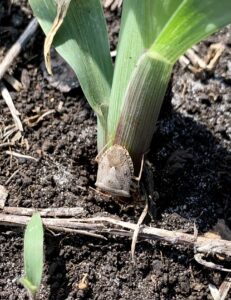
Pine spittlebug nymphs (Image by James R. Baker) are actively feeding now. In July and August, female pine spittlebugs lay their eggs in dead wood or under the bark of live stems of pines, spruces, firs, hemlock and other conifers. They overwinter in the egg stage. When the nymphs hatch from their eggs, they begin to feed. Spittlebugs suck sap out of the plants with their needlelike mouthparts. As the nymphs feed, they excrete "spittle" that protects them from predaceous mites and insects. Scots pine often exhibits flagging of twigs at each pine spittlebug feeding site. The flagging is apparently caused by Diplodia pini, a fungus that invades the tree through the insect's feeding punctures. Similar localized dieback has been observed on Leyland cypress (see Ornamental and Turf Insect Note No. 133 at: http://www.ces.ncsu.edu/depts/ent/notes/O&T/specificplants/note133/note133.html).

Pine spittlebugs tend to be more abundant during dry seasons perhaps because dry weather inhibits the parasitic fungus, Entomophthora aphrophorae. On the other hand, high temperatures cause some mortality of the nymphs. There is only one generation per year. They are normally not too abundant to need treatment. In a short tree consider washing them out with a strong water hose. If necessary, Orthene or some other contact insecticide could be considered when the spittle masses and spittlebugs are present if they are abundant.


The information presented in this newsletter is for educational purposes only and represents the opinions of the respective authors. Any reference to trade names is made with the understanding that no discrimination is intended and no endorsement by the North Carolina Cooperative Extension Service is implied. Use pesticides safely. Read and follow all label directions.

Employment and program opportunities are offered to all people regardless of race, color, national origin, sex, age or disability. North Carolina State University, North Carolina A&T State University, U.S. Department of Agriculture, and local governments cooperating.

North Carolina Cooperative Extension Service

Last modified on May 21, 2007 by Stephen J. Toth, Jr.

This Web version is a cooperative effort between the North Carolina Cooperative Extension Service and the Center for Integrated Pest Management
North Carolina State University College of Agriculture and Life Sciences North Carolina Cooperative Extension Service Department of Entomology Department of Plant Pathology