Major Corn Diseases in North Carolina
Harry E. Duncan, Specialist in Charge, Extension Plant Pathology
K. J. Leonard, Professor (USDA), Plant Pathology
Gary Payne, Assistant Professor, Plant Pathology
Placed on the Web prior to 1/95 by the Center for Integrated Pest Management, NCSU
Table of Contents
- DISEASES
- Seed Rots and Seedling Blights
- Southern Corn Leaf Blight
- Northern Corn Leaf Blight
- Anthracnose
- Southern Rust
- Common Rust
- Common Smut
- Gray Leaf Spot
- Brown Spot
- Stalk Rots
- Ear and Kernel Rots
- NEMATODES
- Stubby-root
- Sting
- VIRUSES
- Maize Dwarf Mosaic Virus
- Maize Chlorotic Dwarf Virus
- BACTERIAL DISEASES
- Bacterial leaf blight
- Bacterial stalk rot
Each year diseases cause some losses in corn production in North Carolina. A
number of diseases affect corn with individual fields often suffering severe
losses.
All parts of the plant may be attacked -- the ears, leaves, stalks, and roots --
at various stages of development. Diseases reduce the value and quality of the
grain and may increase harvesting costs when affected plants lodge.
Corn leaf, ear and stalk diseases generally are favored by warm, wet weather.
Most root rots such as Pythium root rot are more severe in wet than in dry
soils, but charcoal rot is favored by hot, dry conditions. Seedling diseases are
favored by cool soil temperatures that delay emergence and growth of seedlings
and are more severe when planting time is unusually wet. Symptoms of nematode
damage are more pronounced in sandy soils, which can support large nematode
populations, and during dry weather, when the effects of root damage are
apparent as increased plant stress.
There are no completely effective measures for controlling all corn diseases;
however, losses can be minimized by following certain recommended practices.
Growers should become acquainted with disease problems and factors affecting the
severity of the disease.
DISEASES
Seed Rots and Seedling Blights (caused by species of Fusarium,
Diplodia, Pythium, and other fungi). Germinating corn kernels may be
attacked
by a number of soilborne or seedborne fungi that cause seed rots and seedling
blights. The terms "preemergence" and "postemergence damping-off" are often used
to specify the affected growth stage. These diseases are more prevalent in
poorly drained, excessively compacted, or cold, wet soils. Planting old or poor
quality
seed with mechanical injury to the pericarp will increase seed rot and seedling
blight as will planting seed too deep in wet, heavy soils. Hybrids differ in
genetic resistance to the fungi that cause seed rot and seedling blight. Seed
treatment with a good fungicide is an important method for control of these
fungi.
Southern Corn Leaf Blight (caused by the fungus Bipolaris maydis
[Helminthosporium maydis]). Southern corn leaf blight occurs worldwide, but
is particularly damaging in regions of warm, moist weather. Lesions on the leaves
(Fig. 1) caused by Race 0 of the fungus are elongated between the veins, tan, up
to one inch long, with limited parallel margins and buff to brown borders.
Lesions produced by Race T (which was very prevalent in the early 1970s) are tan,
1/4 to 1/2 inch x 1/4 to 1 inch, spindle-shaped or elliptical, with yellow-green
or chlorotic halos. Later, the Race T lesions often have dark, reddish-brown
borders and may occur on all parts of the plants (
Fig. 2). Race T is commonly
found only when hybrids with Texas male sterile cytoplasm are grown. Both races
of the fungus overwinter on corn debris in the field. Thus, rotation and
destruction of residue will reduce losses due to this disease. Resistant hybrids
are also available.
Northern Corn Leaf Blight (caused by the fungus Exserohilum turcicum
[Helminthosporium turcicum]). Symptoms of this disease (
Fig. 3) are long
elliptical, grayish-green or tan lesions ranging from 1 to 6 inches in length,
developing first on lower leaves and later causing severe damage to the upper
leaves under moderately warm and moist weather conditions. This disease is
favored by somewhat cooler weather than southern leaf blight and has been quite
severe in the mountain counties. Northern corn leaf blight can cause premature
death and gray appearance of foliage that resembles frost or drought injury. As
with southern corn leaf blight, control is by rotation, destruction of crop
debris, and use of resistant hybrids. There are at least three pathogenic races
of the fungus, but moderate to good resistance is available to all of them.
Anthracnose (caused by the fungus Colletotrichum graminicola).
Symptoms of this disease vary widely, depending on the hybrid, age of the leaf,
and environment. Small, oval to elongate, water-soaked spots first appear on the
leaves at any stage of growth. The spots may enlarge up to one-half inch long and
become tan at the center with red, reddish-brown, or yellow-orange borders. The
lesions may grow together, blighting the entire leaf. Leaf symptoms are most
common early in the season on the lower leaves and late in the season on the
upper leaves.
Lesions on stalks (
Fig. 4) usually appear initially as black linear streaks under
the epidermis. On susceptible plants the lesions may develop into large oval,
black areas measuring 1/2 to 1 inch, or larger. In severe infections, large areas
of the stalk may be blackened. When the infected stalks are split, a mottled
brown discoloration may be seen, particularly at the nodes. This discoloration
may be present even when lesions are not apparent on the surface of the stalk.
It is common with anthracnose for the upper 1/3 of the plant to prematurely die.
Anthracnose is a very important cause of lodging in North Carolina.
Anthracnose is favored by warm, moist conditions during the growing season.
Plants are most susceptible in the seedling stage and later as they approach
maturity. There is a wide range of susceptibility in hybrids. The fungus
overwinters on plant debris left above ground. Thus, control of this disease is
based upon crop residue destruction, rotation, and use of tolerant or resistant
hybrids.
Southern Rust (caused by the fungus Puccinia polysora). Southern
rust can be recognized by the bright orange or golden brown, circular to oval
pustules which give a rusty appearance to the leaves (
Fig. 5). The pustules are
about the size of a pin head and are filled with powdery masses of orange spores
which can be rubbed off. These spores are readily dislodged and blown about in
the wind. The spores can survive and infect plants after being transported
hundreds of miles by the wind.
The southern rust fungus has no known means of survival in the absence of living
susceptible plants. During the winter months it is limited to tropical areas
where corn is grown year round. The extent to which it spreads into temperate
areas depends upon weather patterns and the susceptibility of the corn along the
path of spread.
Southern rust is favored by the warm, humid conditions found in many lowland
tropical areas where corn is grown. However, even in those areas, corn with good
resistance suffers little or no damage. In temperature areas less ideal for the
growth of the fungus, damage can occur in corn and lacks good resistance.
Since southern rust cannot survive the winter in North Carolina, the initial
infections must result from spores blown into North Carolina from the south. The
fungus can multiply very rapidly on susceptible corn, and the amount of damage
that occurs depends upon how early the first spores arrive. Epidemics may result
from unusual weather patterns that cause mass air movements from the tropics
where the rust is present.
Common Rust (caused by the fungus Puccinia sorghi). Common rust
occurs in temperature to sub-tropical areas. It differs from southern rust by the
darker, more reddish-brown color of the pustules. Also, pustules of common rust
tend to be longer than those of southern rust and they occur more often in
scattered clumps on the leaves. Pustules of southern rust are usually quite
uniformly distributed over the surface of the leaf. Common rust is able to
survive the winters in temperate areas because it produces teliospores, which are
resistant to weathering. These spores germinate in the spring to produce
basidiospores. The basidiospores can infect wood sorrel (Oxalis spp.); the
spores produced in infections on wood sorrel can complete the life cycle of the
fungus by infecting corn.
Common rust has been present for a great many years in all major corn producing
areas of the world. It has not been regarded as a major cause of damage in any
of those areas. In 1951 in one of the heaviest outbreaks of common rust known in
the United States, estimated average losses ranged from less than 1 percent to
3 percent. Resistance and tolerance to common rust are prevalent and effective
in corn hybrids throughout the world.
Common Smut (caused by fungus Ustilago maydis). Common smut occurs
wherever corn is grown. Losses to smut are generally light, but may be important
in some situations, particularly sweet corn. Young actively growing parts of the
plant are susceptible to infection. Large galls may appear on stalks at the
nodes, on ears (Fig. 6), or rarely on tassels. Leaf infections may result in
small inconspicuous galls. On ears or stalks the galls expand rapidly and are
covered with a thin greenish-white or silvery-white tissue. As the galls mature,
the covering ruptures exposing masses of black spores within. Individual galls
on stalks may be up to 6 inches in diameter. On infected ears, a large number of
galls originating from individual infected kernels may combine to form the
compound gall mass that replaces most of the ear.
Smut is usually more severe on plants heavily fertilized with nitrogen. The
severity is increased by injury from hail, cultivators, etc. Control involves
avoiding highly susceptible varieties, avoiding mechanical injury to plants
during cultivation and spraying, and providing well-balanced soil fertility.
Gray Leaf Spot (caused by the fungus Cercospora zeae-maydis). The
fungus can infect leaf blades and, to a much lesser extent, leaf sheaths. The
gray or pale brown lesions are long and narrow with parallel sides delimited by
leaf veins (Fig. 7). The ends are usually blunt, giving the lesions a long
rectangular shape. Lesions commonly are about 1/4 inch wide by about 1 inch long.
When the disease is severe, lesions merge into long stripes. Eventually the
entire leaf may be killed.
Gray leaf spot was first reported on corn in Illinois in 1925. Although it has
been said to be common in South America, it was not reported in the U.S. again
until 1943 when it was found causing moderate to severe damage in some fields in
eastern Tennessee and Kentucky. Gray leaf spot has caused moderate to severe
damage to corn in the mountain valleys of the Appalachian region. In North
Carolina, the disease is most severe in the mountains and western piedmont, but
it has been observed on corn in Wake County when infected debris was spread on
the ground in a field.
The gray leaf spot fungus survives the winter as resistant mycelium in corn
debris left in the field. The disease is usually more severe in no-till planted
corn without rotation. Thus, rotation, debris destruction, and resistant
varieties offer the best methods of controlling this disease. It appears that the
most tolerant hybrids are late maturing hybrids.
Brown Spot (caused by the fungus Physoderma maydis). Brown spot is
favored by high temperatures and high humidity. It attacks leaf blades, sheaths,
and stalks, producing small, reddish-brown to purplish-brown spots which may
merge together to form large brown blotches (
Fig. 8). Weakened stalks frequently
lodge and leaf sheaths may be reduced to shreds. Good cultural practices and the
use of tolerant varieties offer the best control.
Stalk Rots (caused principally by the fungi Diplodia zeae and
species of Fusarium as well as Colletotrichum graminicola). Stalk
rots are present each year and may cause considerable damage, particularly if
abundant rainfall occurs during the latter part of the growing season. Stalks
previously injured by cold, leaf diseases, or insects are especially susceptible
to attack by these fungi. Diseased stalks ripen prematurely and are subject to
excessive stalk breaking (
Fig. 9). Stalk rots (
Figs. 10,
11 and 12) not only add
to the cost of harvesting but also bring the ears in contact with the ground,
increasing their chance of rotting.
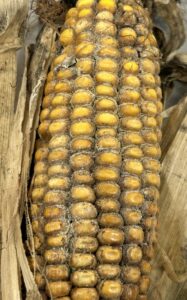
Ear and Kernel Rots (caused by species of Diplodia, Fusarium and
many other fungi). Ear and kernel rots (
Fig. 13) may cause serious losses under
warm, wet conditions at harvest time. Severe infection not only reduces yield but
also lowers the quality and grade of the grain produced. In addition to these
losses, the infected kernels make poor feed and are worthless as seed. The two
principal ear and kernel rot fungi found in North Carolina are Diplodia
and Fusarium. Fusarium typically causes a pink or reddish rot of the ear,
while ears infected with Diplodia appear white to grayish-brown. Moldy
grain may be toxic to livestock, especially to young animals.
Aflatoxin Contamination
Toxic metabolic by-products of fungi known as mycotoxins have received
considerable attention during the past several years. The mycotoxin found in corn
harvested in North Carolina that has received the most attention is aflatoxin,
produced by the fungus Aspergillus flavus. Aflatoxins can occur in several
chemical forms. In corn the most common aflatoxins are aflatoxin B1 and aflatoxin
B2. Aflatoxins are known to cause serious health problems in animals including
reduced weight gain, capillary fragility, reduced fertility, suppressed disease
resistance, and even death. No animal is known to be resistant, but in general,
older animals are more tolerant than younger animals. Aflatoxins have been
implicated in deaths from acute toxicoses in young animals, particularly poultry,
as well as several animal health problems, including reduced fertility and growth
rate. Aspergillus flavus is widely distributed in nature and is favored
by high temperature. Temperatures ranging from 80 to 100 degrees F and a relative
humidity of 85 percent (18 percent moisture in the grain) are optimum for A.
flavus growth and aflatoxin production. Growth of the fungus does not occur
below 12 to 13 percent moisture in the grain.
Aflatoxin contamination is higher in corn that has been produced under stress
conditions. Thus, drought, heat, insect, and fertilizer stress are all conducive
to high levels of aflatoxins. Therefore, in order to minimize the level of
aflatoxins, the following practices should be followed:
- Use recommended production practices.
- Plant early.
- Irrigate to reduce drought stress, especially during pollination.
- Harvest early.
- Avoid kernel damage during harvest.
- Dry and store corn properly.
- Keep storage facilities clean.
- Keep feeding facilities clean.
Nematodes attack corn roots, hereby limiting their development and restricting
the uptake of water and nutrients. Thus, affected plants are stunted and appear
deficient of nutrients. Since nematodes do not occur in a uniform population
throughout the field, stunted plants likewise are not uniformly distributed. They
often appear in roughly circular areas in the field (
Fig. 14). Nematode damage
occurs most often when the preplant densities of certain nematodes are high and
corn seedlings get off to a slow start because of unfavorable growing conditions.
Damage is most severe in the coastal plain area. The two most damaging nematodes
on corn in North Carolina are the stubby-root and sting nematodes.
Stubby-root - (Paratrichodorus minor) - The stubby-root nematodes
do not enter the roots of corn plants, but remain outside the roots and feed on
the growing root tips. Their feeding prevents the further development of the root
tip, resulting in short, stunted or stubby roots (
Fig. 15). The damage to the
root system by stubby-root nematodes resembles that caused by several herbicides.
A plant heavily parasitized with these nematodes is stunted, turns yellow, often
exhibits magnesium deficiency, and produces a small ear. Since these nematodes
are so widespread in the coastal plain area, they may very well be the most
damaging nematodes on corn in North Carolina.
Sting - (Belonolaimus sp.) - The sting nematodes feed from the
outside without penetrating or becoming attached to roots. They feed at root tips
and along the sides of succulent roots. Injured roots show blackened, sunken dead
areas along the root and at the root tip. These areas may girdle the root causing
it to die. Sometimes the damage done to young plants is quite severe and infected
plants may obtain a height of only 8 to 10 inches. The population appears to
increase and decrease very rapidly on corn. They are found in soils that contain
at least 80 percent sand. This nematode, especially when combined with the
stubby-root nematode, causes severe yield losses.
Control of Nematodes
In order to determine whether or not a field should be treated with a nematicide
to control nematodes, a soil sample should be collected in September-November and
sent to the N.C. Department of Agriculture for an assay. Based upon this service,
about 1/3 of the corn acreage in eastern North Carolina should be treated to
control nematodes. Where the population density is high enough to justify
treatment, a grower can expect an increase of about 20 to 25 bushels per acre.
Nematodes are controlled by use of a nematicide, rotation, and crop destruction.
For a more complete discussion on nematodes, please refer to Plant Pathology
Information Note 214 titled Nematodes on Field Corn, which is available
from County Extension offices.
There are two major viruses of corn in North Carolina, maize dwarf mosaic virus
(MDMV) and the maize chlorotic dwarf virus (MCDV). These two virus diseases can
cause serious yield reductions, with reported losses ranging from 5 to 90 percent
in some fields. Much of the loss due to these two diseases in North Carolina is
confined to the piedmont section of the state, although losses in the coastal
plain and mountain areas have been reported. This may be due to two factors: (1)
there is less johnsongrass in the coastal plain area, and (2) the johnsongrass
in the piedmont is infected with the two viruses while the johnsongrass in other
sections of the state is not as heavily infected, or not infected at all. The two
viruses are transmitted from infected johnsongrass to corn by insects. The MDMV
is transmitted by aphids (principally the corn leaf aphid, Aphid maidis
and the MCDV is transmitted by leafhoppers (Graminella nigrifrons).
Maize Dwarf Mosaic Virus - Symptoms of MDMV first appear on the youngest
leaves as an irregular, light and dark green mottle or mosaic which may develop
into narrow streaks along veins that appear as dark green "islands" on a lighter
green background. As infected plants mature, leaves become yellowish-green.
Plants with these symptoms are sometimes stunted with excessive tillering,
multiple ear shoots and poor seed set. Early infection may predispose corn to
root and stalk rots and premature death. Symptoms can appear in the field within
30 days after seedling emergence.
Maize Chlorotic Dwarf Virus - MCDV, which used to be called corn stunt,
causes more severe stunting than does MDMV. Infected leaves become yellow, but
no mosaic pattern develops. Such leaves usually develop a deep, reddish
discoloration later in the season. The internodes of infected plants fail to
elongate, resulting in very stunted plants (
Fig. 16). Quite often infection
occurs late in the season. Thus, the lower portion of the plant develops normally
with the upper portion being red and stunted. Infection can result in severe
reduction in ear size if susceptible varieties are grown and infection occurs
early enough in the development of the plant.
Losses from these two viruses can be reduced by growing varieties that are
resistant, or tolerant, to these viruses. There are several varieties adapted to
North Carolina that are resistant to both viruses.
There are two major bacterial diseases of corn in North Carolina, bacterial leaf
blight (sometimes called Stewart's bacterial wilt) and bacterial stalk rot.
Bacterial leaf blight (caused by the bacterium Erwinia stewartii is more
of a problem with sweet corn than it is with field corn; however, it can be a
problem with certain hybrids. The symptoms are short to long, irregular, pale
green to yellow streaks in the leaves (
Fig. 17). The streaked areas, which die
and become straw-colored, originate from feeding marks of the corn flea beetle.
Sometimes entire leaves die and dry up. When leaves die prematurely, yield is
reduced and weakened plants become more susceptible to stalk rots.
The bacteria overwinter in corn flea beetles, which also spread the bacteria.
Although insect control is important in controlling this disease in sweet corn,
it is not a sound practice for field corn producers. Resistance to the disease,
which is available in many hybrids, is the preferred method of control.
Bacterial stalk rot
(caused by the bacterium Erwinia chrysanthemi pv. zeae)
can be a problem where overhead irrigation is used and the water is
pumped from a lake, pond, or slow-moving stream. Quite often the infection occurs
at about ear height, and the upper portion of the plant breaks over due to a
collapse of the stalk (
Fig. 18). Often, an unpleasant odor is associated with
this disease. The bacteria usually do not spread from plant to plant, so diseased
plants are quite often found scattered throughout the field.
To Reduce Losses due to disease:
- Rotate crops.
- Destroy crop residue.
- Plant resistant varieties.
- Observe proper planting dates.
- Fertilize properly.
- Harvest at proper time.
- Store corn properly.
- Treat seed.
- Control nematodes with nematicides.