InteriorscapeCHAPTER ONE
INTEGRATED PEST MANAGEMENT
IN THE INTERIORSCAPE ENVIRONMENT
To maintain healthy interior plants a plant technician must understand the optimal growing conditions for the species of plants he or she is working with. These include proper light, temperature, humidity, soil moisture and pH. Providing these conditions becomes challenging when an interior landscape can contain 20 or more species of plants in a variety of environments. Appropriate planning, placement, monitoring, and maintenance will help to limit plant stress. Using all available tactics or strategies to manage pests so that an acceptable appearance and quality can be achieved economically and with the least disruption to the environment is called integrated pest management (IPM.)
The goal of IPM is to reduce the occurrence of plant problems and maintain insect populations and disease problems at levels where aesthetic and economic losses are tolerable. Rarely is pest eradication a goal nor is it possible. All economically and environmentally sound practices that help prevent or reduce plant injury are used. Integrated pest management incorporates a wide range of pest controls such as resistant plant varieties, cultural practices, mechanical controls, biological controls and pesticides.
The basic components of an IPM program include:
Typically, a plant manager visits an interior landscape on a regularly scheduled basis. The task of monitoring should be an integral part of each visit. During routine tasks of watering, rotating, and cleaning, be alert to health conditions of the plants and presence of potential pests. Detection of low-level pest populations is doubly beneficial. Early detection allows the technician to manage pests or alter conditions before host plants suffer serious injury. In addition, low levels of pest infestation are typically easier to manage and the use of less toxic management strategies will still be an option. Washing the foliage with a 2 percent soap solution, pruning the problem out, or correcting a poor site condition may eliminate the problem without the use of a pesticide.
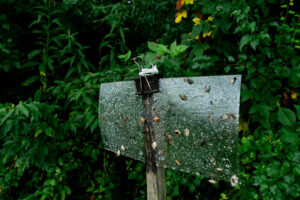
Some insect species can be detected with the use of yellow or blue sticky cards. These cards are approximately 3-inches by 3-inches and have a sticky substance on the surface. The cards are either hung in the canopy of the plant or attached to a stick inserted in the soil. Yellow cards are highly attractive to whiteflies and thrips, while blue cards are more specific for attracting only thrips. Both colors will also attract fungus gnat adults. Fungus gnats are seldom a problem for interiorscape plants, but may become a nuisance. Insects that come in contact with the card's sticky surface cannot escape. Observation of these cards will help determine what insects are present and changes in population density. It is important to write down the numbers of insects per card on each visit. Change the cards on a regular basis or when they become so heavily covered with insects that it is too difficult to count them, or after a pesticide treatment.
To keep monitoring and detection information uniform, develop a system to rank plant condition. If time allows, documenting healthy plant conditions provides a written record of your inspection. If a problem does occur, this background information will help in making a diagnosis. Record information useful for planning management strategies:
When damage or poor plant health is detected, the interior-plant manager needs to determine what cultural or environmental conditions, diseases, insects, mites, or human activity is responsible. Remember, there is often more than one damaging influence. Identify all conditions that may have stressed the plant, causing it to be more susceptible to the problem or pest observed. Table 1 provides a general guide to common symptoms and possible causes of indoor plant disorders.
Diagnosing Plant Disorders
Making an accurate diagnosis of plant problems comes with experience. Adopt
the following diagnostic techniques:
Identify the plant
Certain problems are more common with certain plants. Ficus are susceptible
to scales, schefflera are susceptible to mealybugs, palms are susceptible
to spider mites, ferns are prone to bacterial leaf spots, and dracaenas
are prone to root and stem rots. It is important to recognize the correlation
between host plants and the pests they are susceptible to. Inspect the
whole plant including leaf surfaces- especially the underside- stems, and
twigs. If possible, carefully remove the plant from its container to examine
root and soil conditions. Inspecting the root environment is often difficult
but necessary.
Clearly define the symptoms. Where do the symptoms occur on the plant. Are they at random locations, localized, or in a pattern? Are the symptoms that you identify the same as the symptoms your client is concerned about? (See Table 1.)
Categorize the cause of the problem as contagious or noncontagious.
Contagious disorders may be caused by:
Noncontagious disorders may be caused by problems with:
Although fungal, bacterial, and viral infections can be common in production environments, the interior landscape environment is generally not favorable for disease organisms when appropriate cultural and environmental conditions provide for stress-free plants. Keeping foliage dry and relative humidity low, common conditions in indoor landscapes, is perhaps the best control for foliar diseases. Root rots can be a problem for indoor plants, but generally only when the roots are first damaged by over- or underwatering or high levels of soluble salts in the soil. Therefore, if a root problem occurs, evaluate watering and fertilizing practices and the drainage of the soil and container.
Tools are necessary for thorough investigations and sampling the roots, soil and foliage for pests. Bring hand and pole pruners, a trowel, a soil probe, a sharp knife, a hand lens, specimen bags or containers, and a drop cloth to protect the clients' floor during inspection.
Make observations about the surrounding micro- and macroclimate (conditions in close proximity to the plant and those in the larger, surrounding area). Signs of disease, mites and insects such as thrips are more easily diagnosed with a magnifying lens. Examine soil conditions, drainage, pH and fertility levels.
Consider these factors of the macroclimate: Where are the heat or air-conditioning vents? Are there drafts from doorways? Are light levels adequate? Note temperature and humidity levels and the plant's proximity to windows.
Ask the client about activities that may disturb the plant. Is the container being used as a receptacle for coffee, cigarette butts, or cleaning compounds?
Have ready access to diagnostic references such as Extension bulletins and agents, books, site records, and fellow technicians.
A checklist can help ensure that all pertinent information is collected and considered. Table 1 outlines common symptoms associated with indoor plants and their possible causes.
An organism should not be classified and treated as a pest until it is proven to be one. Insects may pass through several life stages, changing in appearance and activity during their development. Most insects and related pests are affected by pesticides only during one or two phases of their life cycles. For example scale and whiteflies are most successfully treated while they are crawlers. Regular monitoring of the interior landscape detects early infestations when populations are low and indicates the life stages present. Control measures used on small numbers of pests during their susceptible life stage are likely to accomplish your pest management goals. Missing this period of the pest's vulnerability can lead to more severe infestations. When considering pest management treatments:
The interiorscape environment has unique qualities compared to other horticultural settings. In an interior landscape the variety of organisms observed is significantly less than that found outdoors. Yet, as in an outdoor setting, certain plants tend to be vulnerable to specific pests.
English ivy and Schefflera spp. are noted to be susceptible to several insect pests. Thus, you may want to avoid their use, particularly in areas with chronic pest problems or access to the out-of-doors and open windows. Pests from the exterior landscape may come into the interior landscape through doorways and open, unscreened windows. If selection of pest-prone plants is unavoidable, use them on a limited basis and be cautious of where they are placed.
Also, unique to the interior landscape is climate control. The climatic conditions within a building are manipulated for the comfort of people and their activities with little consideration for the plants and pest populations in the same surroundings. Low relative humidity and high temperatures increase the development of spider mite populations. Recognize that plants will not live forever in some environments and some plant decline is expected.
Overall, once an abnormal plant health condition is detected, it is extremely important to devote ample time and research to the diagnostic process. Identify and assess all factors that have contributed to the abnormal condition.
A thorough and systematic diagnostic approach to problem solving will help you evaluate, select, and accurately time the most appropriate management practice(s) for the host plant, pest(s), and site. This process is also the key to avoiding unnecessary applications of pesticides.
All pest management activities have costs in terms of materials, time, or environmental impact. Routine plant management activities that serve as preventative pest management practices are typically defined in a service contract between the client and plant maintenance company. Account for the costs of plant maintenance activities and predicted pest management procedures before signing a contract. It is important that the client and contractor can justify the costs and related benefits of pest management practices.
Replacement plants and their value are often accounted for in the service contract with the understanding that some indoor conditions are harsh and sustaining long- term plant health is extremely difficult. Therefore, cost of replacing or rotating plants is calculated into the original work agreement. Any activity that reduces the frequency of plant replacement will increase the profitability of the account. A plant may be pest free, but poor appearance (limited foliage, long internodes, weak structure, poor color) may be the determining factor for replacement.
Special cases requiring additional pest management strategies are likely to arise over the long term. Cost-benefit analyses are determined when these situations occur. The decision to treat for a pest or to replace a plant may be the responsibility of the account manager. As a plant technician, consult with the appropriate persons before action is taken. For example, a large specimen palm infested with spider mites presents a problem in a shopping mall. Several special circumstances arise when spraying pesticides in a public area; yet, taking no action will result in a costly, labor-intensive replacement. Early pest detection may allow time for treatment with predatory mites or less toxic pesticide materials.
Cost-benefit analysis requires educating the customer on basic plant-growth habits and requirements, pest management alternatives and techniques. Be informed and prepared to explain the decision and need for pest treatments. Educate the client when negotiating a contract and when unique pest outbreaks occur. The clients' input is vital in this process, since it is their interpretation of the cost-benefit analysis that dictates whether a pest management tactic will or will not be implemented.
The client and the plant management company need to agree on acceptable plant appearance. What is acceptable to one may not be acceptable to the other. Aesthetic thresholds are as important as injury thresholds in the interior plantscaping industry.
Many factors limit pest populations. These include natural enemies of pests such as predator insects, plant defenses, and a host of controls implemented by people. The pest management methods most appropriate for a specific circumstance will depend upon the biology of the pest and host plant, and the interior landscape situation. For every pest problem consider all available management tactics and evaluate the benefits and risks of each.
Choose methods that are:
Options will include selecting appropriate plant species for a given site; applying water and fertilizer correctly; pruning, washing, rotating, and replacing plants; altering environmental conditions such as temperature, humidity, exposure to direct light or drafts; sanitation; providing adequate drainage, soil pH and soluble salt levels; and making pesticide applications when necessary.
Most likely, a pest management program will be made up of a combination of methods. No matter how environmentally sound or effective the options are, a pest management program is only successful if it can be economically and practically implemented. Keep in mind the factors which limit the number of appropriate management options:
Also, as a plant manager, consider the option of removing the plants to be treated from an interior landscape and temporarily relocating them outside or to a greenhouse. Relocating plants makes available a larger selection of products registered for use in those areas (including some that may have been canceled for use in the interior landscape setting.) Furthermore, the conditions in a greenhouse (light, temperature, and water) may be more conducive to the plant's recovery. Once the plant has been treated and the problem corrected, it can be replaced in its original interior landscape location.
It is extremely important to evaluate the results of your pest management strategies. This can be done in several ways. Record pest counts or level of infection before and after treatment, comparative damage ratings, length of recovery time, etc. Sticky cards, as discussed under monitoring in this section, are helpful in evaluating the results of an insect management treatment. Keep written records of successes and failures, timing of treatment, and special conditions.
Table 1. A General Diagnostic Guide for Indoor Plants
|
Symptom |
Possible Causes |
| Brown or scorched leaf tips | 1) Poor root health from overwatering, excessive soil dryness (especially
between waterings), excessive fertilizer or other soluble salts in the
soil or root rot disease. 2) Specific nutrient toxicities such as fluoride, copper or boron. 3) Low humidity. 4) Pesticide or mechanical injury. |
| 1) Intense light (sunburn) associated with a recent move of the plant
or excessive soil dryness and wilting. 2) Chilling injury (below 50° F). 3) Chemical spray injury. 4) Overwatering. 5) Fungal or bacterial infections (not common unless plants have recently come from a field or greenhouse). |
|
| Older leaves yellow-green;
Newer leaves yellow-green; All leaves yellow-green; |
1) Insufficient fertilizer, especially nitrogen. 2) Poor root health due to pot-bound growth, compacted soil, or poor drainage. 3) Insufficient light. 4) Senescence (natural aging process, individual leaves). 1) Soil pH (acidity) imbalance. 1) Too much light. |
| Leaf drop | 1) Poor root health from overwatering, excessive dryness or excessive
fertilizer or other soluble salts in the soil, compacted soil or pot- bound
roots. 2) Sudden change in light, temperature, or relative humidity. 3) Root rot disease. |
| Wilting or drooping of foliage | 1) Poor root health from overwatering, excessive dryness or excessive
fertilizer or other soluble salts in the soil, compacted soil, or a poorly
drained container or root rot disease. 2) A toxic chemical poured into the soil. |
| Roots brown in color, soft or rotted; roots with tissue that can easily be "slipped off" leaving behind the string-like center tissues; roots massed at top or bottom of pot. |
1) Poor root health from overwatering, excessive dryness, excessive
fertilizer or other soluble salts in the soil, compacted soil, or a poorly
drained container. 2) A toxic chemical poured into soil. 3) Over or underwatering. 4) Root rot disease. |
| Yellowed leaves with tiny speckling; leaves later bronzed and drying; webbing noted near growing points. | 1) Spider-mite infestation. |
| Leaves or stems covered with a sticky substance; mold growing on leaves; tiny brown or white objects seen on leaves or in crotches of branches; leaf drop or branch dieback; leaf or growing point distortion. | 1) Scale or mealybug infestation. |
Material adapted from Michigan State University
Extension Bulletin E-2308 Interiorscape Pest Management.
A Training Manual for Commercial Pesticide Applicators. Julie Stachecki,
Editor.