Important Orders and Families of Agricultural Pests


Over one million insect species inhabit the world. In spite of this impressive diversity, far less than 0.1 percent of these species pose a threat to agronomic crops in North Carolina. Consequently, these economically important species fall into a limited number of orders and families.

The majority of these orders and families are described in the following pages. However, because this publication is designed to help identify crop pests, many insects found in the field will not fit the descriptions below. Descriptions and keys including harmless and beneficial insects as well as pests would be very informative but also tediously long and minutely detailed. Although the following information is general, it does give an overall perspective of the types of insect and mite pests most likely to be encountered.


GENERAL DESCRIPTION OF ORDERS AND FAMILIES

COLEOPTERA (beetles, weevils)

Beetles undergo complete metamorphosis; that is, they pass through four life stages -- egg, larva, pupa, adult -- during development. The larval stage is often a grub, wireworm, or stem borer. Adults have chewing mouthparts, a uniformly leathery or rigid, veinless pair of forewings, and a membranous pair of hind wings.

Cerambycidae (long-horned beetles). These beetles are generally elongate and cylindrical in shape, and often brightly colored. Their distinctive antennae extend over one-half the length of the body, sometimes even surpassing the body length. Adults typically feed on flowers; the larvae often bore into stems of herbaceous plants or trees. The soybean stem borer is practically the only agronomic pest in this family, although some species are a threat to fruit and ornamental trees.

Chrysomelidae (leaf beetles). Oval to oval-elongate in shape, chrysomelid beetles are usually less than 13 mm long. Their color and shape is so variable, however, that they may be difficult to identify consistently. Since both the larval and adult chrysomelids are phytophagous, a large number of economically significant species occur in this family. Adults feed on flowers and foliage; many larval forms attack plant roots. This family encompasses the corn rootworms, cereal leaf beetle, bean leaf beetle, and flea beetles.

Coccinellidae (lady beetles). Characteristically, lady beetles have round or oval, strongly convex bodies with bright contrasting colors. Many beneficial predatory species, in addition to a limited number of phytophagous species, make up this family. The Mexican bean beetle, whose adult and larva both consume crop foliage, is one of the more damaging members of this family.

Curculionidae (snout beetles, weevils, billbugs). The largest of the beetle families, Curculionidae is comprised almost entirely of plant feeders. They are easily recognized by their noticeably elongated snout. Although the snout a pears noselike, the beetles' mouthparts are located at its tip and the elbowed antennae are borne on its midsection.

When disturbed, weevils and billbugs often tuck in their legs and antennae and fall to the ground where they rese ble dirt clods. The boll weevil may well be the most infamous member of this family.

Elateridae (click beetles). Adult members of this family derive their name from their peculiar method of righting themselves. When on their back, these beetles can snap two body segments together, spring up into the air, and land on their feet. Ranging from 3 to 45 mm long, adults inhabit flowers and leaves while larvae attack seeds and roots. The larvae, or wireworms, cause more economic damage than the adults.

Meloidae (blister beetles). These narrow, elongate beetles are common, but relatively innocuous, foliage and flower feeders. The adults produce cantharidin in quantities which may cause blisters to form on sensitive human skin. The larvae of many species are beneficial in that they feed on grasshopper eggs. Several blister beetle species are occasionally pests of soybeans.

Scarabaeidae (scarab beetles). Like the coccinellids, scarab beetles are oval or elongate and convex. Scarabs, however, are larger with heavier bodies. Some members feed on decaying organic matter while others prefer living plants. Both larvae and adults cause plant damage. Commonly known as white grubs, the larvae often abound among the roots of grasses. Adults of plant-feeding species are primarily attracted to ornamental and fruit trees as well as shrubs and flowers. A notable exception is the Japanese beetle which sporadically damages corn and so beans.

Tenebrionidae (darkling beetles). Many members of this family are pests of stored grain. Out in the field, however, the larvae of some species cause damage similar to that of wireworms. As a result, these larvae are known as false wireworms. Most adult darkling beetles are black or brown.

DIPTERA (flies)

Like beetles, flies also undergo complete metamorphosis. The larvae, however, are commonly referred to as maggots. The fact that flies have only a single pair of wings distinguishes them from most other flying insects. A pair of small knoblike appendages, known as halters, is all that remains of what may have been a hind pair of wings. Adults have either piercing-sucking or sponging mouthparts, but larvae are endowed with chewing or rasping mouthparts.

Anthomyiidae (root maggot flies). In this family, the larva is the injurious life stage. Although most larvae are root- and seed-destroying maggots, some are leafminers. The seedcorn maggot is a common pest belonging to this family. To distinguish the adults from similar flies, wing venation must be closely examined (see couplet 3 of Key to Adults).

Cecidomyiidae (midges). Although most injurious members of this family are gall formers, the agronomic pest species do not cause this type of damage. The adult midges are innocuous, gnatlike insects; the larvae feed in seedheads or between the leaf sheath and stem. Adults can often be identified by their long legs and antennae. The Hessian fly and the sorghum midge are notorious members of this family.

HEMIPTERA/suborder HETEROPTERA (true bugs)

True bugs undergo simple metamorphosis developing through only three life stages: egg, nymph, and adult. They feed by means of piercing-sucking mouthparts (a stylet-like beak) which originate at the front of the head. A triangular area, known as the scutellum, is evident on the middle area of the thorax. True bugs have two pairs of wings or none. If wings are present, the front pair is partially thickened or leathery, the second pair membranous.

Lygaeidae (seed bugs, chinch bugs). There is great variability among the members of this family. Some are phytophagous, others predaceous. Wing venation (as described in the Key) distinguishes members of this family from other Heteropteran families. The chinch bug is its best known member.

Miridae (plant bugs, lygus bugs). Although referred to as plant bugs, some mirid bugs are predaceous. True to the family name, however, most members do extract sap from plants. Like lygaeid bugs, wing characteristics also distinguish mirids from other bug families. The tarnished plant bug and the suckfly belong to this family.

Pentatomidae (stink bugs). Stink bugs receive their name as a result of the disagreeable odor they are capable of producing. Their family name Pentatomidae refers to their five-segmented antennae. Although both these features are useful identifying characteristics, these bugs are more quickly recognized by their shieldlike shape. As with the previous two families, both predaceous and phytophagous insects belong to this family. However, most species, including the green, brown, and Southern green stink bugs, damage seed crops, particularly soybeans.

HEMIPTERA/suborder HOMOPTERA (aphids, whiteflies, leafhoppers, scales).

Like the true bugs, members of this order have simple metamorphosis and piercing-sucking mouthparts. They differ in that both pairs of wings are membranous and the beak arises from the back of the head instead of the front. In some cases, adults may be wingless. Under such circumstances, male and female adults are often unlike in form.

Aleyrodidae (whiteflies). Less than 3 mm long, whitefly adults are tiny moth-like insects. Both sexes have wings as adults. The scale-like nymphs lose their legs after the first molt and are occasionally referred to as larvae. A resting stage, known as the pupa, precedes adult emergence. Whiteflies regain their legs as adults. These insects do undergo gradual or simple metamorphosis even though names assigned to the various life stages are analogous to those of complete metamorphosis.

Aphididae (aphids). Another family of tiny insects, the Aphididae contains winged and wingless forms. But whether winged or not, all aphids are basically pear-shaped with long antennae and a pair of tailpipe-like structures known as cornicles. Color varies greatly among species. Wingless adult females produce young without mating and, therefore, large populations often develop rapidly. All aphids, both adults and nymphs, extract plant sap.

Cercopidae (spittlebugs). Larger than aphids and whiteflies, spittlebugs may be up to 13 mm long. The brown, black, or gray adults are jumping insects which do not attract as much attention as the nymphs. Enveloped in a white, frothy mass resembling spittle, brightly colored nymphs suck sap from plants and sometimes transmit plant diseases. Only the nymphal stage of this insect family causes economic injury to plants.

Cicadellidae (leafhoppers). Leafhoppers are fairly similar in size and appearance to the above spittlebug family. They are distinguished primarily by spines on the legs (see couplet 23 in Key). Leafhoppers have the peculiar habit of running sideways, although when disturbed, adults will hop or fly away. Feeding on a wide range of plants, many leafhoppers transmit plant diseases or inject toxic substances into plants. Therefore, leafhoppers are capable of causing more plant injury than most sapsucking insects.

Membracidae (treehoppers). Treehoppers are 10 to 12 mm long, and characteristically appear horned or "humpbacked" because of their enlarged pronotum. Unlike spittlebugs and leafhoppers, treehoppers cause damage primarily by inserting eggs into plants rather than by extracting plant juices. The threecornered alfalfa hopper is one of the few treehoppers that damages agronomic crops.

LEPIDOPTERA (moths, butterflies)

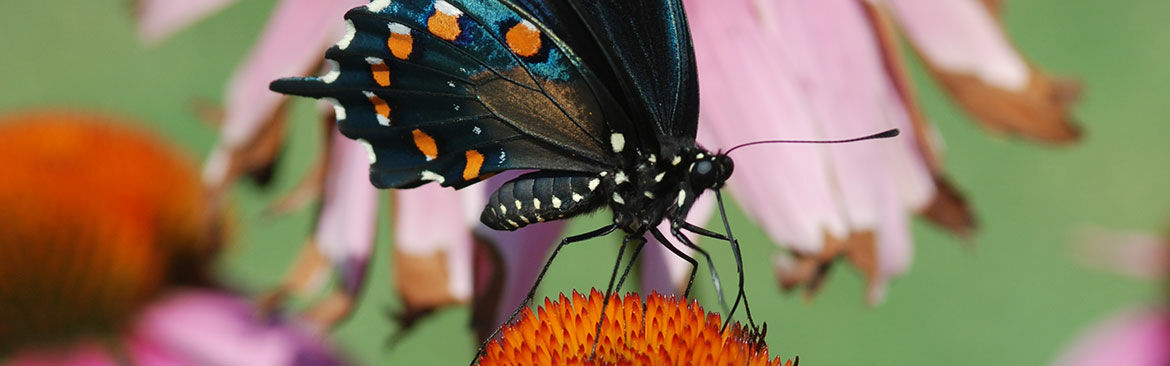
Butterflies and moths undergo complete metamorphosis: egg, larva, pupa, and adult. The larvae, commonly known as caterpillars, have chewing mouthparts. Adults have long, coiled, threadlike mouthparts which are used for siphoning nectar. Their two pairs of membranous wings are covered with minute scales which rub off easily. Within this order, the larva is the economically damaging life stage.

Noctuidae (cutworm moths). The Noctuidae is a large family of much economic importance to agriculture. Among the larvae of this family are the well known armyworms, cutworms, bollworms, and loopers, to mention a few. Primarily foliage feeders, many species also consume stems and grains or bore into stalks, ears, or bolls. The heavy-bodied moths are usually drab in color and have wingspans in excess of 20 mm.

Pyralidae (snout and grass moths). True to their name, the small, delicate moths of this family have a prominent snout (labial palps) and are commonly found in grassy areas. The larvae vary from stalk borers to foliage feeders. Among the agriculturally destructive members of the family are the sod webworms, the lesser cornstalk borer, and the European corn borer.

Sphingidae (sphinx moths). These medium- to large-bodied moths resemble hummingbirds in their hovering feeding habit. The larvae of sphinx moths almost always have a spinelike projection on their eighth abdominal segment and, therefore, are commonly known as hornworms. These voracious foliage feeders are a threat to many solanaceous crops.

ORTHOPTERA (grasshoppers and crickets)

Grasshoppers and crickets develop gradually, the young bearing much resemblance to the adults. All life stages have chewing mouthparts. Most adults have two pairs of wings: the first thickened and leathery, the second membranous. This order contains a limited number of agricultural pests.

Acrididae (short-horned grasshoppers). This family is among the most destructive of all Orthoptera. Concentrating particularly on grassy plants, nymphs and adults are voracious foliage feeders. Although equipped with characteristically enlarged "jumping legs," some grasshoppers also migrate by flying in swarms. Coloration varies widely among species and antennae are never longer than the body.

Gryllidae (crickets). Crickets generally are not considered serious economic pests. Some species, however, can damage pastures significantly by consuming large quantities of grass. Easily overlooked, members of this group are usually brown or black, with antennae at least as long as their body. Female adults have a needlelike ovipositor which they use to place eggs in soft organic matter.

Gryllotalpidae (mole crickets). Mole crickets are among the most striking and unique of all insects. Their stout, shovellike forelegs and large, beady eyes give them an almost crawfishlike appearance. Although they feed on the roots of grasses, they do not usually directly damage field crops. As these insects tunnel through the soil, they destroy roots and cause the soil to dry out. As a result, crops on infested soils wilt from lack of water.

THYSANOPTERA (thrips)

Rarely as large as 5 mm, North American thrips are minute insects. Primarily phytophagous, they rasp plant tissues and feed on the released juices. Metamorphosis in thrips is usually considered simple or gradual, although in some ways resembling complete metamorphosis. The first two wingless instars are known as larvae. During the next one or two instars (depending on the species) as wings become apparent, thrips are called prepupae. A pupal resting stage precedes adult emergence. Adults are generally characterized by having two pairs of slender wings with hairlike fringe. Wingless adults do exist, but occur primarily during the winter.

Thripidae (common thrips). The largest thrips family, Thripidae, also contains the highest number of economically important thrips species. Bulbs, leaves, and flowers are all subject to thrips attack. Common thrips are not easily distinguished from other thrips families. Because of their minute size, species identification in the field is not practical.

ACARINA (mites)

Mites are very tiny arthropods closely related to insects. Some are barely visible with the naked eye; others are microscopic. Their size and frequent similarity in shape and color make it difficult to distinguish between species. Not all mites found on field crops cause damage to plants. Some are predaceous and help control the harmful mite species. In this respect it is useful to know which species are present. In most states, the agricultural extension service offers a pest identification service or reference to one. In North Carolina, the majority of agronomic mite pests fall into the family Tetranychidae in the suborder Prostigmata.

Tetranychidae (spider mites). This mite family contains a large number of pest species. The twospotted spider mite, carmine spider mite, and Banks grass mite are among the most common. Some members of this family spin silken webs over plant foliage.